
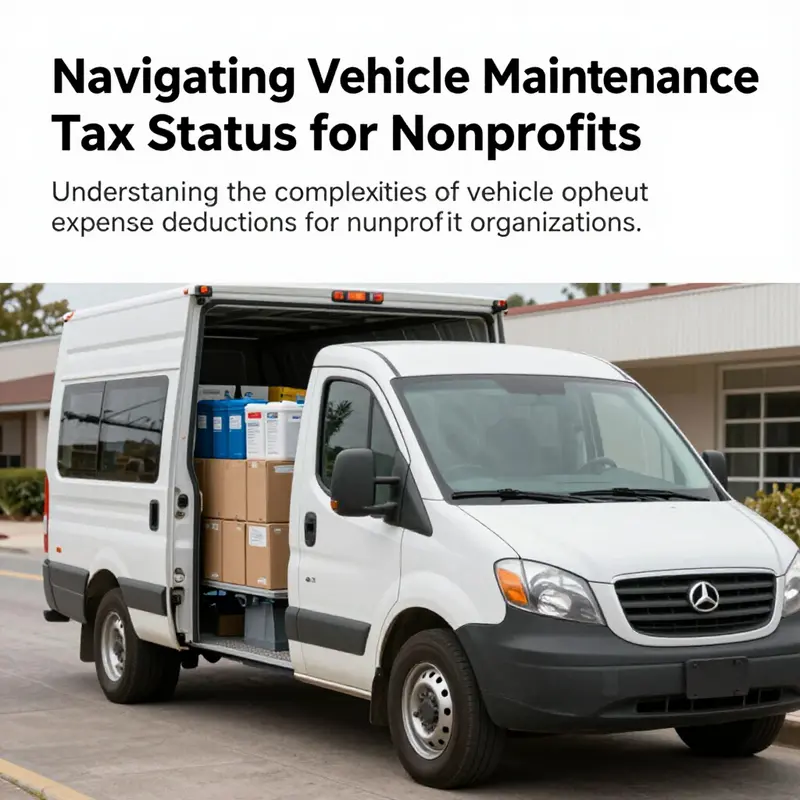
For nonprofit organizations, the operating costs related to vehicle maintenance can often be a point of confusion, particularly when it comes to tax exemptions. Many business owners involved in nonprofits may wonder whether the costs associated with maintaining these vehicles are tax-exempt. This article aims to clarify that vehicle maintenance expenses are generally not tax-exempt, even for organizations with 501(c)(3) status. The subsequent chapters delve into the nuances of how these expenses can be treated in relation to nonprofit operations. The first chapter will explain the tax exemption status of vehicle maintenance for nonprofits, while the second will assess the impact of achieving 501(c)(3) status on vehicle-related expenses. Finally, the third chapter will focus on the deductibility of these maintenance costs, guiding business owners through what they can expect regarding tax benefits.
Beyond Exemption: The Subtle Ways Vehicle Maintenance Shapes a Nonprofit’s Tax Picture
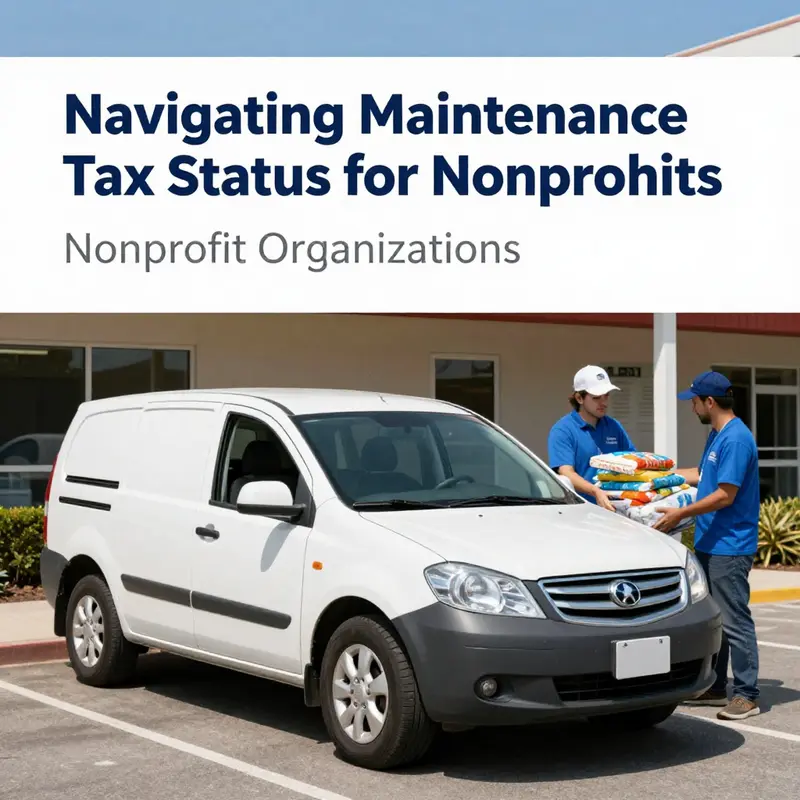
Nonprofit organizations often begin with a hopeful assumption: if we do good, we’ll be exempt from the burdens that weigh on for‑profit entities. In the realm of vehicle use, that hope needs careful calibration. The term tax-exempt is most often understood as an exemption from federal income tax on earnings when a charity qualifies under section 501(c)(3) of the Internal Revenue Code. Yet the maintenance and operation of vehicles tied to that mission do not automatically ride along as a tax-free perk. The costs of keeping a fleet on the road—fuel, routine service, tires, brakes, insurance, and the like—are generally treated by the Internal Revenue Service as ordinary and necessary business expenses. They are deductible only to the extent they are directly connected to the organization’s exempt purpose and incurred in furtherance of that purpose. In other words, maintenance is not a tax-exempt activity by itself; it is a deductible expense that reduces taxable income, if the organization has any tax liability to begin with. This distinction matters a lot in practical terms, because it frames how a nonprofit projects its budgets, files its returns, and demonstrates to donors and regulators that it is using its resources in a manner consistent with its mission.
Where the nuance becomes important is in how vehicle use intersects with the organization’s exempt purpose. A nonprofit that relies on a vehicle to deliver meals to homebound seniors, transport volunteers to service sites, or shuttle participants to program activities is using its fleet in a way that advances the charitable objective. When maintenance costs are incurred in service of that objective, they are typically treated as ordinary and necessary expenses related to program delivery. They become deductible expenses that help determine taxable income, not items that render the organization exempt in the first place. However, if a nonprofit also runs commercial activities through its fleet—such as paid transportation services or other income-generating ventures not substantially related to its exempt purpose—those activities can generate Unrelated Business Income (UBI). In that scenario, the organization may owe tax on the income from those unrelated activities, even if the nonprofit remains tax-exempt overall for its mission-related activities. The key takeaway is that the existence of a fleet does not erode tax-exempt status; misalignment between fleet use and exempt purposes can, over time, invite scrutiny of how the fleet is funded and how revenues are treated.
To understand maintenance costs within this framework, consider the practical implications of how the nonprofit accounts for expenses. Maintenance, as a line item, is part of operating costs that enable the fleet to fulfill its mission. If the vehicle is used primarily for charitable purposes, the maintenance costs help the program operate and thus support the exemption. For example, when a nonprofit uses a van to deliver meals, collect diapers for distribution, or transport clients to clinics, the costs associated with keeping that van safe and functional are essential to the mission. The deductibility of these costs hinges on proper documentation showing that the maintenance is directly related to program activities. In this context, the vehicle itself becomes a tool of the exempt purpose, and the maintenance expense is a necessary expenditure tied to that tool.
Additionally, the IRS recognizes that there are special accounting considerations for vehicles placed in service by tax-exempt organizations. In some circumstances, these vehicles may be exempt from depreciation requirements or subject to a simplified depreciation framework. The guidance suggests that certain properties used by nonprofits may not be required to be depreciated under specific conditions, which is a relief from administrative burdens for resource-strapped organizations. This depreciation nuance reduces the ongoing administrative load and can improve the efficiency with which a nonprofit allocates its funds toward the mission, rather than toward complex asset accounting. Yet even this favorable treatment does not translate into a blanket tax exemption for maintenance costs themselves. Depreciation rules influence how assets are reflected on the balance sheet and how deductions are taken over time; they do not change the fundamental status that maintenance expenses reduce taxable income rather than producing a tax-free outcome.
The landscape broadens when a nonprofit considers incentives or credits tied to vehicle use, especially in the context of modern, cleaner fleets. The IRS guidance points to credits such as the Commercial Clean Vehicle Credit, which is designed to encourage the purchase or lease of eligible clean vehicles. While many nonprofits may explore these incentives to support mission-related activities, eligibility depends on the vehicle’s characteristics, the purchase structure, and how the vehicle is used. It is essential to recognize that credits are separate from deductions. A tax credit directly reduces tax owed, often on a dollar-for-dollar basis, while a deduction lowers taxable income. For a nonprofit, the practical impact of credits can be meaningful for capital budgeting and expansion plans, but the existence of a credit does not erase the fundamental rule that maintenance itself remains a deductible expense rather than an exemption. The nuance becomes especially relevant when a nonprofit contemplates fleet modernization or expansion in pursuit of its exempt objectives. A strategic decision about switching to a more fuel-efficient or all-electric fleet could, in theory, position the organization to access credits that indirectly improve its bottom line by reducing net costs over time. In such cases, careful planning is required to ensure that the usage of the vehicle aligns with the exempt purpose and that any credits are properly claimed in accordance with IRS rules.
This interplay between maintenance costs, depreciation considerations, and potential credits underscores a central theme: the tax picture for a nonprofit with a fleet is not a simple binary of exempt versus non-exempt. It is a dynamic, multi-layered calculation that depends on how the fleet is used, how costs are allocated, and how program activities translate into reductions in taxable income or anticipated credits. The emphasis should be on alignment—ensuring that vehicle use and related expenses are integral to the organization’s mission and that accounting practices clearly reflect this alignment. When a nonprofit purchases or leases a vehicle, it should document precisely how the vehicle serves the exempt purpose, how maintenance supports that service, and how any depreciation or credit treatment is applied in the annual financial statements and tax filings. This approach not only reduces compliance risk but also builds trust with stakeholders by showing that every dollar spent on the fleet is contributing to the organization’s mission rather than subsidizing unrelated commercial activity.
Evaluating the maintenance picture in this light invites a more thoughtful approach to fleet management. Organizations may find it helpful to treat the fleet as a mission-support asset, with a governance process that reviews usage patterns, maintenance schedules, and cost allocations on a regular basis. A single vehicle used for high‑impact charitable activity can justify higher maintenance expenditures if those costs translate into a measurable expansion of service delivery. Conversely, a fleet used to generate significant revenue from activities that are not substantially related to the exempt purpose could trigger UBI concerns and require a more disciplined separation between program-related functions and commercial operations. In practice, this translates to robust accounting practices: meticulous mileage tracking, clear categorization of expenses by program versus administration, and transparent documentation of how services funded by the fleet advance the charity’s mission.
For organizations seeking a practical touchpoint, a useful starting point is a simple framework for evaluating maintenance expenses. First, assess whether the vehicle’s use directly furthers the exempt purpose. If it does, categorize maintenance costs as program-related expenses that reduce taxable income. Second, identify any activities that might blur the line between mission and revenue-generating operations. If such activities exist, consider allocating the revenue and related costs into separate streams for accounting and tax purposes to avoid complicating the nonprofit’s tax profile. Third, maintain a formal depreciation policy that recognizes any applicable exceptions for vehicles placed in service by the nonprofit, and document the rationale for any depreciation or non-depreciation outcomes. This disciplined approach not only supports compliance but also clarifies to donors and grantmakers how fleet investments translate into mission impact.
The discussion would be incomplete without acknowledging the practical resource linked to the fundamental idea of vehicle maintenance. For readers curious about what constitutes vehicle maintenance itself—the day-to-day care, repairs, and upkeep that keep a fleet functional—an accessible overview is available through the article that defines maintenance in concrete terms. This resource helps nonprofits anchor their accounting practices in a shared understanding of what counts as maintenance, making it easier to distinguish routine servicing from capital expenditures or other categories. The link can be found here: the basics of vehicle maintenance.
As nonprofits navigate these considerations, it becomes evident that the tax-exemption landscape around vehicle maintenance is not a fixed rule set. It is a living framework built on how vehicles are used in service of the mission, how costs are allocated, and how the fleet’s impact is demonstrated in financial reporting and compliance. The right approach respects the letter of the code while recognizing the realities of mission delivery. It also invites prudent strategic planning: when to invest in a more efficient or cleaner fleet, how to structure programs to maximize the charitable impact while maintaining tax compliance, and how to communicate effectively with stakeholders about the financial stewardship of fleet resources. In this sense, the maintenance drawer inside a nonprofit’s accounting system becomes more than a cost center; it becomes a window into how the organization sustains its work over time, with every tire rotation and every brake service mapped to a concrete service delivery outcome that advances the public good.
Ultimately, the goal is clear: maintain the fleet in a way that is fully aligned with the exempt purpose, uphold compliance with IRS guidelines, and leverage legitimate credits and depreciation rules when they exist to support mission work. This multifaceted approach reduces the risk of misinterpretation and helps ensure that vehicle maintenance remains a facilitator of service rather than a trapdoor to tax complications. By treating maintenance as a mission-enabled expense, by documenting how each kilometer or mile serves the charitable objective, and by staying current on exemptions, depreciation, and credit opportunities, nonprofits can manage their fleets responsibly and with confidence that their stewardship practices reflect the organization’s core values. External resources and official guidance remain essential touchpoints, but it is the disciplined integration of use, cost, and purpose that yields a coherent tax and financial strategy for nonprofit fleets.
External resource: https://www.irs.gov/credits-deductions/individuals/commercial-clean-vehicle-credit
Steering Toward Compliance: How 501(c)(3) Status Shapes Vehicle Expenses for Nonprofits
When a nonprofit operates a fleet or even a single vehicle to advance its charitable mission, the question of taxes often centers on one simple, persistent idea: does 501(c)(3) status grant a free pass for vehicle maintenance costs? The short answer is no. The long, more nuanced answer lies in how the Internal Revenue Code views expenses and how the organization demonstrates that its use of vehicles serves an exempt purpose. A nonprofit under 501(c)(3) enjoys exemption from federal income tax on earnings related to its exempt activities, but this shield does not automatically convert every vehicle expense into a tax-free event. Instead, vehicle costs are treated as ordinary and necessary business expenses that can be deductible or depreciable, but only to the extent they are directly connected to the organization’s tax-exempt mission and carefully documented. This distinction matters because it influences how a nonprofit budgets, allocates resources, and remains in good standing with the IRS during audits or reviews.
To grasp the practical implications, consider a nonprofit that transports clients to medical appointments or delivers meals to homebound neighbors. The fuel, maintenance, insurance, and depreciation on the vehicle used for those purposes are costs that, in the right circumstances, can be treated as deductible business expenses on a federal return. But deductible does not mean exempt. Deductible expenses reduce taxable income where tax applies, and for organizations that have unrelated business income or other taxable activities, these deductions can temper the overall tax liability. In practice, this means the organization must be clear about how each vehicle is used, why that use advances the exempt purpose, and how the costs are allocated between exempt and nonexempt activities. The lines are real and the consequences of missteps can be penalties, disallowances, or questions from auditors.
A foundational principle is that the use must be connected to the exempt purpose. The IRS frames this as an alignment between the mission and the vehicle’s purpose. If a van is used solely for transporting volunteers to a fundraising event, the activity may still support the mission, but the crucial question is whether the use primarily furthers exempt goals rather than personal or unrelated activities. The maintenance and operating costs are deductible only to the extent that they support the exempt purpose. Personal use by staff or board members complicates the matter and can trigger issues of private inurement, a scenario the IRS takes seriously because it prohibits benefits accruing personally to insiders beyond reasonable compensation. In practice, if a staff member uses a nonprofit vehicle for a personal trip and the organization does not properly reimburse or record that use, that is a red flag that could jeopardize the organization’s tax-exempt status.
Recordkeeping is not merely administrative clutter; it is the backbone of the legitimate deduction framework. Detailed logs that capture the date, purpose, mileage, and location of each vehicle use create a transparent record that can support deductions should the IRS request substantiation. The logs don’t just prove that a trip happened; they demonstrate that the trip served an exempt purpose and that the expenses incurred were ordinary and necessary to fulfill that mission. The burden of proof rests with the organization, and a robust documentation system is the best defense against any later question about the relationship between the vehicle use and the exempt activity. In many cases, this means adopting a consistent method for allocating costs between exempt and nonexempt uses, such as prorating fuel and maintenance when a vehicle serves multiple roles.
In the context of purchase or lease of vehicles, depreciation and capitalization rules come into play. Vehicles that are owned or long-term leased are capital assets for tax purposes, and the IRS generally requires depreciation under established schedules, typically MACRS. The depreciation deduction is an annual accounting tool that allocates the cost of the vehicle over its economic life. Missteps here—such as forgetting to capitalize improvements, treating a vehicle improvement as an ordinary expense instead of a capital expenditure—can trigger penalties or adjustments in a tax audit. On the flip side, proper depreciation planning can yield meaningful deductions over time, improving the organization’s financial flexibility while maintaining compliance. Even when the organization isn’t generating large taxable income, depreciation affects the reported financial position and can influence decisions about fleet upgrades, replacements, or the reallocation of resources toward mission-critical activities.
Another dimension to consider is related to unrelated business income tax, or UBIT. If a nonprofit uses a vehicle in connection with a trade or business that is not substantially related to its exempt purpose, the income may be subject to UBIT. This is a separate tax concern from the ordinary deduction framework for vehicle expenses, yet it intersects with how the organization organizes and documents vehicle use. For example, if a nonprofit rents a van for a profit-making venture unrelated to its mission, or uses a vehicle to support a business activity that is not substantially related to the exempt purpose, the resulting income could be taxable unless properly insulated within the related and directly connected activities. The existence of UBIT underscores the importance of clear boundaries and a disciplined approach to cost allocation. It also highlights why robust governance—board oversight, routine policy reviews, and transparent reporting—matters as much as the mechanics of depreciation schedules or mileage logs.
The reference materials from the IRS illuminate the practical boundaries of these rules. They emphasize that 501(c)(3) status enables certain deductions for vehicle-related expenses when they are incurred in furtherance of exempt purposes, but they also set forth essential guardrails: the use must be primarily for exempt activity, personal or private benefit must be avoided or properly reimbursed, and rigorous documentation must be maintained. These guardrails are not punitive by design; they are safeguards meant to ensure that the nonprofit’s resources serve the public good and that any financial advantages do not drift toward private gain. The archival guidance also recognizes that the life cycle of a public charity includes operational expenses that cover the day-to-day work of serving the mission, including transportation, which can be a significant part of the budget for organizations engaged in community outreach, healthcare, housing assistance, or disaster relief.
In daily practice, what does this mean for the nonprofit administrator who confronts a fleet decision, a maintenance bill, or a reimbursement request? It means approaching vehicle costs with a dual lens: one that honors the exempt mission and another that respects the financial discipline that governs all tax-exempt organizations. The maintenance of a vehicle used in service of the mission—oil changes, tire replacements, brake service, routine inspections, and even repairs after a mission-related trip—becomes a candidate for deduction or capitalization only if the costs can be traced to a specific mission-related use. If, however, the same vehicle also serves administrative tasks such as transporting staff to internal meetings on a regular basis, a portion of those costs may fall into a mixed-use category where careful allocation is required. The administrator must decide how to allocate fuel costs, insurance, maintenance, and depreciation between exempt and nonexempt uses, always anchoring the decision to objective records rather than gut feeling or convenience.
When we speak of documentation, we are not discussing a bureaucratic ritual that delays mission work. We are describing the essential practice that makes it possible to defend choices if or when questions arise. A well-documented file includes trip logs, client or beneficiary records (as permissible and compliant with privacy standards), dates, mileage, route details, and a clear statement of the vehicle’s role in achieving the exempt purpose for each trip. In the aggregate, these records demonstrate that the organization’s transportation expenses align with the mission and that the use of funds is accountable, transparent, and efficient. It is precisely this discipline that many successful nonprofits cultivate to maintain public trust, secure continued support, and avoid the pitfalls that can come with ambiguous or poorly documented costs.
As a broader context, the vehicle costs themselves fit into the same regulatory framework that governs other program-related expenses. If the organization runs a food delivery program, a medical shuttle, or a neighborhood outreach initiative, vehicle maintenance costs are part of the operational expenses necessary to realize those programs. The challenge lies in ensuring that the accounting treatment—whether as a current deductible expense, a capital depreciation, or a mixed allocation—accurately reflects the vehicle’s role in the program and does not overstate or understate the true expense attributable to the exempt purpose. This is where professional judgment, prudent budgeting, and ongoing compliance reviews intersect. It is also where resources like training on vehicle-related tax rules can be transformative, helping staff and volunteers understand what counts as a cost tied to the mission, what counts as personal use, and how to capture the data that proves the connection.
To make the concept more tangible, imagine a nonprofit that operates a mobile clinic, a service that brings healthcare to underserved neighborhoods. The vehicle is essential to reaching clients who otherwise cannot access care. The cost of keeping that vehicle on the road—fuel, maintenance, insurance, tires, and scheduled servicing—are direct expenses of the program. The nonprofit can deduct these costs as ordinary and necessary business expenses if the vehicle’s usage is tracked and the expenses are allocated to the mission-driven activity. If, on a given month, staff also use the vehicle to run personal errands or to commute to the office, the nonprofit must separate those days and record any personal-use reimbursements. This separation ensures that the charitable purpose remains the primary driver of the vehicle’s expenses and that personal benefits do not sneak into the program’s financial statements without appropriate compensation.
The practical consequences of applying these rules are not abstract accounting concerns; they shape how a nonprofit plans its fleet, budgets for maintenance, and communicates with donors and grant makers. Donors want to know that funds are used efficiently and transparently. Grant makers expect that the organization can demonstrate a clear link between transportation and program outcomes. Auditors look for the reliability of records and the integrity of the cost allocations. These expectations reinforce the idea that vehicle maintenance, while not inherently exempt, becomes a powerful enabler of the mission when handled with discipline and integrity. The result is a more credible, resilient organization that can sustain its programs over time, even as fleets evolve and mission needs shift.
For readers who want a practical starting point to deepen their understanding of what counts as appropriate vehicle maintenance and how to document it, an accessible resource is a general guide on vehicle maintenance itself. It offers concrete definitions and examples that help distinguish routine upkeep from nonessential or personal use. By grounding policy in widely understood concepts, nonprofits can craft internal procedures that are easier to implement and defend. This approach also supports the broader governance framework, which blends policy, training, and oversight to ensure that vehicle costs stay aligned with the mission while remaining compliant with tax rules.
In addition to internal controls, nonprofits can benefit from linking relevant, reputable guidance to their governance materials. For instance, a concise section on how to categorize and document vehicle expenses can be bolstered by a link to a straightforward explanation of vehicle maintenance fundamentals. See the resource titled What is vehicle maintenance for an approachable overview that can help staff distinguish routine upkeep from other types of vehicle costs. This internal resource can complement the formal policy by providing a common reference point for volunteers and staff who handle day-to-day transportation needs. What is vehicle maintenance
As organizations refine their policies, they can also consider how to handle depreciation and capital expenditures in the context of fleet replacement cycles. A well-timed upgrade or a switch to a more fuel-efficient or safer vehicle can yield long-term cost savings and reduce the ongoing burden of maintenance. When a nonprofit plans for such changes, it should project the impact on both deductions and potential UBIT implications, ensuring that any new or changed activities remain tightly connected to the exempt purpose. The financial planning process should integrate the transportation strategy with program metrics, so that every dollar spent on vehicles is mapped to outcomes—more clients served, faster delivery of essential goods, or broader reach in the community. This alignment is not only fiscally prudent; it also strengthens the case for the value of the nonprofit’s mission when communicating with supporters and regulators.
The chapter’s core takeaway—rooted in the 501(c)(3) framework and reinforced by IRS guidance—is that vehicle expenses are not inherently tax-exempt. They become meaningful deductions or depreciation items when they are demonstrably tied to the exempt purpose, properly allocated, and supported by rigorous records. That linkage between activity and outcome is what distinguishes legitimate program costs from opportunities for impropriety. It is also what allows nonprofits to maximize the impact of their transportation needs without compromising compliance or public trust. As the operational landscape changes—perhaps a community health initiative expands its mobile services, or a disaster relief program deploys emergency transport—the underlying principle remains constant: keep the mission clearly in sight, document everything, and ensure that every mile traveled serves the public good as defined by the organization’s exempt purposes.
The legal and regulatory terrain surrounding vehicle expenses for nonprofits is not static. Congress, regulatory bodies, and the IRS periodically refine guidance to reflect new activities, emerging risk factors, and evolving best practices in nonprofit governance. A prudent approach for any organization is to treat vehicle-related decisions as strategic, not merely mechanical. That means engaging the board in policy discussions about acceptable use, documenting mileage and purpose consistently, and building a culture of accountability where staff, volunteers, and beneficiaries understand why and how transportation costs matter to the mission. It also means staying informed about changes in tax law and IRS procedures that could affect how vehicle expenses are treated in future years. By integrating policy with practice, nonprofits can maintain the flexibility they need to meet community needs while preserving the integrity of their tax-exempt status and the trust of those who support their work.
In closing, the relationship between 501(c)(3) status and vehicle expenses is best understood as a careful balance between mission, accountability, and prudent tax planning. The maintenance of a nonprofit’s vehicle is not a tax-exempt activity by itself; rather, it is a legitimate program cost that can be deducted or depreciated to the extent it directly furthers exempt purposes and is supported by robust documentation. When done correctly, vehicle expenses support service delivery without compromising compliance. When done sloppily, they invite questions that can undermine both the organization’s finances and its standing with donors and the public. The guiding principle remains straightforward: let the vehicle serve the mission, log every relevant detail, allocate costs with honesty and precision, and consult authoritative sources to ensure that the path you choose respects both the generosity of donors and the expectations of the tax system. For those seeking the most authoritative guidance on the charitable use of vehicles, consult the IRS resources on this topic. External guidance is a critical companion to internal policy, ensuring that a nonprofit’s fleet remains a reliable, mission-driven asset rather than a source of risk.
External resources and further reading provide essential context for ongoing governance and compliance. The IRS materials linked here offer detailed rules and examples that complement the broader narrative explored in this chapter. https://www.irs.gov/publications/p4302#enUS2025_publink100069782
Tax Truths and Tire Tracks: Navigating Vehicle Maintenance Deductibility for Nonprofits
When a nonprofit owns or operates vehicles as part of delivering its mission, questions about taxes naturally follow. One of the most common is whether the costs to maintain those vehicles—oil changes, tire replacements, brake repairs, and routine servicing—carry any kind of tax-exempt status. The sober answer is that maintenance itself is not an exempt activity. It does not generate an exemption from federal income tax. Instead, maintenance costs can be deductible, but only as ordinary and necessary business expenses that directly relate to the organization’s exempt purpose and are incurred in furtherance of that purpose. In other words, maintenance helps the nonprofit run its programs, but it does not become tax-exempt simply because a vehicle keeps operating in service of charity, education, or other exempt functions.
To appreciate how this works in practice, it helps to keep two ideas in view. First, the nonprofit’s federal income tax exemption under section 501(c)(3) means the organization’s earned income is not taxed at the entity level. That exemption, however, does not blanket all costs associated with daily operations. Second, the tax code recognizes certain expenses as deductible when computing taxable income. For nonprofits, those deductions correspond to costs that are ordinary and necessary to carry out the exempt purpose. When vehicle maintenance is directly tied to a program—for example, transporting clients to appointments, delivering meals, or bringing students to a service site—the costs may be deductible to the extent they are properly allocated to the exempt activity. Yet the mere fact that maintenance supports the mission does not convert the expense into a tax exemption; it remains a deduction that lowers taxable income, not a grant of tax-exempt status.
This framing aligns with the guidance that charitable activities require deduction of expenses as part of calculating taxable income rather than an automatic tax exemption for the expenditure itself. The Internal Revenue Service clarifies that the key test is whether the expense is ordinary and necessary in conducting the organization’s exempt function. In the vehicle context, ordinary means common in nonprofit operations, and necessary means helpful or essential to the mission. When maintenance costs are incurred in service of those activities, they are typically deductible as part of the organization’s program or administrative expenses, depending on how the vehicle is used. A nonprofit that transports clients to medical appointments, for instance, would generally be able to deduct maintenance costs associated with that transportation, as long as the costs are properly allocated to the proportion of use connected to the exempt purpose.
A practical way to anchor this is to imagine a nonprofit that operates a van to deliver groceries to homebound seniors. If the van is used exclusively for deliveries that further the charitable mission, the maintenance costs for those trips are deductible as ordinary and necessary expenses tied to the exempt purpose. But when the van also serves staff commuting to the office or runs errands unrelated to the mission, the organization must separate those business-like or non-mission uses from mission-related use. The IRS approach to that separation is explicit: if a vehicle has mixed use, only the portion of expenses proportional to the business or mission-related use can be deducted. The more precise the tracking, the more credible the deduction.
To translate this into action, nonprofits rely on careful documentation. Mileage logs, trip purpose notes, dates, and the extent of business use versus personal use become the backbone of any deduction claim related to vehicle maintenance. The process isn’t merely a paperwork formality; it is the evidentiary trail that demonstrates the costs are tied to mission-driven activities and that the allocation between exempt and non-exempt usage is defensible in an audit. Without robust records, deductions for maintenance costs risk being disallowed, undermining the financial integrity of the organization and potentially triggering penalties. In this sense, good recordkeeping is both a shield and a practicality: it protects the organization in audits and ensures the finances reflect the true, mission-related work being performed.
Publication 4221, the IRS Guide for Charities and Nonprofit Organizations, provides a structured framework for navigating these complexities. It is the touchstone for how to track mileage, allocate vehicle-related expenses, and document the basis for deductions when a vehicle serves multiple purposes. The guide emphasizes not only the need to separate costs by use but also the importance of substantiating the relationship between the vehicle activity and the exempt purpose. For instance, if a nonprofit uses a van to shuttle participants to a community health clinic and to transport staff on administrative tasks, the maintenance expenses would be allocated according to the percentage of miles driven for mission-related use. The documentation should include trip logs that capture dates, miles traveled, and the purpose of each trip, along with receipts for maintenance services. This kind of meticulous recordkeeping is essential for ensuring that the deduction reflects actual mission-related activity and survives scrutiny in an audit.
One hallmark of the deductibility framework is the principle of allocation. A vehicle used primarily for program work may have most of its maintenance costs allocated to the exempt purpose. If the vehicle is used 70% of the time for transporting clients to medical appointments and 30% for staff non-program use, the typical approach would be to attribute approximately 70% of the maintenance costs to the excludable or deductible category tied to the exempt purpose. The remaining 30% would be treated as a personal or non-exempt use. While the math may sound straightforward, the challenge lies in establishing a credible and consistent allocation method. Relying on a single, simplistic snapshot—say, a monthly percent of total miles—can be risky if it does not reflect actual usage patterns across the year. Auditors will scrutinize the consistency of logs and the rationale behind the allocation method, so it is prudent to adopt a method that routinely mirrors the vehicle’s mission-related operations.
Depreciation enters the conversation when the nonprofit owns the vehicle. If the vehicle is used more than 50% for business or mission-related purposes, the organization may claim depreciation under Section 179 of the Internal Revenue Code, subject to annual limits and the vehicle’s classification. This provision can provide a meaningful offset to the upfront investment in a vehicle, particularly for a larger fleet used to service ongoing programs. However, depreciation is not a universal windfall. It is bound by limitations that the IRS imposes to prevent disproportionate deductions, especially for passenger automobiles. Nonprofits should carefully assess the vehicle’s usage pattern, the vehicle type, and the related costs before electing to take depreciation under Section 179. The decision often hinges on long-term program needs, expected mileage, and available administrative capacity to maintain the required documentation for depreciation calculations.
In practice, many nonprofits experience a twofold benefit from properly handling vehicle-related expenses. First, maintaining accurate records and allocating costs in line with exempt activities helps ensure that every deductible maintenance expense is supported by credible data. Second, the ability to claim depreciation or other vehicle-related deductions can meaningfully reduce taxable income, freeing resources that can be redirected toward mission activities. The interplay between deductible maintenance costs and depreciation illustrates a broader truth: tax rules reward disciplined accounting and mission-focused use of resources. A well-maintained fleet aligned with the nonprofit’s exempt purpose not only serves the community but also strengthens the organization’s financial footing by translating operational needs into fiscally sound deductions.
To ground this discussion in a concrete context, consider a nonprofit using a vehicle to transport clients to appointments. The organization tracks maintenance costs as they occur, logging each service with the date, the mileage at the time of service, and the trip’s mission-related purpose. Over a given year, the vehicle is driven 70% of its miles for client transport and 30% for administrative tasks or personal use by staff. The nonprofit maintains a mileage log that documents these distinctions and keeps receipts for oil changes, brake work, tire replacements, and other routine services. When year-end tax reporting comes due, the organization calculates the deductible maintenance expense by applying the mission-related percentage to the total maintenance costs. If total maintenance costs for the year were $8,000, and 70% supported the exempt purpose, $5,600 would be allocated as a deductible expense against the nonprofit’s taxable income. If the vehicle is owned and used more than half the time for mission purposes, depreciation under Section 179 might also be considered, subject to the applicable limits and the vehicle’s eligibility. In such a scenario, the nonprofit would weigh the combined benefit of depreciation against the ongoing maintenance deductions, guided by the longer-term financial strategy and program needs.
A related nuance concerns mixed-use situations where a vehicle serves both for charitable activities and for staff commuting that is not mission-related. In these cases, allocating maintenance costs becomes even more critical. The organization should document not only the miles and purpose of each trip but also the proportion of time and cost associated with each use. The guidance suggests establishing a consistent methodology and applying it consistently across the year. And because audits often hinge on what is documented and how it is justified, organizations may benefit from maintaining a year-long ledger that separates program-related maintenance from general administrative costs. Such a ledger becomes a practical tool for ensuring that the numbers reflect actual mission-related activity and that the deduction remains defensible under scrutiny.
In addition to documentation, nonprofits should remain mindful of broader tax considerations that intersect with vehicle maintenance. While the focus here is on federal income tax, there are ancillary issues that can affect overall tax planning. For example, sales tax exemptions or credits on certain vehicle purchases, incentives for fleet modernization, or state-specific rules about charitable use of vehicles can influence the total cost of operating a fleet. Although these factors do not erase the fundamental rule that maintenance costs are not automatically tax-exempt, they can, in some cases, reduce the net cost of maintaining a vehicle used for exempt activities. It is prudent to consult state guidance and, when possible, seek advice from a tax professional who can translate federal rules into state-specific implications for the nonprofit’s unique circumstances.
Throughout this process, an overarching principle remains central: the organization’s financial reporting should reflect a disciplined alignment between vehicle use and exempt purposes. When done well, this alignment not only supports compliance but also reinforces the nonprofit’s accountability to donors, supporters, and governing bodies. Donors in particular expect transparent accounting for how resources are used to advance the mission. By documenting mission-related vehicle use and maintaining robust records of maintenance expenses and depreciation decisions, nonprofits can demonstrate responsible stewardship. The result is a clearer picture of program costs, a more credible narrative about impact, and a tax posture that is accurate and defensible rather than improvised.
For readers seeking practical definitions and more formal guidance, a helpful starting point is a concise overview of what constitutes vehicle maintenance and why it matters for nonprofits. See What is Vehicle Maintenance for a straightforward definition and practical framing that can be applied in budgeting and year-end reporting. This reference complements the IRS publications by grounding the discussion in everyday operations and clarifying how routine care translates into allowable deductions. For a deeper dive into the allocation mechanics and substantiation requirements, the IRS materials and the publication set provide structured criteria and examples that can be adapted to a nonprofit’s particular fleet and mission profile.
As nonprofits navigate these rules, the underlying message is steady and simple: maintenance is not a free pass from tax, but with careful tracking, allocation, and strategic planning, it can be a meaningful component of the organization’s tax-efficient operational toolkit. The goal is not to maximize deductions at risk of noncompliance, but to ensure that the dollars spent on keeping vehicles safe, reliable, and mission-ready are accurately reflected in the organization’s financials and align with the purpose for which the nonprofit exists.
Internal link for quick reference: What is Vehicle Maintenance.
External resource for further guidance: https://www.irs.gov/publications/p4221
Final thoughts
Understanding the tax status of vehicle maintenance for nonprofit organizations helps clarify its treatment under IRS rules. While vehicle maintenance costs are not tax-exempt, they can indeed be deductible if they align with the nonprofit’s mission-specific operations. For business owners involved in nonprofits, grasping this distinction is crucial for effective financial planning and maximizing potential tax benefits. As you navigate these complexities, remember that maintaining clear records of expenses related to vehicle operations is essential. This clarity not only supports your organization’s mission but can also yield favorable tax deductions in the process.