
Driving without a front bumper might seem trivial, yet it can have serious legal implications for vehicle owners and business operators alike. Understanding the nuances of state laws can empower business owners to ensure their vehicles remain compliant and safe. This article will guide you through the legal ramifications of lacking a front bumper, the necessary safety regulations tied to vehicle inspections, and a comparative analysis of laws in different states. As we explore potential fines and legal penalties, we’ll also emphasize why maintaining bumper integrity is crucial for public safety. Each chapter builds on these themes to ensure you are well-informed and prepared to navigate the complexities of vehicle compliance.
Between Compliance and Consequence: Navigating State Laws on Driving Without a Front Bumper
Driving without a front bumper is not federally banned in the United States, but most states regulate bumpers as a safety feature. A missing or damaged bumper can trigger citations for an unsafe condition, failed inspections, or impoundment, and may affect insurance coverage. Bumpers are part of the vehicle’s safety system, absorbing impact and protecting occupants and pedestrians; when absent, the risk increases and authorities may treat the vehicle as unsafe. Enforcement varies by state: some require maintaining original equipment, others cite unsafe condition or improper equipment, and inspections play a gatekeeping role. California, New York, and Texas illustrate risk-based standards that can lead to fines or impoundment if the bumper is missing. Insurance considerations may arise if coverage is disputed because the vehicle is deemed unsafe. The practical takeaway: repair or replace the bumper promptly, verify local requirements, and keep documentation. For official guidance, consult your state DMV and the National Highway Traffic Safety Administration.
Front-Line Rules: How Laws and Inspections Decide Driving Without a Front Bumper
A bumper is more than a cosmetic shield. It is a designed safety feature that absorbs minor impacts, helps protect the vehicle’s structure, and supports the coordination of safety systems. When a bumper is missing or severely damaged, the car’s integrity is compromised. This isn’t merely an aesthetic flaw; it’s a risk to occupants, other road users, and even the car’s headlights and sensors that may be integrated into the bumper assembly. In practice, this means that the decision to drive with a missing front bumper sits at the intersection of safety engineering and law, where a driver’s everyday choices meet a grid of rules that vary by place and circumstance. Understanding what that means requires looking at how different jurisdictions treat bumper integrity, how inspections function, and what the consequences tend to be when a vehicle fails to meet those standards.
Because safety devices and road rules operate at the state level in the United States, there is no single federal ban on driving with no bumper. Instead, many states treat a missing bumper as an unsafe vehicle condition or improper equipment. The consequence is not a uniform federal statute but a patchwork of statutes and administrative rules that can lead to fines, citations, or a vehicle being placed out of service if a law enforcement officer deems the car unsafe for road use. This landscape can feel uneven to drivers who travel across state lines, yet it reflects a shared understanding: bumpers contribute to predictable damage control and occupant protection in the kinds of crashes that occur far more often than dramatic, high-speed collisions.
In specific jurisdictions, the rules are explicit enough to create clear obligations. California, for example, has long framed operating a vehicle with parts that could cause injury or damage as unlawful when those parts are not in proper condition. Vehicle Code Section 24000 is often cited as a baseline that signals a vehicle must be maintained in a way that does not create unreasonable risk. A missing front bumper can, depending on surrounding circumstances and how the law enforcement officer interprets risk, fall under this umbrella. In other states, the emphasis shifts toward maintaining the original structural components that safeguard not just the vehicle’s body but the safety systems that rely on a complete envelope around the passenger compartment. States such as New York and Texas have similarly underscored the expectation that vehicles retain their essential structural components, including bumpers, to ensure safety norms on public roads.
These state-level expectations align with how inspections function in many places. A bumper that is detached, loose, or missing can become a straightforward reason for failure in a state safety inspection or a DMV screening. The practical effect is that a driver may be cited for an unsafe vehicle condition, or the vehicle may be deemed unfit for operation until the bumper is repaired or replaced and the road-ready status is re-verified. This is not a mere paperwork exercise; a bumper contributes to how energy is managed in a minor crash, how the front of the vehicle aligns with other systems, and how lights and sensors located in or near the bumper operate correctly. When those elements are compromised, the risk assessment conducted during the inspection shifts toward an unsafe assessment, and the vehicle fails the test.
A useful anchor in this discussion is the broader federal frame provided by the National Highway Traffic Safety Administration. Bumpers are designed to reduce damage in minor crashes, particularly at low speeds—often cited as crashes under about 5 mph. This design intent supports a public safety rationale: even relatively small impacts can result in costly damage or injury if the bumper system is absent or misaligned. It is important to note, however, that federal standards do not blanketly require bumpers on every vehicle, especially older models manufactured before 1974. The current safety regime emphasizes compliance with safety regulations that apply to modern vehicles, the integrity of the bumper assembly, and adherence to vehicle-specific design expectations that influence crash outcomes.
When a roadside encounter or a DMV inspection highlights a missing bumper, the practical consequence for the driver is straightforward: the vehicle may be deemed unsafe for operation on public roads until the bumper is restored. The stakes are not simply about meeting a cosmetic standard; they are about maintaining the protective envelope around the engine, the passenger compartment, and critical safety components that could be compromised during a collision. The result can be a citation, a requirement to repair, a temporary hold on operation, or even impoundment in egregious cases. The precise penalty and remedy depend on the jurisdiction and the officer’s assessment of risk, but the underlying logic is consistent: a front bumper is a functional element of road safety, not merely a piece of exterior styling.
For drivers navigating this terrain, the path is pragmatic. The most reliable option is to avoid driving in a condition where a bumper is missing or loose. If the bumper is damaged but still attached, prompt repair or secure reattachment is advisable to prevent further deterioration and to restore compliance. Vehicle owners should consult local codes and the DMV’s guidance to understand the specific requirements that apply to their vehicle type and year. If one must move a car to a safe location after an incident, arranging a tow rather than driving with a compromised bumper reduces the risk of a legal violation and potential harm on the road. This approach aligns with the core message of safety regulations: operating a vehicle in a state that does not maintain the intended protective design increases the likelihood of enforcement action and dangerous outcomes for everyone on the road.
The legal nuance can feel subtle. A driver may believe a bumper is only a cosmetic issue or a question of appearance, but the enforcement reality reflects a different priority: road safety. The bumper is part of a system that houses some lights, sensors, and structural elements integral to how the car behaves in a collision. When a bumper is missing, those safety perceptions may be altered, and the law simultaneously holds the vehicle to a standard designed to protect lives and limbs. This convergence of engineering intent and legal consequence helps explain why a missing bumper is treated as more than a mere roadside inconvenience.
To place this in a broader context, consider the everyday consequences. A driver who is stopped for a missing front bumper may receive a notice requiring repair before continuing operation. If the repair is delayed, the vehicle could accumulate further penalties or become non-operational on public roads. In some cases, an inspection might be the trigger for the problem, with the bumper’s status determining pass or fail outcomes. The ongoing tension between safety design and legal compliance underscores why the bumper topic remains a critical touchpoint for responsible car ownership and for understanding what it means to keep a car street-ready.
For readers seeking a compact, practical takeaway, remember that the bumper is not a decorative item but part of the safety architecture that protects occupants and pedestrians. Local rules and inspection regimes translate that safety philosophy into concrete expectations. If you are unsure about your jurisdiction’s stance, a quick check with the state DMV or your local law enforcement office can clarify what counts as an unsafe condition and what steps will restore compliance.
A note on broader guidance and ongoing learning can be found in general vehicle maintenance resources. For a straightforward overview of safety basics and practical maintenance considerations, you can visit the Vehicle Tricks blog. This resource provides accessible insights that help keep vehicles in good standing with safety norms and state regulations. Vehicle Tricks blog.
Finally, if you want to explore official regulatory guidance from the federal side, the National Highway Traffic Safety Administration offers detailed information on bumper design, performance, and compliance. The NHTSA site is a reliable reference for understanding how bumpers are intended to function in real-world crashes and what standards apply to modern vehicles. You can visit their general portal at https://www.nhtsa.gov to locate the latest resources and safety guidelines.
Bumpers, Boundaries, and the Law: Navigating the Patchwork of Front-Bumper Rules Across States
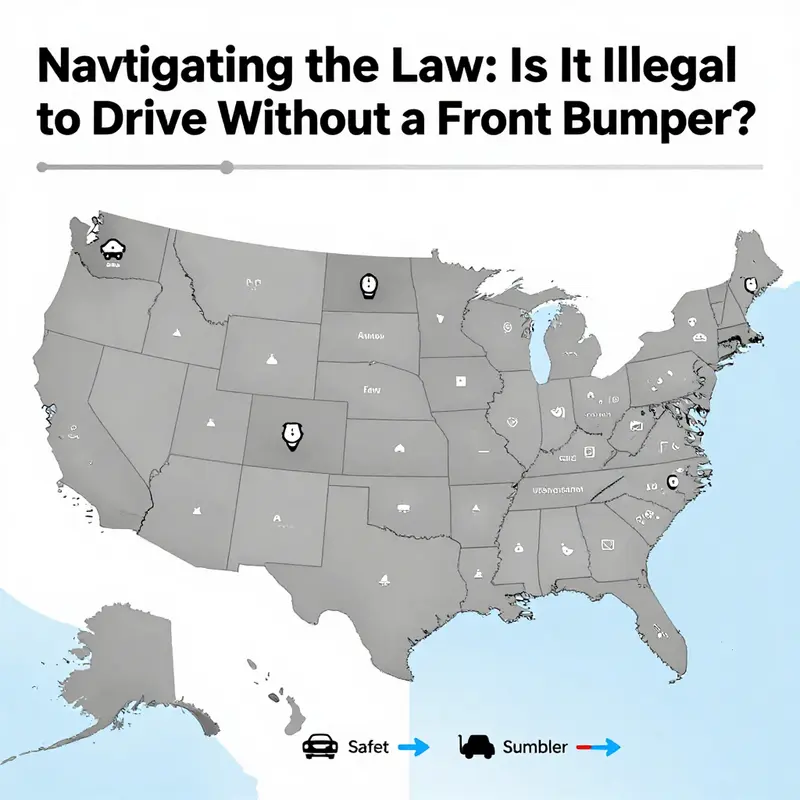
**Bumpers are more than cosmetic accessories in modern cars; they are integral components of a vehicle’s safety system. A front bumper, designed to absorb and redirect impact at low speeds, contributes to occupant protection, pedestrian safety, and the protection of critical systems behind the grille. Yet when a bumper is missing or severely damaged, the question shifts from design to duty: is it legal to drive in such a condition? The answer is not one-size-fits-all. It unfolds through a landscape of state statutes, enforcement practices, and practical considerations that vary from place to place. What follows is a cohesive investigation into how different jurisdictions treat front bumpers in the context of safety, responsibility, and everyday driving. While there is no universal federal prohibition, many states rely on vehicle-safety laws and inspection regimes that effectively regulate bumper integrity, sometimes with biting penalties for neglect or unsafe conditions.
In the United States, there is no federal rule that outright bans driving with a missing front bumper. The federal government’s vehicle-safety framework primarily addresses crash performance, passive safety systems, and overall crashworthiness, but it does not typically prescribe a universal bumper-for-all rule. The real governance happens at the state level, where traffic laws and vehicle-safety standards are written, interpreted, and enforced by state departments of motor vehicles, police, and inspectors. That creates a mosaic: some states impose explicit bumper-related requirements, while others rely on broader concepts like “unsafe vehicle condition” or “improper equipment.” The practical consequence is that a driver may ride legally in one state with a missing bumper, and in a neighboring state face a ticket or a requirement to repair before driving away.
A concrete example often cited in discussions about bumper legality is California. California’s vehicle-safety framework emphasizes preventing conditions likely to cause injury or damage. In that vein, Vehicle Code sections generally prohibit operating a vehicle with parts or configurations that present a clear risk. A missing front bumper could be considered a violation if it creates a risk, such as exposing sharp edges, reducing crashworthiness, or increasing the likelihood of collateral damage in even a minor collision. The principle at work is straightforward: the law targets conditions that meaningfully elevate danger on the road, not cosmetic omissions alone. The practical upshot is that a bumperless car may attract enforcement once a police officer observes a safety hazard, or during a required inspection, when the absence is deemed to render the vehicle unsafe for operation. This is not a blanket statement that every bumperless vehicle is illegal everywhere in California, but it highlights the legal logic: the vehicle’s condition must not jeopardize safety.
Across other states, the approach can be less explicit in the letters of the statute but equally strict in effect. In many jurisdictions, the focus is on maintaining the vehicle’s original structural components and safety systems. Some states require vehicles to retain their original bumpers or bumper structure for safety reasons, which can translate into penalties for driving with a missing bumper or damaged bumper that fails to meet the original design intent. Even when the exact bumper is not enumerated in the code, the broader categories of “unsafe vehicle condition” or “improper equipment” provide a basis for enforcement. Enforcement may occur during traffic stops, during routine safety checks, or as part of the state inspection regime. A missing bumper can trigger a citation, require repair, or contribute to a vehicle failing a mandatory inspection. In jurisdictions where inspection or emissions programs are mandatory, a missing bumper is a common reason for an automatic failure, because inspectors treat bumper integrity as part of the vehicle’s crashworthiness and protective envelope.
The legal landscape also considers the practical realities of driving, such as the risk of pedestrians, other vehicles, and property. A front bumper’s role extends to minimizing injury during low-speed crashes. Even if a bumper’s absence might seem to affect only aesthetics or noise, many safety inspectors and law enforcement officers assess the broader risk: does the missing bumper expose the vehicle to greater chance of injuring occupants in a collision or passersby in a crash? Does it compromise critical systems or create sharp edges that are likely to cause harm? These questions push the conversation beyond design into safety and responsibility. As a result, a driver who operates with a front bumper missing may encounter a spectrum of consequences, from a simple advisory to a formal citation, to mandatory repairs or even vehicle impoundment in extreme cases.
The experience of drivers navigating this terrain is shaped by the local enforcement culture as well as the specific wording of the relevant statutes. In some places, the law is written in broad terms, with inspectors applying safety judgment to each situation. In others, the code may be more explicit about required bumper presence or the necessity of maintaining certain structural components. What remains constant is the principle that the road is a system designed to reduce risk, and safety features that protect that system—like bumpers—are part of the contract between a vehicle and the environment it operates in. When a bumper is absent, the vehicle’s risk profile changes, and thus the legal and regulatory response becomes more likely to reflect concerns about safety rather than mere aesthetics.
For readers trying to gauge their own situation, a practical approach is to check with the state’s Department of Motor Vehicles or the local police department for the exact rules that apply. Inspect the vehicle with an eye toward the conditions that regulators typically consider: Is the bumper still structurally attached and functional? Does its absence create sharp edges, expose essential components, or alter the vehicle’s crash performance? Does the vehicle pass safety inspections or roadworthiness checks in any scheduled inspection or test? In many cases, the safe course is to replace or repair the bumper to restore the vehicle to its design-safe condition, both to minimize risk and to avoid regulatory trouble.
Within this broader context, it is useful to consider how drivers can think about safety and legality in practical terms. Some people may assume that a bumperless car is a temporary abnormality that will be tolerated in daily driving. Others worry about catching a traffic stop or failing a roadside inspection. The reality is often somewhere in between, with enforcement varying by state and even by locality within a state, depending on patrol priorities, the presence of safety campaigns, and patterns of vehicle violations. It is not unusual for a bumper to be damaged in a collision or degraded by wear and tear, yet many jurisdictions will still require prompt repair to ensure the vehicle can be operated legally and safely again. In the absence of a universal rule, the safest strategy is proactive maintenance: replace damaged bumpers promptly, ensure the bumper system is reinstalled correctly, and verify compatibility with any aftermarket components to avoid creating safety or legal issues.
The broader takeaway from this state-by-state flavor of regulation is that the law, more often than not, aligns with a philosophy of safety rather than one of cosmetic tolerance. If you are considering driving a vehicle with a missing front bumper, the prudent move is to treat it as a safety concern with potential legal consequences rather than a mere cosmetic deficiency. This is not about fear of fines alone; it is about maintaining the structural integrity of the vehicle, protecting occupants, and reducing the risk to pedestrians and other road users. When in doubt, consult the official sources that govern motor-vehicle safety in your area, and err on the side of restoring the bumper to its proper condition before resuming regular driving.
For readers seeking a broader safety context beyond bumper-specific questions, a deeper dive into how modern vehicles fare under various safety regimes can be informative. How vehicles like SUVs or crossovers fare in winter conditions, for instance, often hinges on a combination of tires, traction systems, and protective enclosures that include the bumper as a critical element of the crash-avoidance chain. As you explore the legal terrain surrounding front bumpers, consider also the practical realities of everyday driving—how a missing bumper can influence insurance investigations after a collision, how it might affect liability determinations in accidents, and how it can influence the outcomes of a roadside inspection or a police stop.
In sum, there is no universal federal ban on driving with a missing front bumper, but many states treat bumper integrity as part of the safety framework that governs vehicle operation. The resulting legal posture tends to be contextual: the bumper becomes a live issue when its absence creates risk or undermines crashworthiness, or when the vehicle fails to meet inspection standards. The best approach for any driver is to verify local codes, pursue prompt repair or replacement, and maintain a vehicle that clearly adheres to safety expectations. This path not only reduces the likelihood of a citation or impoundment but also preserves safety margins for everyone sharing the road. For those who want to connect safety considerations with broader maintenance and safety discussions, a related exploration can be found at how-safe-are-jeep-wranglers-unveiling-the-truth.
External resource: https://www.nhtsa.gov/vehicle-safety
Frontline Compliance: How Laws Gate Driveability When the Front Bumper is Gone
Driving without a front bumper is rarely just a cosmetic choice. It sits at the intersection of safety design, roadway policy, and everyday enforcement. The question of legality, unlike some federal mandates, is not uniform across the United States. Instead, it becomes a state-by-state matter where lawmakers and enforcement officers weigh the bumper’s role in protecting occupants, pedestrians, and critical vehicle components against the practical realities of repair timelines and vehicle condition. In many places, bumpers are treated as more than trim; they are part of the safety framework engineered to absorb minor impacts, shield vital systems, and help preserve the vehicle’s integrity during routine, low-speed crashes. When a bumper is missing or visibly damaged, the vehicle can appear to be an unsafe instrument rather than a standard, roadworthy machine. This perception can drive enforcement actions that look back to the moment a piece of the safety architecture is no longer present or functioning as designed.
In California, the law underscores a broader commitment to operating a vehicle that is not likely to cause injury or damage. The cited framework suggests that operating with a part that creates risk—such as a missing bumper—could fall under prohibitions aimed at preventing harm. While the exact statutory language can feel technical, the practical takeaway for drivers is straightforward: a bumper that is gone or nonfunctional can trigger violations by labeling the vehicle as unsafe. Other states, including New York and Texas, illuminate a similar philosophy. They emphasize preserving original structural components and safety systems because those components are integral to protecting people in the event of a collision, even at low speeds. The common thread across these jurisdictions is clear: safety devices that rely on structural integrity are part of the standard that keeps a car legally usable on the street.
Beyond explicit prohibitions, the world of vehicle inspections adds another layer of accountability. State inspection regimes, often administered through the DMV or an equivalent agency, frequently evaluate bumper condition as part of the overall safety assessment. A missing bumper can become a disqualifying factor, resulting in a failed inspection and the practical consequences that follow: postponing road use until the bumpers are restored or repaired. If a driver finds themselves cited for an “unsafe vehicle condition” or “improper equipment” related to bumper status, the next steps typically involve tow or impoundment only in the most urgent cases, but more commonly a fix-it ticket or a required repair order. The upshot is simple: there is little advantage in continuing to operate a vehicle that has been deemed unsafe, and the process to rectify the situation often takes priority over immediate travel plans.
For readers seeking a consolidated reference point, the National Highway Traffic Safety Administration (NHTSA) remains a primary authority on vehicle safety standards, including bumper considerations. Their guidance helps explain why bumpers exist beyond appearance and how they contribute to occupant protection and pedestrian safety. The broader implication for drivers is that bumper integrity is not optional in the eyes of the safety community; it is an element of the system designed to reduce harm in everyday accidents. Without that system, the risk of injuring occupants or bystanders can rise, and the legal system sees that heightened risk as a reason to intervene.
The penalties for driving without a bumper, while varying by jurisdiction, share notable commonalities. Across multiple states, a missing bumper can attract a traffic citation that falls within the realm of improper equipment or unsafe vehicle condition. Fines commonly range from modest amounts in the fifty-dollar neighborhood to several hundred dollars for more serious cases or when aggravating factors are present—such as the bumper’s absence coinciding with other safety system failures or a history of violations. In many episodes, law enforcement may issue a fix-it ticket. Such tickets require the driver to repair or replace the bumper within a specified period. The practical consequence is twofold: the vehicle remains operable only if the repair is completed within the deadline, and there are escalating costs if the deadline is missed or the repair is incomplete. The logic behind fix-it tickets is pragmatic: they pair accountability with a path back to compliance, rather than immediate punitive action. If a driver ignores a fix-it ticket or fails to present proof of repair, the penalties can compound, potentially transforming a relatively minor administrative issue into a more substantial fine or even impoundment in extreme circumstances.
The safety implications of driving with a missing bumper extend beyond the money men and the paperwork. Bumpers are engineered to manage energy exchange during low-speed collisions, a scenario that plays out far more often than high-speed crashes. When the bumper is absent or severely damaged, that energy-absorption capability is compromised. The result can be more significant damage to the vehicle’s frame, the cooling system, and critical lighting components, as well as an increased likelihood of pedestrian injury in the event of an impact with a person. Pedestrian safety is not merely a humane concern; it is a regulatory priority. If a car’s frontal geometry deviates enough to create wandering or unpredictable behavior—for example, by exposing sharp edges or by altering how nearby reflectors interact with public lighting—the risk to bystanders rises. Lawmakers and inspectors naturally reflect that risk in the penalties and required corrective steps they impose on motorists who drive with missing or defective bumpers. The logic is consistent: the bumper is not optional, and its absence has practical implications that extend well beyond personal convenience.
Practically speaking, a driver who finds themselves with a missing bumper is confronted not only with potential penalties but also with logistical questions: How do I get back on the road quickly and legally? What records or receipts do I need to keep to prove compliance? The answer typically begins with a visit to a qualified auto shop or a dealership that specializes in the vehicle’s make and model. Replacing a bumper is not always a trivial fix; some cars require careful alignment, structural support checks, and reattachment of associated components like headlights, grilles, or sensors. In some cases, the bumper must be replaced with an item that matches the vehicle’s original specifications, which can influence both the cost and the timeframe for re-entry into traffic. This is not merely about meeting a cosmetic standard; it is about reinstating a system designed to work as a single, integrated safety unit.
For drivers who are curious about how these principles play out in consumer conversations, there is value in considering broader vehicle-safety discussions beyond the narrow question of legality. In related content, readers can explore practical perspectives on vehicle safety and how automakers balance design, safety, and performance. The linked article, for example, examines how different models perform under varied conditions and how safety features contribute to overall risk management. While the focus there may be broader, the underlying message is relevant: safety features are not optional extras — they are essential to lawful operation on public roads. For readers who want a more concrete, vehicle-specific look, a resource like how-safe-are-jeep-wranglers-unveiling-the-truth can offer additional context on how widely safety features are perceived and evaluated in consumer discourse.
Even with a clear danger signal and robust state laws, there is room for nuance. In some circumstances, a bumper may be temporarily removed for legitimate reasons, such as repairing a damaged component or replacing a broken mounting point after a collision. In those situations, drivers should be proactive: document the repair plan, communicate with the local police or highway patrol if they anticipate extended downtime, and ensure the vehicle is not on the road in a condition that could be considered a hazard. A roadside encounter where a missing bumper is noticed can lead to a safer, more orderly resolution if the driver has evidence of a repair plan and timeline. The overarching aim of these measures is to reduce risk while enabling the driver to return to lawful operation as soon as possible.
As readers move forward, the practical takeaway is clear: the bumpers on our vehicles are not merely decorative elements; they are a legally and technically critical part of the safety system. Understanding how different states translate that reality into enforcement helps drivers anticipate potential fines, inspect requirements, and the steps needed to restore compliance. It also frames why the decision to drive with a missing bumper carries both immediate and long-term consequences—financial, legal, and practical. In the end, the road is navigated most effectively when safety is treated as a baseline obligation, not a negotiable preference. For those who want a deeper dive into related safety considerations and how they intersect with everyday driving, a broader exploration of vehicle safety literature and case studies can offer further insight into where bumper integrity fits within the larger safety ecosystem. And as the chain of accountability tightens, the path back to lawful operation becomes a matter of timely repair, proper documentation, and a renewed commitment to operating a vehicle that protects both its occupants and the people around it.
External reference for readers seeking official safety standards and current regulatory framing can be found at the National Highway Traffic Safety Administration (NHTSA) website: https://www.nhtsa.gov/
Bumper Rules and Road Safety: Reading the Law Between the Grille
Bumpers have long sat at the edge of everyday safety, a component many drivers ignore until it’s missing, damaged, or suddenly required to bear the weight of a low-speed collision. When we ask whether it is illegal to drive without a front bumper, we are really asking how safety, law, and liability intersect on the road. The short answer is nuanced: there is no single federal ban that prohibits driving without a front bumper in every circumstance. Instead, legality arises from a web of state regulations, inspection standards, and enforcement practices that treat bumper integrity as part of a broader commitment to crashworthiness and public safety. To understand how this plays out, it helps to move from a general principle to the specifics that govern a everyday driving decision. In most jurisdictions, the bumper is not a mere cosmetic cover but a designed element of vehicle safety, intended to absorb energy and steer impact forces away from occupants and critical systems during low-speed crashes. When a bumper is missing or its mounting is compromised, the vehicle’s crash dynamics can change in ways that regulators and law enforcement find unacceptable in the context of routine road use. This is not about aesthetics; it is about predictable performance when accidents happen, and about ensuring that a vehicle remains a controlled, recoverable object rather than a moving hazard. Across the United States, the framework is built from three pillars: statutory requirements that describe what parts a roadworthy vehicle must retain; inspection and testing regimes that verify the presence and function of those parts; and enforcement mechanisms that translate code language into practical consequences for drivers who fail to meet safety standards. The result is a landscape in which a missing bumper may trigger a cascade of legal and practical problems, even if there is no single universal prohibition that applies everywhere. The precise answer depends on where you are and what happened on the road that day. Yet the underlying logic is consistent: if a missing bumper creates a risk of injury or damage, it is unlikely to be treated as a minor nuisance. The law looks to safety outcomes, not to the symmetry of a vehicle’s front end. In California, for example, the governing vehicle code prohibits operating a vehicle with any part that is likely to cause injury or damage. While not stating a bumper by name in every case, the language is broad enough to encompass a missing front bumper if its absence could create a hazard. Other states take a similar approach but phrase the requirement in terms of maintaining the original structural components for safety. In jurisdictions such as New York and Texas, statutes or administrative codes emphasize that essential safety components—bumpers among them—must remain in proper condition to protect occupants and other road users. This is not a relic of the 20th century; it is an up-to-date recognition that modern bumpers are designed as part of a system that includes crumple zones, energy absorption, and mounting hardware. In practice, the consequence is that a missing bumper can lead to a citation or a more serious charge, especially if the officer or inspector determines that the vehicle’s condition poses a risk during typical, everyday driving. The legal calculus becomes even more intricate when the vehicle must pass a state inspection. In many states, routine DMV inspections check for bumper integrity as part of a broader safety assessment. A missing bumper, or one that is not securely attached, can result in an automatic failure that prevents the vehicle from being registered or re-registered until repairs are completed. If the bumper is damaged but still present, the inspection may require repair or replacement if the defect compromises the mounting points or energy-absorption performance. The inspector’s verdict—whether the vehicle is safe to operate—depends on whether the bumper, in its current state, could contribute to a crash or failure that endangers the driver, passengers, or other road users. When a violation is issued, the penalties can vary widely. Some jurisdictions attach a simple fine for “improper equipment” or “unsafe vehicle condition,” while others may impose more significant penalties, including mandatory repair orders, vehicle impoundment, or restrictions on operation until the deficiencies are corrected. In practice, what is illegal in one county may be treated as a fix-it ticket in another. The cost of noncompliance can extend beyond the immediate fine. A failing vehicle at inspection may lead to higher insurance premiums, increased scrutiny by law enforcement during stops, and additional inspection requirements in the future. The interplay between enforcement and public safety has a practical moral: the state does not seek to harass drivers who are temporarily between bumper fixes, but it does seek to deter situations where a missing bumper could contribute to a preventable injury. The practical pathway to staying compliant is straightforward, though occasionally overlooked. If your bumper is damaged or missing, repair or replacement is the recommended course. Replacing with an original or certified equivalent bumper preserves the vehicle’s designed energy-absorption characteristics, ensures proper mounting geometry, and aligns with the requirements of inspection regimes. It is not enough to tape, strap, or loosely attach a bumper in the name of speed or convenience; regulators understand that a secure, properly mounted bumper is part of a vehicle’s crashworthy system. Equally important is a respect for the rules governing aftermarket parts. Some jurisdictions impose limits on how non-original bumpers or nonstandard mounting hardware can be used if they alter crumple zones or the ability to mount a bumper in a way that meets safety standards. In that sense, the bumper becomes a touchstone for maintenance discipline: it reveals whether a driver treats the vehicle as a system designed to protect its occupants or as a cosmetic shell that can be modified without consequence. The broader implications reach beyond the individual trip. Public safety regulation operates on the assumption that manufacturers design vehicles to meet tested performance targets, and that society benefits when those targets are maintained across the fleet. Research into crashworthiness demonstrates that even small changes in bumper structure or mounting can influence occupant protection during low-speed crashes. In domestic A-class vehicles, for instance, the base design and material integrity of bumpers significantly affect how well a vehicle tolerates energy transfer during a collision and what the downstream repair costs will be. These findings underscore a central theme of modern road policy: safety is a system property. It depends on the quality of design, the rigor of testing, and the commitment of enforcement to uphold those standards. The same principle resonates in another domain of bumpers that regulators monitor closely—the safety of consumer products designed for vulnerable populations. The crib bumper controversy, which has spurred a wide debate about the risks of suffocation and entrapment for infants, echoes a larger truth: safety standards must be enforceable, enforceable through clear labeling and decisive action when hazards arise. A survey of public opinion on crib bumpers reveals how perceptions of risk can diverge from the actual safety profile, and it highlights the need for regulatory clarity and robust testing. The parallel to automobile bumpers is instructive. Just as lawmakers and regulators must balance consumer choice with safety, vehicle safety authorities must balance the realities of repair, maintenance, and replacement with the imperative to protect lives on the road. Even when a bumper is temporarily removed for repair, the public policy message remains consistent: a vehicle should not be operated in a way that weakens its crashworthiness or creates uncertainty for other road users. This is not about a single inspection sticker or a one-time citation; it is about a shared commitment to a higher standard of road safety that travels with every car on the highway. In practice, that means drivers should educate themselves about their state’s specific codes, check with the local DMV for inspection requirements, and prioritize repairs that restore the vehicle to its designed safety condition. It means manufacturers and repair shops should communicate clearly about what constitutes a safe bumper system and what compliance looks like in terms of mounting, energy absorption, and compatibility with the rest of the collision protection architecture. It also means policymakers should maintain vigilance against loopholes that allow vehicles to circulate with deteriorated or inadequately supported bumpers. The objective is not to trap drivers in bureaucratic red tape but to reduce preventable injuries and to reinforce the social contract that the road is a shared space with predictable rules. If you find yourself navigating a bumper-related issue, approach it as a safety problem, not merely a mechanical nuisance. Plan ahead, verify local regulations, and pursue a repair path that preserves the vehicle’s protective design. In the end, the legality of driving without a front bumper is not a single statute, but a tapestry of standards, inspections, and expectations that together promote a safer road environment for everyone. External reading on related safety regulation and the subtleties of risk perception can be informative for those seeking a broader perspective: https://www.ncbi.nlm.nih.gov/pmc/articles/PMC10285694/
Final thoughts
Understanding the legal framework surrounding driving without a front bumper is vital for business owners. By remaining informed about state-specific regulations, acknowledging the importance of safety inspections, and recognizing the potential consequences of non-compliance, vehicle owners can safeguard their operations. It’s not just about following the law; it’s about ensuring the safety of all road users. Equip yourself with this knowledge to make informed decisions regarding your vehicles.