
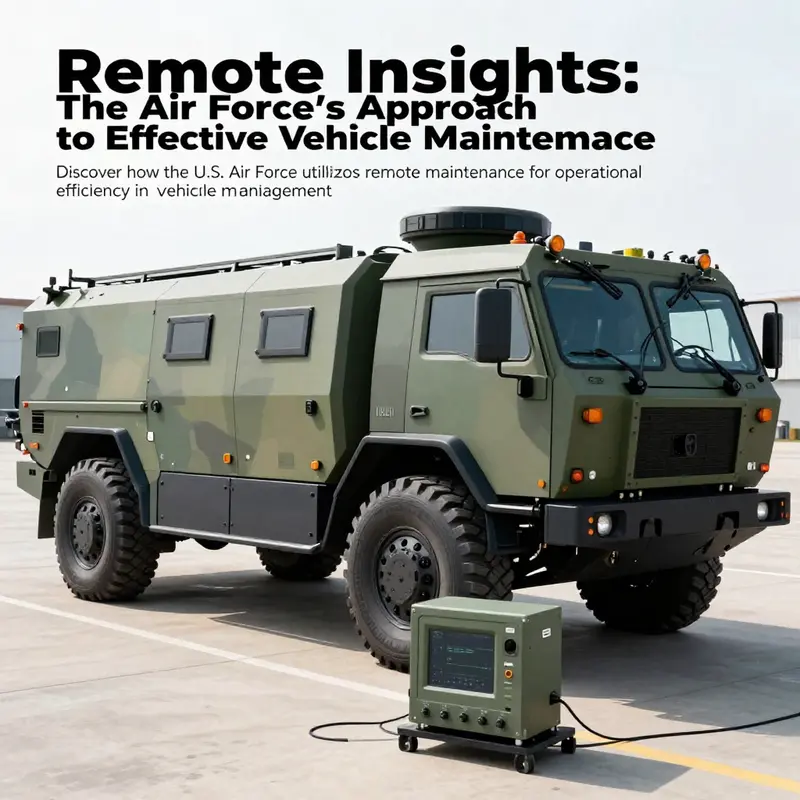
In the realm of military logistics, vehicle readiness is paramount. The U.S. Air Force addresses this critical need through innovative remote vehicle maintenance operations, which merge advanced communication technologies with proactive maintenance strategies. This article delves into the intricate workings of these operations, emphasizing their reliance on real-time data, efficiency improvements, and the future of predictive maintenance. Each chapter will offer business owners valuable insights into how these methodologies can enhance their own fleet management practices.
Guardians of Readiness: How Air Force Remote Vehicle Maintenance Orchestrates Operations and Technologies
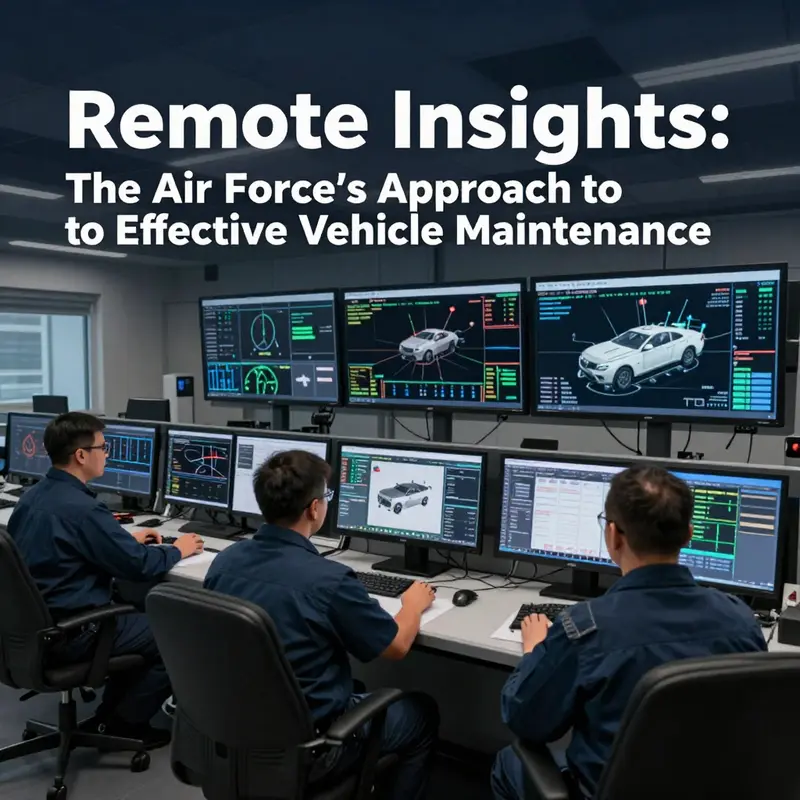
Remote vehicle maintenance within the U.S. Air Force operates as a sophisticated nerve center for a vast fleet of ground support vehicles. From a centralized hub, technicians and engineers monitor, diagnose, and guide maintenance activities that keep cargo trucks, transport vehicles, and essential support equipment ready for every mission. The effort rests on a carefully engineered blend of advanced diagnostics, secure communications, and data-driven decision making. It is less a single task than a continuous, adaptive workflow that aligns people, machines, and information around the shared objective of peak fleet availability. To understand the full picture, it helps to imagine a highly coordinated orchestra where sensors, analysts, field technicians, and logistics professionals play different instruments but move in perfect tempo to produce reliable performance in the field.
At the core of this system are advanced diagnostic tools and systems that provide a steady stream of vehicle health indicators. Onboard diagnostics, vibration analyses, temperature readings, hydraulic pressures, electrical system status, and battery health all feed into remote monitoring platforms. These platforms, fortified by robust cybersecurity and protected networks, relay data in real time to a centralized operations center. The result is a continuous health portrait of the fleet, rather than a series of delayed snapshots. Real-time analytics turn raw measurements into actionable insights. When a sensor signals an abnormal pattern—perhaps rising engine temperature during a routine operation, or an unusual vibration signature in a transport trailer—the system flags it for review and, if needed, initiates an automated or semi-automated diagnostic sequence. This is not merely about detecting faults; it is about predicting them before they disrupt readiness. In many cases, a trending anomaly is enough to trigger a preemptive maintenance window that allows crews to address the issue during planned downtime, thereby avoiding unplanned downtime on the flightline or in theater operations.
The way data travels through the system is as important as the data itself. Secure communication networks connect distant sites with the maintenance command and control centers. This connectivity enables rapid, bidirectional exchanges: telemetry streams from vehicles to analysts and, on the reverse path, guidance and repair instructions from remote experts to on-site teams. The security layer is essential, given that the information encompasses sensitive vehicle performance and operational plans. The Air Force’s approach treats this as a shield and a conduit—the shield protects sensitive data, while the conduit enables seamless access to critical performance information for timely decision making. In practice, technicians on the ground never work in isolation. They are supported by remote specialists who provide troubleshooting guidance, diagnostic interpretations, and repair recommendations that align with the latest data-driven insights.
IoT integration forms a large part of the remote maintenance architecture. Vehicles carry a suite of sensors that report status across multiple subsystems. This Internet of Things fabric creates a unified data tapestry in which the condition of engines, transmissions, brakes, cooling systems, and electrical networks can be assessed holistically. The IoT layer makes predictive maintenance feasible in a way that reactive methods never could. Instead of waiting for a failure to occur, maintenance decisions are guided by patterns in the data—seasonal loads, cumulative wear, and environmental conditions—that together inform when an intervention should happen. The aim is straightforward: intervene early enough to prevent disruption, but late enough to maximize the use of up-to-date parts and tools. This balance minimizes unnecessary maintenance while still guarding against surprises that could jeopardize operations.
The maintenance management systems that underpin remote vehicle upkeep also serve as a bridge to broader Air Force maintenance practices. A standardized framework for performance metrics and indicators helps quantify how well remote monitoring and on-site maintenance collaborate to sustain readiness. By defining common benchmarks, the system enables apples-to-apples comparisons across units and bases. Such standardization supports continuous improvement, allowing leaders to identify best practices, replicate efficient workflows, and allocate resources where they yield the greatest return. A key part of this framework is the practice of evaluating remote monitoring capabilities against agreed standards, ensuring that the data-driven approach remains aligned with mission requirements. The research surrounding this area highlights how standardization not only clarifies expectations but also accelerates learning across diverse maintenance environments.
Predictive maintenance, as a core discipline, shifts the emphasis from fix-after-failure to fix-before-failure. It rests on reliable data, validated models, and disciplined execution. When predictive signals indicate an impending issue, maintenance planners and field teams can schedule interventions at a time that minimizes impact on operations. The benefits are tangible: reduced unplanned downtime, lower repair costs, and higher vehicle availability. In a force where every minute of vehicle time is valuable, even modest improvements in predictability translate into meaningful gains in readiness. Remote maintenance units gain a frictionless view into which vehicles or fleets are most at risk, enabling prioritized actions and more intelligent parts management. This is especially important for older fleets or those that operate under demanding conditions, where wear patterns and failure modes may evolve over time.
An equally important dimension is the human element that links remote monitoring to on-site execution. The most advanced sensors and analytics are powerless without skilled technicians who can interpret the data within the context of real-world operating conditions. Remote teams provide technical guidance, troubleshooting support, and repair recommendations that are tailored to the specific circumstances on the ground. This collaborative dynamic reduces trial-and-error approaches, accelerates repairs, and ensures that the right parts and tools are available when they are most needed. It also creates a feedback loop: insights gained during fieldwork refine the predictive models and diagnostics used in remote monitoring, leading to better forecasts and more efficient workflows over time. The interplay between remote and on-site expertise embodies a practical convergence of data science and hands-on engineering, where theory becomes action and action informs theory.
Fleet management in this paradigm extends beyond the immediate task of keeping vehicles operational. It encompasses planning, logistics, training, and even culture. Data-driven models measure factors that influence maintenance performance, including the skill and availability of personnel, the availability of spare parts, the accessibility of specialized tools, and the age and complexity of the fleet. Linear regression and other simple statistical methods are used to evaluate how these factors correlate with maintenance outcomes across different units. The results guide where to invest in training, how to structure maintenance schedules, and how to optimize warehouse inventories so that the right components are on hand at the right time. In practice, this means fewer trips to distant depots, shorter wait times for critical parts, and more predictable turnaround times for repairs. It also means maintenance staff can focus their attention where it matters most, rather than being consumed by administrative tasks or by repetitive, low-value diagnostic steps.
A narrative like this would be incomplete without acknowledging the broader context in which remote vehicle maintenance operates. It sits at the intersection of cybersecurity, data governance, and organizational culture, all of which shape how effectively data can be collected, analyzed, and acted upon. Security is not merely a checkbox; it is an ongoing discipline that protects sensitive tactical information while preserving the agility that maintenance operations require. Likewise, governance frameworks ensure data quality, consistency, and traceability, so that decisions based on analytics are credible and auditable. Beyond technology and policy, success hinges on a workforce capable of integrating new tools with established practices. Training programs, cross-functional teams, and a culture that values continuous improvement are essential to sustain the momentum of digital transformation in maintenance. This human and organizational dimension explains why remote vehicle maintenance is more than a technical capability; it is a strategic capability that complements other Air Force efforts to modernize and optimize operations at scale.
To connect the idea of maintenance fundamentals with a practical, on-the-ground perspective, consider the broader knowledge base around what maintenance actually entails. A concise overview of maintenance principles helps frame why remote monitoring and predictive analytics matter so much. For a more expansive discussion, readers can consult resources that explain the core concept of vehicle maintenance and how it informs decisions across fleets of different ages and roles. What is Vehicle Maintenance? provides foundational context that complements the more specialized remote, data-driven approach described here. It bridges general maintenance thinking with the precise, technologically enabled practices that characterize Air Force remote vehicle upkeep.
The overall effect of remote vehicle maintenance is measured not only by fewer faults but by faster, smarter responses that preserve mission readiness. Improved response times arise from the immediacy of data delivery and the clarity of remote guidance. When a problem is detected early, technicians can plan interventions that minimize disruption and maximize the available window for repairs. Efficient resource allocation follows from precise diagnostics that identify which components truly require attention, enabling supply chains to reduce stockouts and overstock alike. Faster vehicle turnaround becomes possible when the repair path is clear, parts are available, and on-site teams operate with a well-informed, shared plan. In combination, these benefits yield higher fleet availability and improved confidence in the Air Force’s ability to fulfill its commitments under varied conditions and demands.
There is a continuous loop at work: data prompts analysis, analysis informs action, action generates new data, and new data refines the analysis. Each cycle strengthens the ability to anticipate issues before they escalate and to orchestrate maintenance activities with a precision that was unimaginable a generation ago. This is the essence of how Air Force remote vehicle maintenance supports readiness. It blends the precision of analytics with the craft of hands-on repair, underpinned by secure and reliable communications that ensure information flows where it is needed, when it is needed, without compromising safety or security. The result is not merely a maintenance capability; it is a resilient operational capability that adapts to changing technologies, evolving threats, and the shifting demands of modern military logistics.
As the Air Force continues to pursue digital transformation, remote maintenance serves as a cornerstone of how the service leverages data to sustain its assets. The integration of diagnostic intelligence, IoT-enabled sensing, real-time analytics, and structured maintenance management creates a scalable model that can adapt to new platforms and evolving mission profiles. It is a model that recognizes the value of collaboration between centralized experts and the technicians who keep the machines moving in the field. It also acknowledges that technology alone cannot deliver readiness; it requires trained personnel who can translate data into action and execute with discipline and care. The blend of technology, process, and people is what ultimately makes remote vehicle maintenance a strategic advantage—one that keeps the Air Force’s fleet capable, available, and ready to fulfill its responsibilities whenever and wherever they are needed.
For readers seeking a concrete starting point to explore how maintenance concepts translate into everyday decisions, a succinct primer on vehicle maintenance can provide useful context. What is Vehicle Maintenance? offers a clear, accessible foundation that helps readers understand why the Air Force’s remote approach emphasizes continuous monitoring, predictive interventions, and collaborative problem-solving. Such resources illuminate the pathways by which data becomes wiser action and how disciplined maintenance practice underwrites mission success. What is Vehicle Maintenance?
In sum, Air Force remote vehicle maintenance embodies a forward-looking integration of technology and practice. It elevates maintenance from a reactive, schedule-bound activity to a proactive, data-guided discipline that protects readiness. By watching the health of every vehicle through sensors and dashboards, by translating streams of data into timely, targeted interventions, and by weaving the expertise of remote specialists with on-site know-how, the Air Force builds a maintenance ecosystem capable of supporting complex operations across diverse theaters. The result is a fleet that spends less time out of service, an organization that makes better use of its people and its parts, and a readiness posture that can adjust in step with the pace of modern military demands. As this ecosystem evolves, it will continue to rely on secure networks, reliable diagnostics, and the everyday courage of technicians who solve problems in ways that marry science with craft. For those who study or participate in defense maintenance, the Air Force’s remote vehicle maintenance model offers a compelling blueprint for how to harness technology to sustain critical capabilities in dynamic environments.
External resource: official U.S. Air Force website.
null
null
null
null
Predictive Eyes on the Fleet: How Remote Vehicle Maintenance Transforms Air Force Readiness
Predictive Eyes on the Fleet: How Remote Vehicle Maintenance Transforms Air Force Readiness
Remote vehicle maintenance in the Air Force has become less about reacting to breakdowns. It is now about anticipating failures, prioritizing work, and keeping mission systems ready. Remote maintenance teams monitor fleets from centralized sites. They pull streams of diagnostic and telematics data from trucks, trailers, generators, and support equipment. That data arrives continuously, creating a portrait of each asset’s health. Analysts and technicians use those portraits to spot trends and early warning signs. The result is maintenance that fixes cause, not just symptom.
A core shift underpins this change: condition-based maintenance evolving into predictive maintenance. Sensors and onboard systems report temperatures, voltages, vibration levels, and fuel metrics. Telemetry links those signals to data hubs where models analyze patterns. Predictive tools estimate remaining useful life and probability of failure. This capability changes how planners allocate people, parts, and tools. Instead of a calendar-based schedule, maintenance becomes dynamically prioritized. Crews are dispatched for targeted repairs. Time-consuming inspections are reduced. Critical assets stay in service longer.
The technical backbone of remote operations is a standardized data pipeline. Data collection uses common protocols and formats. That standardization allows heterogeneous equipment to speak the same language. It also makes analytics portable across vehicle types. Centralized platforms store and normalize incoming data. They apply rules and machine learning models to flag anomalies. When an issue is detected, the platform generates a clear action item. It can recommend diagnostics, replacement parts, or interim measures. Those recommendations travel to on-site teams through secure channels. The coordination accelerates troubleshooting and reduces mission disruption.
Human expertise remains central. Remote analysts do not replace hands-on mechanics. Instead, they augment them with context. A remote specialist can interpret a vibration signature and tell a technician which bearing to inspect. They can send a wiring diagram, a torque spec, or a short diagnostic routine. This guidance shortens the repair cycle. It also helps less-experienced technicians complete complex tasks. Over time, remote support acts as a distributed mentoring system. It raises the baseline competence across dispersed units.
Logistics and parts forecasting are two of the biggest efficiency gains. Predictive models identify likely future failures across the fleet. Maintenance managers use those forecasts to pre-position high-use spares. Supply chains shift from emergency shipments to scheduled replenishment. This lowers transport costs and reduces downtime waiting for parts. It also improves the utilization of limited depot space. Forecasting also tightens inventory control, so valuable components are not overstocked. The net effect is a leaner, more responsive supply network that supports forward-deployed forces.
Training and workforce planning change in step with technology. Remote vehicle maintenance creates new roles. Data engineers, systems integrators, and predictive analysts work alongside classic mechanics. Training pipelines now include courses on diagnostics, data interpretation, and remote collaboration tools. Technicians learn to trust analytics and to communicate findings back into the models. That feedback loop improves prediction accuracy. Moreover, remote maintenance reduces the need for specialized skills at every location. Instead, centers of expertise provide guidance to multiple sites, freeing on-site personnel to concentrate on execution.
Security and data governance are persistent concerns. The same connectivity that enables predictive insights exposes systems to cyber risk. Remote maintenance programs adopt strict access controls, encryption, and monitoring. Data integrity is enforced so models operate on trustworthy inputs. Governance policies determine who can view or act on sensitive information. They also set rules for data retention and sharing across commands. A robust security posture ensures that remote maintenance benefits do not come at the cost of mission vulnerability.
Deploying predictive maintenance in austere environments presents unique engineering problems. Bandwidth can be limited, and connectivity intermittent. Remote systems therefore incorporate local caching and edge analytics. Edge devices filter raw telemetry and run lightweight anomaly detection. They forward condensed summaries when links are available. This approach preserves predictive capability while reducing reliance on persistent, high-bandwidth connections. It also protects operations in contested or remote theaters where communications may be degraded.
Measuring success requires clear metrics. Readiness rates, mean time between failures, and mean time to repair remain primary indicators. Predictive maintenance adds measures like prediction accuracy, parts forecast variance, and percentage of repairs initiated by analytics. Commanders can see how remote maintenance shortens repair cycles and reduces unscheduled downtime. Financial measures likewise improve, with lifecycle costs falling as preventive repairs replace expensive overhauls. These metrics help justify investment and guide continuous improvement.
Interoperability across legacy and modern platforms is a practical challenge. Many vehicles were not built with today’s telemetry standards. Retrofitting sensors and gateways is often necessary. Programs prioritize the most critical assets first, focusing on fleet segments where predictive gains are highest. Incremental modernization mitigates risk and controls cost. Over time, newer purchases incorporate standardized telematics and interface components. The long-term effect is a progressively more homogeneous fleet from a data perspective, which eases scaling of predictive capabilities.
Artificial intelligence continues to refine predictive accuracy. Machine learning models detect subtle correlations humans might miss. They can model complex failure modes that depend on multiple interacting signals. However, models need high-quality training data and sustained validation. Remote maintenance teams maintain labeled incident records so algorithms learn from real events. Human oversight corrects model drift and ensures that analytics remain grounded in engineering reality. The best outcomes arise when algorithms highlight candidates and humans confirm root causes.
Culture and trust determine adoption speed. Maintenance personnel must trust recommendations and understand the reasoning behind them. Transparent models, clear alerts, and easy access to supporting data build that trust. Early success stories—where predictive guidance prevented a mission-impacting failure—encourage further use. Leaders must also ensure that predictive tools do not become a way to overwork limited personnel. Instead, they should be framed as force multipliers that improve work quality and reduce unnecessary effort.
In remote and expeditionary settings, the combination of predictive analytics and remote guidance changes force posture. Units can operate farther and longer from bases. They do not need full maintenance detachments co-located with every convoy or airfield. Instead, a leaner on-site team, backed by a remote center, can keep assets mission-ready. This reduces logistics tails and increases operational agility.
There are practical limits and open questions. Data gaps, sensor failures, and imperfect models will still cause surprises. The path forward is iterative. Programs must prioritize usable outputs over perfect predictions. A simple reliable alert that prevents a failure has more value than a complex model with marginally better accuracy. Over time, however, data volume and model maturity will raise the baseline of reliability.
Remote vehicle maintenance is changing how the Air Force thinks about readiness. Predictive strategies reduce downtime and save resources. Standardized data architectures and remote expertise extend technical reach. Edge analytics and robust security permit operations in difficult environments. Training and culture shift to embrace data-driven maintenance as an integral capability. As algorithms improve and systems interoperate, remote maintenance will become a central pillar of fleet sustainment.
For a concise explanation of vehicle upkeep fundamentals, see what is vehicle maintenance. For more details on a prominent predictive toolkit and its implementation, refer to the official Air Force announcement: https://www.af.mil/News/Article-Display/Article/3675298/air-force-shifts-to-new-software-toolkit-for-predictive-maintenance/
Final thoughts
The landscape of vehicle maintenance is evolving, especially within the military context, where operational readiness hinges on both technology and strategy. The U.S. Air Force’s remote vehicle maintenance operations illustrate a model that optimizes parts availability, employs real-time data analysis, and anticipates future needs through predictive maintenance strategies. These methodologies not only ensure the efficiency and reliability of military fleets but also provide valuable lessons for business owners in optimizing their own vehicle operations. By integrating similar practices, businesses can enhance their fleet management efficiency and maintain high operational standards.