

For Jeep business owners, encountering a vehicle that won’t start despite having electrical power can be a frustrating and costly issue. Understanding the reasons behind this problem and being able to troubleshoot it efficiently can save you time and resources. This guide will delve into the symptoms of a Jeep that won’t start, outline common mechanical issues, and provide safety precautions to follow during troubleshooting. By the end, you will be equipped with the knowledge to address the starting issue effectively and keep your operations running smoothly.
Chapter 1: Power in the Dash, Silence in the Crank—Decoding Start Symptoms in a Jeep
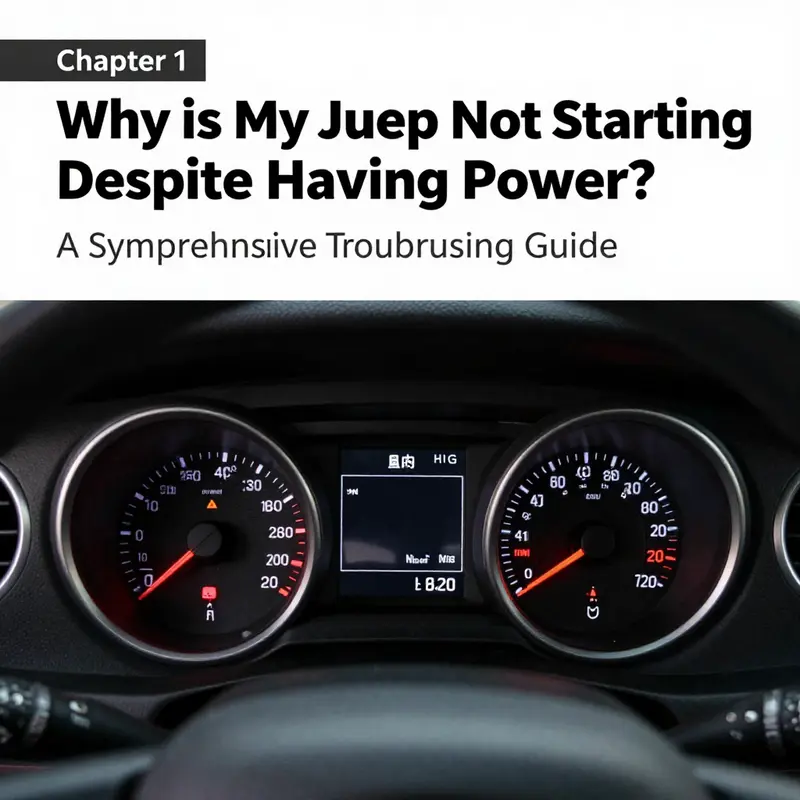
When a Jeep won’t start but still has power, it can feel like the vehicle is signaling you with a puzzle rather than a straightforward failure. The lights glow, the gauges move, the radio hums, and yet when you twist the key or press the start button, the engine remains stubbornly quiet. That contrast—vital electrical systems functioning while the heart of the engine stays still—points away from a dead battery and toward the starting system or its immediate circuitry. It is a scenario that rewards careful listening, measured testing, and a willingness to follow the path of clues where the symptoms lead. The moment you accept that the problem lies not with the energy in the battery but with the chain of events that translates that energy into motion, the diagnostic process becomes a logical, almost tactile exercise. You can picture the journey of electricity through a map of relays, solenoids, ignition circuits, and sensors, each node a potential bottleneck or miscommunication that prevents the engine from turning over. In practice, this means that a Jeep with power intact but no cranking is not a single-failure, it is a conversation between several components that must be interpreted in the right order. This chapter invites you to walk through that conversation with patience, because the correct fault can often be narrowed down by listening to the engine’s signals, observing the dash indicators, and validating how the vehicle behaves at the moment you attempt to start it.
The first step is to acknowledge the spectrum of what you might hear or not hear when you engage the starting system. A completely silent attempt to start—no click, no buzz, no audible sign of life—tends to point toward the ignition switch, a broken starter circuit, or a poor connection in the lead-up from the battery to the starter motor. A single, solid click or a rapid fire of clicks typically implies that the starter solenoid or relay is trying to engage but cannot sustain the necessary current. A slow, labored crank—often described as a choked or wheezy rotation—suggests the opposite: the starter is receiving insufficient current or is mechanically slow to engage due to wear or binding. And then there are the dash cues that accompany the event: the battery warning light, a key icon blinking, or immobilizer indicators that betray a security lockout. All of these signals are not random noise but a language you can learn to interpret. For many Jeep owners, the presence of an illuminated security icon or a blinking key symbol alongside the attempt to start is a clear hint that the immobilizer or anti-theft system is interfering with the ignition process. If you have access to a dashboard legend or the owner’s manual, it can be useful to cross-check these symbols as you go, but the most important thing is to read the sequence as it unfolds in real time. If you want a quick visual reference to the symbols that often appear on a Jeep’s dashboard, a concise guide is available here: dashboard symbols explained, which can help you interpret what a blinking key icon or a battery light might be signaling in your specific model.
To begin translating the symptoms into a plan, imagine the starting sequence as a chain of events that must occur in a precise order: the ignition switch must send a feed to the starting circuit, the relay or solenoid must receive that feed and switch power to the starter motor, the starter must engage to turn the engine over, and the engine management system must allow combustion. Any weak link in that chain will stop the process and leave you listening to the quiet, or listening to a click that repeats at regular intervals. The most efficient approach is to test the chain without jumping directly to the most invasive repair, because many starter issues are caused by something simple and addressable—like a corroded terminal, a loose ground strap, or a degraded connection in the wiring harness. This is where the diagnostic mindset becomes crucial: you are not chasing a single scorched component but verifying a relationship, a connection, and a signal that must travel from one point to another with enough integrity to carry current and command action.
The initial diagnosis begins with confirming the symptom pattern you observe in the moment you attempt to start. If there is a lack of noise, the summit of suspicion rises toward the ignition switch, a broken starter circuit, or a loose or corroded connection in the wiring that feeds the starter solenoid. A rapid clicking sound, on the other hand, is a telltale sign that the system is trying to engage but cannot sustain current—often because the battery is weak or the connection between the battery and the starter is compromised, even though the vehicle’s other electrical systems appear to be functioning. A slower spin, with the starter seeming to drag, can indicate a binding starter motor, a seized engine, or insufficient current arriving at the motor due to a sagging battery under load. These sound cues, when considered alongside dashboard indicators, build a preliminary map of where to look next. The dash’s battery light and security indicators can either support or complicate your interpretation. A battery light that glows during a start attempt may tempt you to focus on the charging system, but you can bridge both possibilities by testing voltage under load and watching how the lights themselves behave when you command the start. If the moment you push the button or turn the key triggers momentary lights and a stuttering cradle of sounds, the problem might be in the link between the battery and the starter rather than in the battery’s capacity alone. If, however, the dash remains steady with a glowing battery symbol throughout, you likely have a charging or battery issue that masquerades as a starting problem only because the engine cannot draw enough current to turn over cleanly.
In this diagnostic journey, the immobilizer or anti-theft system plays a more quiet but equally vital role. If the ignition is reacting to a recognized key, the engine will respond; if the system fails to recognize the key, the engine may be blocked from cranking despite power being present elsewhere. The symptom can be particularly tricky because the vehicle might show normal power use while the immobilizer prevents the engine from starting. You may see a blinking key icon, a steady or intermittent immobilizer warning, or catch a message on the display indicating an access or security issue. In many Jeep configurations, an immobilizer fault forces a gentle, non-invasive stop to protect the vehicle from theft, and the remedy is not a heavy repair but rather a system reset, a key replacement, or dealer-level programming to re-synchronize the immobilizer to the vehicle’s control module. While immobilizer symptoms can be subtle, they are a common culprit in the “power present, engine not starting” scenario and deserve careful attention, especially when other electrical components appear to operate normally.
The irrigating principle behind this initial diagnosis is clarity: do not jump to conclusions about the battery’s health when the signs point to the starting circuit or the immobilizer’s logic. Begin with the simplest check that can confirm or disprove a direct short between the battery and the starter, then broaden the scope to include critical relays, fuses, and ignition switch behavior. When you approach the problem with this mindset, the path becomes a manageable sequence rather than an overwhelming bundle of potential failures. As you proceed, there are practical cues you can rely on to guide your steps with confidence. One such cue is how the vehicle behaves when you attempt to start in different gear states on an automatic transmission. If the transmission range sensor thinks the gear is not in Park or Neutral, the engine will not crank even if power is present. This nuance—the need for the selector to be recognized in a safe starting position—emerges naturally from the more general principle of starting-system interference rather than a simple energy shortage. If in doubt, cycling the lever to N and back to Park, then attempting a start again, is a non-invasive test that aligns with the aim of preserving the battery and avoiding unnecessary wear on the starter while you gather information about the system’s state.
Another layer of diagnostic insight comes from listening not only to the engine’s chatter but to the environment around the vehicle. A hot, slow or hesitant crank can indicate a mechanical drag that is actually independent of the electrical system—a result of a seized engine or a binding accessory. A cranking sound paired with a too-slow voltage drop is a textbook sign of a weakened battery or corroded connections, even when the interior lights and dashboard functions appear unaffected. Checking the fuel system remains a part of the broader diagnostic story, but it belongs later in the sequence when you confirm the engine is mechanically turning. If the starter motor is delivering torque, yet the engine refuses to catch, you are suddenly in the realm of fuel or spark—issues that require a different diagnostic lens. The beauty of starting-system troubleshooting is that, by focusing first on the chain of events essential to crank, you can quickly separate electrical from mechanical issues and reduce the list of potential culprits.
To connect this diagnostic narrative with practical actions, imagine the moment you decide to test the starter physically. A cautious tap on the starter housing with a non-metallic tool is sometimes described as a temporary aid to unstick a binding inside the motor. This temporary impulse is not a fix but a diagnostic nudge that can indicate whether the starter is mechanically stuck versus electronically unresponsive. If the engine responds to such a nudge by cranking briefly, you have strong evidence that the starter assembly is at least partly functional and that a more comprehensive replacement or servicing is warranted. It is essential, however, to perform such a test safely—engine off, vehicle secured, and with proper protection from moving parts—so that you do not expose yourself to unnecessary risk or create a new problem. The next step, if the starter shows signs of life only after a gentle strike, is to inspect the starter’s electrical connections, particularly the battery terminals and the cable grounds. Loose or corroded connections are common, especially in climates with temperature fluctuations or where road debris can knock against the battery housing or harnesses. A simple clean and tighten can restore a reliable circuit for many starters that have merely succumbed to poor contact rather than internal failure.
If the basic physical checks yield no decisive answers, the diagnostic journey takes a careful turn toward the electrical relay and ignition circuit. The starter relay and its associated wiring are a frequent source of intermittent failures. Swapping in a relay of the same specification, or testing the existing relay with a known-good unit, can reveal a relay that intermittently fails to supply current to the starter coil. In this moment, the test is not a guess but a direct read of how the circuit behaves under a known load. If the relay proves to be the culprit, the fix is straightforward and relatively inexpensive, but if the problem persists after confirming the relay, you must widen your inspection to the ignition switch and its feed path. A faulty ignition switch can fail to send the start signal to the starter circuit while still enabling other electrical functions. In such cases, the key or push-button interface can exhibit signs of wear or contact burn on its internal terminals, and a professional inspection may be required to re-secure or replace the switch and restore a clean start signal.
At this juncture in the diagnostic cycle, you may encounter the immobilizer again, especially if all mechanical and electrical checks pass but the engine still refuses to engage. In modern Jeeps, the immobilizer logic is a gatekeeper that prevents unauthorized engine start. If the system does not recognize the key, even though the battery is healthy and the starter appears ready, the engine will stay at rest. Reset procedures, spare keys, or dealer-level programming might be necessary. The immobilizer’s influence is not inherently a fault in the starting system’s physical hardware; rather, it is a communication issue between the key fob and the vehicle’s anti-theft module. It is here that a patient, methodical approach pays dividends, because you minimize the risk of overlooking a security-related cause in favor of hardware replacement. In many situations, replacing the key fob battery or attempting to start with a spare key can illuminate whether the issue is a recognition problem or an actual mechanical failure. If the immobilizer is confirmed as the obstacle, the path forward often involves coordinated steps with a dealership or a qualified technician to reset the system or reprogram the correct keys.
All of these threads—starter, ignition circuit, battery health, and immobilizer logic—rejoin in a central rule of troubleshooting: start with the simplest potential failure and gradually test more complex possibilities only as needed. This approach not only reduces unnecessary costs and labor but also protects the vehicle from further damage due to repeated, forceful attempts to start it when the root cause lies elsewhere. If you find that the engine cranks more slowly than expected or that the voltage dips below critical thresholds during cranking, you are facing a battery or charging-system challenge that demands attention to static and dynamic voltage measurements. A healthy battery should show at least 12.6 volts when the engine is off, and at least 13.5 to 14.8 volts when the engine is running and the alternator is supplying charge. If you observe a significant voltage drop during cranking—falling under about 9.6 volts—it is an unmistakable indicator that the starting system cannot draw enough current, and the battery or wiring path must be re-evaluated. While these checks may be familiar to a seasoned mechanic, they are equally accessible to a careful owner who can borrow a multimeter and follow a disciplined sequence of measurements. In practice, these readings transform from abstract electrical numbers into a practical verdict about whether the problem lies in the battery, the wiring, or the starting motor itself.
As you navigate this diagnostic landscape, keep in mind the practical, everyday steps that can save time and frustration. Start by ensuring the parking brake is engaged and the transmission is in the correct position; for automatic transmissions, try starting in Park or Neutral. Listen for the cadence of the starter and any accompanying sounds. Feel for a drop in dashboard illumination or an audible cue when you turn the key or press the start button. Check the battery terminals for corrosion and ensure all ground straps are solidly attached. If a test reveals no clear fault, don’t assume the worst. A small, overlooked detail—like a loose ignition coil connector or a loose fusible link near the battery—can derail the starting sequence more often than a worn starter itself. By keeping your hands and mind focused on the sequence of events that must occur for the engine to turn, you preserve the ability to identify the fault without replacing components unnecessarily.
To bring this narrative back to practical, model-agnostic guidance, remember that the root categories of failure in this scenario are the starting motor (or its drive path), the ignition or starter relay/witching circuit, the battery and charging path, and the security or immobilizer logic. Each category contains sub-cases, yet they share a common diagnostic language: listen to the signal, verify the connection, measure the voltage under load, and then escalate only when a clear correlation between symptom and component is established. If you find yourself at a sticking point and the symptoms persist after addressing referrable mechanical and electrical concerns, it may be time to consult a trained technician who can perform more advanced checks with diagnostic tools. In many cases, a professional can perform a controlled, system-wide check that not only identifies the fault but also documents precautionary steps to prevent future occurrences. This is not a failure of the vehicle’s character but a reminder that even robust, modern vehicles contain intricate systems that require thoughtful, systematic attention when they misbehave.
For readers who want to anchor these ideas with additional visual and model-specific context, a trusted resource that compiles common start-at-power scenarios can be helpful. It lays out a clear sequence of checks you can perform in a structured, safe manner and reinforces the concept that “power present” is the first clue—not a conclusion. This perspective aligns with a practical, evidence-based approach rather than an urgent, speculative fix. While the exact starting sequence and the relative importance of each component may vary by model year and trim level, the underlying diagnostic logic remains consistent across Jeep lines: diagnose the starting chain from the source of power to the motor, consider the security layer that could block starting, and verify that the system is signaling the right command to engage the engine.
In sum, when a Jeep has power but will not start, you are witnessing the firmware of your vehicle’s decision-making rather than a simple failure of energy. The path forward is to treat the symptoms as a narrative in time—a sequence of events you can observe, test, and interpret. Start by listening to sounds, watching indicators, and testing essential connections. Move methodically through the starter, the ignition circuit, and the immobilizer logic, and then expand to the battery and charging system only as the evidence warrants. By adopting this disciplined approach, you reduce guesswork and increase the odds of a first-pass repair, preserving both the health of your vehicle and your own peace of mind. If, after careful testing, a single culprit remains elusive, remember that a professional diagnostic session can bring closure with clarity, ensuring you get back on the road with confidence.
For further quick reference on interpreting dashboard indicators while diagnosing starting issues, you can explore a dedicated guide that explains the common symbols you are likely to see and what they imply about your Jeep’s electrical health and security state. This resource complements the step-by-step reasoning outlined above and serves as a practical memory aid during a roadside check or a garage visit. And when you’re ready for broader context that extends beyond the Jeep family, a reputable external diagnostic overview can provide additional diagnostic angles and cross-brand insights that help you understand how similar symptoms manifest in other vehicles as well.
External resource for broader context: https://www.autocar.co.uk/car-news/jeep-wont-start-what-to-do
null
null
Power Is Present, The Engine Won’t Turn: A Safety-First, Troubleshooting Journey for Jeeps That Won’t Start
Power sits in the dash, the gauges glow, and the radio hums, yet the engine refuses to turn over. It is a puzzling moment that tests patience as much as it tests your vehicle. When a Jeep shows power but won’t start, the cause is rarely one single fault. More often it is a chain of possibilities that touches the battery, the starter and ignition circuit, the immobilizer, and even fuel delivery or sensors. The goal is not to chase a random suspect but to follow a disciplined, safety minded process that respects the complexity of modern electrical and mechanical systems. A calm, methodical approach reduces the risk of causing new problems and increases the odds of identifying the real culprit without turning a simple no-start into a costly repair.
Safety is the foundation. Before you touch a wire or test a connection, park on a level surface, engage the parking brake, and turn the ignition off. If you plan to work near the battery, disconnect the negative terminal first to reduce the risk of short circuits. Wear protective gloves and eye protection because metal and battery terminals can spark or shed corrosion. If temperatures are low, give yourself extra time and handle each step deliberately. A rushed inspection invites mistakes and can mask invisible hazards that could injure you or damage the electrical system.
With safety secured, begin with a visual examination that costs nothing more than your eyes and a clean microfiber cloth. Inspect the battery terminals for corrosion that looks like white powder or blue-green residue, and check for loose or frayed cables. Tighten any loose connections, but do not over-torque which can damage posts. If corrosion is present, neutralize it with a baking soda and water paste, scrub with a nylon brush, and wipe dry before reconnecting. A swollen or cracked battery case is a red flag signaling a replacement is likely needed. The battery might still read voltage when isolated, but under load it can collapse, leaving you stranded just when you need power most.
Next, test the health of the battery with a multimeter. A healthy, rested battery should show roughly 12.6 volts when the vehicle is idle. If you read around 12.4 volts or lower, the battery is already compromised and may not deliver sufficient current to the starter. A voltage reading alone can be misleading, so perform a load test if possible or measure voltage during a crank. If the lights dim noticeably during the attempted start, the battery or wiring to the starter is likely the bottleneck. When the engine remains stubborn despite a reasonable static voltage, consider whether the alternator is charging properly; with the engine running, the charging system should hold the voltage in the 13.5 to 14.8 volt range. A healthy alternator keeps the battery topped up during operation and prevents voltage sag during cranking.
If the battery proves solid under these checks, the focus shifts to the starting circuit and adjacent components. The starter motor is a frequent culprit, especially in Jeeps that rack up mileage. A click without engine rotation often points to a faulty starter solenoid, loose ground, or worn motor brushes. A light tap on the starter while another person attempts to start the vehicle can sometimes determine whether the unit is sticking. If tapping yields momentary engagement, the starter may be close to failure and require replacement. Treat this as a diagnostic cue rather than a fix, and proceed to confirm wiring integrity—inspect the connectors for corrosion or looseness and ensure the long battery-to-starter cable is intact with no bare metal exposed.
Another pivotal component is the ignition switch. In high-mileage Jeeps, the physical switch can wear out or lose the ability to send a start signal, producing a dead response even with a healthy battery. If you suspect this path, you will need to inspect wiring and perhaps test the voltage at the switch output with the proper tool. Likewise, the start relay inside the fuse/relay box can fail, cutting the signal to the starter without obvious external symptoms. Replacing a failed relay with the correct specification is the simplest remedy when a test confirms it is defective.
Immobilizer systems add a further layer of protection that can complicate a no-start condition. When the key is not recognized or the fob’s battery is weak, the engine may refuse to crank or start even though the dash lights are active. If you see a keys icon flashing or a security lamp lit, or you notice the vehicle is not responding to a key cycle, try the spare key or replace the key fob battery. Some Jeeps feature a built-in reset sequence for immobilizer recognition; if that fails, dealer programming may be necessary to re-sync the key. In any event, bypassing or defeating the immobilizer is not recommended and can create longer term security vulnerabilities.
Beyond starting circuitry and immobilizer logic, the position of the transmission can influence the no-start condition. Automatic Jeeps rely on a sensor that confirms the transmission is in Park or Neutral before allowing the engine to crank. If this sensor or its wiring is faulty, the vehicle may refuse to start even when there is power at the dash. A practical test is to cycle the gear lever from Park to Neutral and back, then attempt to start again. If a sensor fault is suspected, replacement or recalibration of the linkage may be required, a job typically handled by a professional.
Fuel delivery deserves attention as well. A common scenario is engine power with no ignition because the engine never receives fuel in the proper amount or at the correct pressure. Listen for a faint whine from the fuel pump when you turn the key to Run. If you hear nothing, or if the fuel pressure is below the manufacturer’s specification, the pump or filter could be at fault. Ensure the fuel level is adequate; a near-empty tank increases the risk of air entering the fuel line, which complicates cranking. Replacing a clogged fuel filter is a straightforward maintenance task that can resolve stubborn no-start symptoms, while a failed pump is a more involved repair.
The ignition system and the engine control module depend on reliable sensor signals. The crankshaft position sensor and camshaft position sensor signal timing and coordination. A failure in either sensor can prevent ignition timing from aligning with fuel injection, so the engine never fires even though the battery provides power. If these sensors are suspected, a diagnostic scan can reveal abnormal readings or loss of signal. A hand-held scanner shows live data streams that can illuminate whether the ECU is receiving the crank and cam signals in real time, and a fault code often points toward one of these sensors rather than to the whole engine.
A practical diagnostic step is to perform an OBD-II scan. The scanner translates stored and pending fault codes into something you can act on. In power-with-no-start scenarios, codes related to voltage supply, immobilizer authentication, or transmission logic are common. While exact codes vary by model and year, P0562 indicates a low power voltage condition, P1640 can point to immobilizer problems, and P0700 suggests a transmission controller fault that can co-exist with a no-start symptom on some configurations. Interpreting these codes against the service manual guides your next move, whether it is component replacement or further testing with specialized equipment.
An often overlooked cue is the audible sequence that sometimes accompanies a start attempt. In certain Jeep configurations, three short beeps can accompany a delayed or failed start. This triad of sounds may flag a door interlock, a seatbelt sensor, a low fuel warning, or a security alert. The exact meaning depends on the model and year, so consult the owner’s manual if you hear this signal. This little sound cue matters because it can alert you to a potential peripheral issue that would otherwise be dismissed as irrelevant to starting, such as a delay in the door switch or a low fuel state.
If you have walked through the steps outlined above and the Jeep still refuses to start, avoid repeated, forceful cranking. Continuous cranking wastes battery energy, risks overheating the starter, and can flood the engine. Refrain from pushing the equipment into a repair that lies beyond your comfort zone. Instead, consider calling road assistance or a professional technician who can perform high level diagnostics with a capable scanner, inspect hidden wiring, and verify the integrity of the power supply under load. The goal is to protect the battery and the electronics while pinpointing the true source of the no-start condition.
For readers seeking a concentrated checklist that aligns with Jeep-specific behavior, a consolidated reference exists in the Jeep Wont Start article, which consolidates typical failure modes and troubleshooting steps. See Jeep Won’t Start: Common Causes and Troubleshooting Tips for a compact guide that helps you compare your observations against a tested framework. This internal link serves as a quick companion to the approach described here, enabling you to cross-check symptoms with common patterns and to decide whether the issue is electrical, mechanical, immobilizer related, or fuel system driven. Remember that different models and years present unique nuances, so treat the reference as a guide rather than a universal rule.
To bring this journey to a practical close, keep a running log of what you observe at each step: the switch position, the presence or absence of lights, any clicking or whirring, and any audible beeps. A concise notebook helps you maintain clarity when the vehicle is quiet and the clock is ticking. If fault codes appear, record them and compare with service literature before substituting parts. The least risky path is to fix obvious, accessible issues first and escalate only when the symptom persists beyond reasonable troubleshooting.
When it is time to seek outside help, you will be glad you approached the situation with a methodical plan. A technician with a proper diagnostic toolkit can verify power delivery under load, test the starter and ignition circuits in functional contexts, and confirm whether a sensor is failing or a security system needs reprogramming. And when it comes to broader context about starting problems, external resources can offer additional perspectives, harmonizing with model specifics and the latest service guidance. For broader guidance on diagnosing starting issues, see this external resource that provides a comprehensive overview of common and unusual scenarios: Autoblog’s car won’t start troubleshooting guide. This external reference complements the focused, Jeep-specific guidance and can help you understand how the problematic symptoms fit within a wider landscape of starting problems across modern vehicles.
In summary, a Jeep that shows power but will not start requires a patient, systematic approach. Start with safety, then confirm battery health, inspect the starter and ignition system, verify immobilizer status, review transmission signals, consider fuel delivery, and scale into sensor diagnostics if needed. Use a reliable scan tool to read fault codes, but remember that codes are guides, not a final verdict. If the problem persists after your best checks, do not maximize the risk by forcing the engine to start. Instead, seek professional support so you can prevent panel damage, protect your electronics, and get to the bottom of the no-start condition with the least risk and the greatest likelihood of a repair.
Final thoughts
Encountering a Jeep that won’t start despite having electrical power can signal underlying issues that require prompt attention. By understanding the symptoms and potential causes, such as battery performance, ignition problems, or safety locks, Jeep business owners can troubleshoot effectively or seek professional help when needed. Prioritizing vehicle maintenance not only helps in resolving such issues but also keeps your business operations running smoothly. Implement the troubleshooting steps provided and ensure your Jeep is always ready to overcome any journey ahead.