
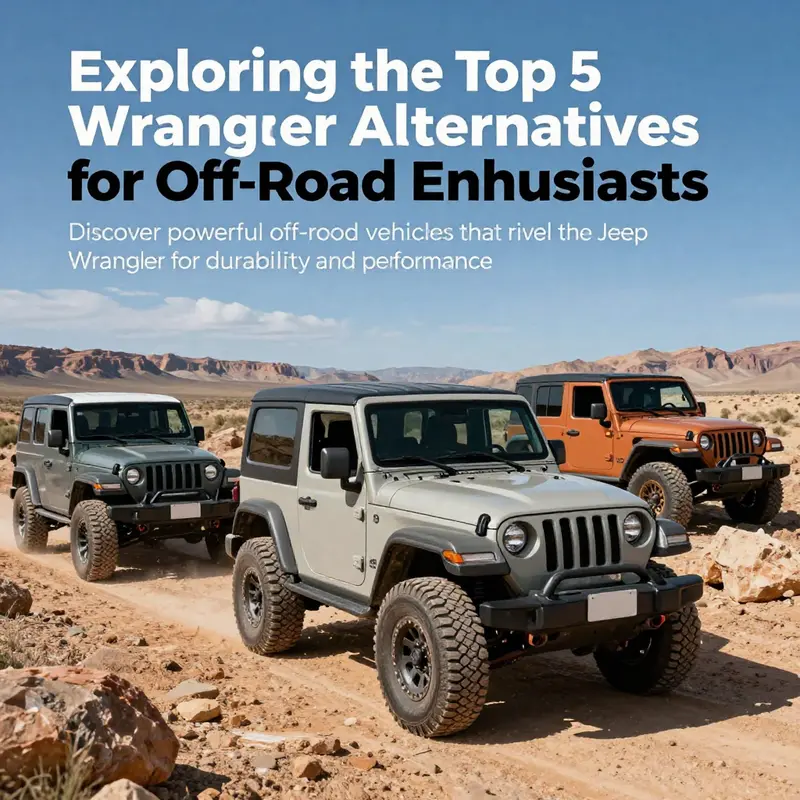
For business owners and off-roading aficionados alike, the quest for the perfect vehicle combines rugged capability with reliability and comfort. The Jeep Wrangler has long been the go-to choice for adventurers, but the automotive market has evolved with several exceptional alternatives that promise robust performance in off-road environments. In the following chapters, we will navigate through some of the best options available: from the modern Ford Bronco to the enduring Toyota 4Runner, the hybrid utility of the Jeep Gladiator, the luxurious Land Rover Defender, and the iconic Mercedes-Benz G-Class. Each vehicle brings a unique blend of features and strengths that cater to the varied demands of off-road enthusiasts and business-minded individuals seeking reliable transportation solutions.
Beyond the Wrangler: A Thorough Look at the Top 5 Off-Road Alternatives
The Jeep Wrangler has long been the image most people name when they think of serious off-road capability. Its approachable silhouette, go-anywhere attitude, and modular spirit have shaped a segment. Yet the landscape of capable off-roaders has evolved. A handful of competitors now offer nearly Wrangler-level competence in different flavors, from rugged reliability and utilitarian practicality to luxury-grade refinement and even electric power. This chapter folds those options into one narrative, tracing how each alternative speaks to a different kind of adventure, a different budget, and a different approach to what it means to go off the beaten path.
If the Wrangler is the archetype of open-air exploration, the field that surrounds it is a spectrum. On one end are vehicles that emphasize proven mechanicals and steadfast durability, built for decades of rugged use. On the other, there are machines that lean into modern luxury, or push the envelope with electrification, all while maintaining serious off-road chops. The purpose of considering these top five is not merely to pick a new badge to chase, but to understand how each vehicle reframes the off-road equation: how it handles trails, how it tows or carries gear, how it behaves on pavement, and what kind of ownership experience it offers day in and day out. In this context, the five alternatives profiled here demonstrate a range of philosophies, from the dependable, high-mileage workhorse to the high-tech, high-cost statement piece.
The first of the five embodies the convergence of modern power and traditional reliability. The 2026 Toyota 4Runner slots into the conversation as a premier alternative for buyers who prize predictable performance and long-term value. Its new 2.4-liter turbocharged engine feeds 278 horsepower and 317 pound-feet of torque through an eight-speed automatic, with power primarily routed to the rear wheels in standard configurations. This setup brings a balance between brisk daily drivability and confident low-end torque for trail climbs. The 4Runner’s chassis embraces a rear-locking differential, an attribute that can be decisive when traction is thin and rock steps or muddy ruts demand every ounce of grip. Its suspension relies on a traditional, proven arrangement with both front and rear axles solidly mounted, providing the tactile feedback and robustness that serious off-roaders expect. Yet the 4Runner does not ignore comfort. Independent front and rear suspension with stabilizer bars offer a smoother ride on rough pavement than many rugged rock crawlers. The payload of capability extends beyond off-road performance: a standard towing capacity of 6,000 pounds makes family trips or expedition builds more feasible, expanding the vehicle’s role beyond weekend trail duty. Reliability remains a defining virtue; JD Power’s dependability metrics consistently place the 4Runner in the high eights, signaling a vehicle whose owners expect fewer trips to the shop and more miles on the odometer. In a market where durability translates to real-life value, the 4Runner’s combination of enduring build quality and practical powertrain makes it a compelling Wrangler alternative for those who want a trusted companion for long journeys and demanding backcountry work.
The next vehicle brings a different flavor of open-air capability while preserving the Wrangler’s spirit of rugged versatility. The 2026 Jeep Gladiator, a pickup that carries the Wrangler DNA into a practical cargo bed, is an ideal choice for adventurers who need true utility without sacrificing capability. Its powertrain aligns with the familiar, offering a robust 3.6-liter V6 engine that delivers 285 horsepower and 260 pound-feet of torque, paired with an eight-speed automatic and full-time four-wheel drive. Heavy-duty underpinnings keep the Gladiator sturdy in rough terrain, with Dana solid axles front and rear and a steel frame contributing to a rock-solid platform. The suspension employs a double-wishbone front and trailing-arm rear layout, designed to provide a balance between articulation in the dirt and a stable, composed ride on the highway. The Gladiator’s distinguishing feature is the bed: a versatile space that can be sealed or opened to the elements, a feature that invites rugging up a weekend of gear, bikes, or kayaks without needing a trailer. Towing capacity stands at 4,500 pounds, which, while not class-leading, is more than adequate for most outdoor-focused workflows. Removable roof panels and doors, plus the fold-down windshield option, preserve the true open-air experience that outdoor enthusiasts crave. The Gladiator rivals the Wrangler not just on capability, but on the ethos of adventure itself—a vehicle that invites owners to return to a freer, more car-like way of living with a practical twist on the classic Jeep formula.
Beyond the brand siblings and the open-air heritage, a new breed of super-capable machines pushes the envelope on raw performance. The Ford Bronco Raptor enters this conversation with one mission: to redefine what extreme off-road performance looks like in a production vehicle. It sits at a higher end of the spectrum in terms of capability and price, yet it is a statement of engineering intent that cannot be ignored. With a 3.0-liter twin-turbo V6 delivering 418 horsepower and 460 pound-feet of torque, the Raptor channels power through a 10-speed automatic and a four-wheel-drive system designed for confident rock crawling and desert speed alike. The suspension is purpose-built for extreme travel, featuring Fox Racing shocks and heavy-duty springs that enhance articulation and stability over challenging terrain. The Raptor’s driving modes—such as Baja and Rock—tune throttle response, gearing, and suspension behavior to suit dynamic off-road conditions, enabling a more aggressive, ready-for-anything approach. A notable caveat is price: the Raptor sits at a premium level, reflecting its focus on high-performance off-roading rather than budget-conscious, all-purpose utility. Nevertheless, for enthusiasts who equate off-road prowess with adrenaline-fueled capability, the Bronco Raptor is a benchmark. It challenges other brass tacks of the segment by proving that a modern, capable off-road vehicle can also be a legitimate performance machine on the trail, a hint of what the category is capable of when freed from conventional constraints.
If performance and raw speed are not the sole determinants, another contender blends capability with a distinct sense of refinement. The 2026 Land Rover Defender—specifically the long wheelbase variant—embodies the luxury off-roader archetype without surrendering grip on the trail. Its ground clearance reaches 12 inches with air suspension, allowing it to negotiate rough surfaces and steep approaches with ease. Under the hood, buyers have a choice of effective engines, including a 3.0-liter supercharged inline-six capable of around 395 horsepower, paired with an eight-speed transmission that feels effortless across the speed spectrum. The Defender’s Terrain Response 2 system is a core feature, enabling five selectable modes—Grass/Gravel/Sand, Mud/Ruts, Snow, Rock Crawl, and Custom—to optimize throttle, traction, and stability control across varying environments. The Defender’s appeal lies not only in its performance but in its interior: a cabin that blends luxury with tactile durability, materials that can withstand family wear and off-road scrapes, and technology that quietly supports drivers on expedition routes. The long-wheelbase version emphasizes passenger comfort and cargo space, making it a compelling option for families who want a capable off-roader that can also serve as a refined daily driver. The price, while higher than the Wrangler’s typical entry, reflects the Defender’s blend of capability and luxury—the kind of vehicle that invites longer, more ambitious journeys with a dose of understated elegance.
Rounding out the field is a vehicle that signals a future-focused direction for off-road capability. The GMC Hummer EV Edition 1 represents the electric frontier in a category built on torque, grip, and go-anywhere confidence. With three electric motors delivering a colossal 1,000 horsepower and more than 10,000 pound-feet of torque, it delivers astonishing acceleration and remarkable low-end pull. Its ground clearance tops many rivals at 16 inches, aided by an adaptive air suspension that maintains ride height across terrain. A standout feature is the Crab Walk, which allows the rear wheels to steer in the opposite direction to the front, enabling tight maneuvers in confined spaces—a useful trick when negotiating rock gardens or climbing boulder-strewn trails. The Hummer EV rides on a dedicated electric platform, and its 37-inch tires underpin a willingness to tackle seriously rugged conditions. The Edition 1, as the name implies, comes with a premium price that reflects its niche appeal and advanced technology, but it marks an important milestone in the way off-road performance can be achieved—through electric power, sophisticated software, and a bold design language.
Together, these five vehicles illustrate a broad spectrum of what it means to pursue off-road adventure today. The Toyota 4Runner offers a high-mileage, resilient platform with practical towing and a reputation for longevity. The Gladiator preserves the Wrangler’s open-air identity while adding genuine cargo utility and the comfort of a traditional pickup chassis. The Bronco Raptor pushes the performance envelope with a ready-for-dust-off-road realism that favors speed and muscular capability. The Defender marries rugged capability with luxury, giving a refined operator an enviable blend of comfort and ability. The Hummer EV Edition 1 shows how electrification can redefine what off-road performance looks like, trading pure interior silence and torque for dramatic capability and a new powertrain ethos. Each vehicle speaks to a distinct ownership mindset, and each remains a credible alternative for someone who loves the sense of stepping into something that can conquer terrain with confidence—whether that terrain carries a family, a toolbox, a trailer, or a weekend of unpaved exploration.
For readers who want to broaden the comparison beyond badge familiarity, a broader look at models that resemble the Wrangler’s silhouette or ethos can be informative. A concise overview of cars that look similar to Jeep Wrangler—top alternatives—offers a glimpse into how styling language and functional design cues echo across the segment. You can explore that overview here: Cars That Look Similar to Jeep Wrangler: Top Alternatives.
The landscape of off-road vehicles continues to evolve, and the choices reflect not only the terrain people aim to conquer but also how they want to live with their vehicle. Some buyers will prioritize proven reliability and towing capacity, others will seek the pure thrill of high-speed off-road performance, while a growing segment will be drawn to the future of powertrains and the potential for cleaner, yet equally capable, exploration. The Wrangler remains a touchstone, but the field around it has expanded in ways that invite reconsideration of how we measure readiness for the next excursion. The five alternatives profiled here—each with its own strengths and compromises—provide a compact cross-section of what serious off-roading can look like today. They remind us that capability is not a singular prescription; it is a spectrum that accommodates different dreams of adventure, different daily realities, and different long-term visions of ownership.
External reference for further reading on one of the key powertrains discussed above can be found in industry coverage that reviews the 2026 Toyota 4Runner’s powertrain and chassis dynamics. See the MotorTrend overview for context and comparison: https://www.motortrend.com/cars/2026-toyota-4runner/.
Rugged Rivals on the Trail: A Thorough, No-Nonsense Head-to-Head Between Two Iconic Off-Road Giants

In the canon of modern off-roaders, two iconic platforms sit at opposite ends of a shared purpose: to conquer terrain that tests machinery, nerves, and curiosity in equal measure. They arrive with different backstories, design priorities, and relationships to daily life, yet each promises a certain purity of intent. One embodies a contemporary reinvention of rugged versatility, with modular panels, removable top and doors, and a drive system that rewards experimentation. The other is a time-tested arrangement of steel, axle, and ground-holding confidence—a platform grown with its community and owner-driven evolution. When you place them side by side, you watch two philosophies argue their case through sheet metal, suspension travel, gearing, and the way a vehicle behaves as the trail narrows to a rock face or mud trench. The result isn’t simply a winner and a loser; it’s a conversation about how people want to approach off-road adventure in the 21st century, and it helps explain why the broader field of top-tier off-road platforms remains dynamic and diverse.
To begin, the two vehicles straddle the line between factory intention and field-ready customization in markedly different ways. The modern, modular platform speaks the language of the current era: a body designed to be removed or reconfigured, a chassis that tolerates aggressive suspension tuning, and a feature set that leans into electronic traction management and adaptable driving modes. In practice, this means a four-wheel-drive system that can be tuned for gritty crawls, steep ascents, or slick surfaces, with low-range gearing and the option for electronic differentials that can be locked when the going gets stubborn. It’s the kind of package that makes the operator feel empowered, as if the vehicle is a collaborative partner on the trail, ready to morph into a precise tool for the task at hand. The emphasis here is not simply raw capability but a curated blend of capability and interface—the sense that you can dial in the level of assist or restraint you want, depending on whether you’re negotiating a boulder field, carving through sand dunes, or cruising back to pavement after a long day’s run.
The other platform is the archetype of endurance and cultural resonance. Its geometry and engineering refuse to over-promise the impossible while still delivering on the basic truth of off-road capability: impede the wheel that’s slipping, maximize the grip of the wheel that’s bearing load, and keep the tires in contact with the ground as much as possible. This is achieved through a robust, traditional layout—one that has become a canvas for decades of owner-driven upgrades, from engine swaps to suspension swaps, from underbody protection to bumper-mounted winches. The chassis remains fundamentally sturdy and forgiving in the ways that matter on the trail. The ride is often incrementally tool-like rather than polished for comfort; it embraces a degree of ruggedness that many enthusiasts actually seek as a form of tactile feedback—trust earned through rough roads, deep ruts, and long, slow ascents instead of a quiet, polished highway ride.
In performance terms, each platform exhibits strengths that align with distinct styles of exploration. The modern, modular option often shines in on-road contexts and in situations where the driver wants a high degree of certainty under a wider range of conditions. Its design supports a more comfortable daily driver experience, even as its off-road credentials are reinforced by a suite of electronically aided confidence systems. When the trail grows steep, or the surface becomes unpredictable, the vehicle draws on precise control over torque distribution and wheel-speed management that feels almost surgical in execution. The emphasis is on predictable, repeatable performance and a sense that the machine is an adaptable tool—able to be tuned for the particular event of the day, whether that’s a gnarly rock garden, a muddy hillside, or a distant backroad detour.
The classic platform, by contrast, is defined by a raw, unfiltered relation to terrain. It communicates through mechanical cadence: a deep-gear crawl, a whine of the transfer case, a feeling of the drivetrain working as a single unit to keep the vehicle balanced on a precarious line. Its reliability comes from a legacy of proven components, and its strength lies in the capacity for owner-driven evolution. This is where enthusiasts spend weekends counting the miles of trail and the hours of tinkering, turning the vehicle into a personal instrument for adventure. It’s not that the modern platform can’t be upgraded; it’s that the upgrades tend to start from a place of high-end electronic integration and a perception of future-proofing. The traditional machine begins with a test of grit and stamina and then becomes a laboratory for experimentation, often drawing on generations of community knowledge to tackle every new obstacle.
The two machines also approach steering, articulation, and ground clearance with complementary, if contrasting, philosophies. The modern variant generally features a more aggressive overall stance, thanks to a suspension design that prioritizes both travel and refined on-road behavior. It is aimed at enabling the operator to approach rough sections with confidence, knowing that the system can adapt through its electronic nerves to maintain momentum. The classic platform leans into a geometry that favors steady, deliberate pacing and the ability for the driver to read the terrain with the body and the hands. It relies on mechanical linkages and a direct relationship between throttle input and wheel behavior, which many experienced off-roaders equate with a clearer sense of control in precarious situations. In this sense, the competition reveals two routes to the same destination: one route through advanced integration and modularity, the other through tested, proven mechanics with a community-backed ecosystem of parts and knowledge.
Price and ownership experience enter the discussion as well, and here the contrast remains instructive. The modern platform tends to bundle more standard equipment into the base price, reflecting the market’s expectation that buyers will demand a high level of equipment and convenience even in a vehicle designed for unpaved immersion. You are buying into a system that can offer immediate capabilities—traction management, configurable drive modes, and a roster of on-pavement comforts—that can reduce the perceived cost of admission for someone who wants a one-vehicle solution. Yet this can also translate into a higher upfront price and potentially higher running costs, should one choose to keep the electronics and sophistication engaged, or to replace components as software updates migrate or hardware ages.
The traditional platform speaks a different language on price. Its value proposition is less about the latest gadgetry and more about longevity, ease of maintenance, and the possibility of substantial, hands-on upgrades that might reduce incremental ownership costs over time. While stock equipment remains capable, the true value often arrives when owners engage with the vehicle as a platform for experimentation—engine swaps, suspension upgrades, protective armor, studded tires in winter, and rock sliders that arrive before the trail does. The maintenance rhythm tends to be straightforward, with a culture that prizes resourcefulness and a long-standing network of specialists who can keep the vehicle performing in backcountry settings. In the end, choosing between these two approaches is less about which is superior and more about which philosophy aligns with the owner’s ambitions, time horizon, and willingness to engage with the vehicle as a living project.
As the discussion narrows to practical reality, the question often boils down to how each platform handles the day-to-day as well as the dream day on the trail. If you value a more urban-friendly companion that can turn on a dime for highway commutes, handle a long weekend trip with a comfortable interior, and provide a degree of programmable versatility that makes it feel like a modern tool chest, the contemporary platform has a compelling appeal. It invites owners to push the envelope with a blend of precision engineering and digital assistance that reduces the guesswork in demanding conditions. It also points to a broader ecosystem of accessories and optimization options, meaning that the vehicle remains a dynamic project long after the first few trail runs.
If, however, your heart beats fastest at the thought of patching together a rugged machine with a story, a slate of proven components, and a thriving culture of do-it-yourself improvement, the traditional platform offers a different kind of thrill. Its capability isn’t just in what comes from the factory; it’s in what the owner can extract from it through patience, skill, and a willingness to tailor the vehicle to a specific set of terrains. Within this frame, the two platforms don’t simply compete for the same customers; they expand the conversation about how to approach off-road exploration. They illustrate the broad spectrum of possibilities that the top-tier market is willing to entertain, from the most modern, digitally integrated alternative to the most classic, mechanically intimate edition.
The overall takeaway from this head-to-head is nuanced. Neither vehicle claims an absolute, one-size-fits-all advantage. Each excels in different chapters of the same story. For a reader who is weighing the next step in an off-road journey, the decision depends on the kind of trail that calls most loudly, the nature of the owner’s daily life, and the extent to which time and budget are available for experimentation and customization. The modern, modular platform is a bastion of ready-to-go capability wrapped in a high-tech shell, ideal for a driver who imagines a daily drive that doubles as a staging ground for serious trail work. The traditional platform remains a living instrument of adventure, a vehicle that invites the owner to become a participant in its ongoing evolution and to anchor a tradition that has grown with the sport itself.
In the broader context of top off-road contenders, this head-to-head highlights why the field remains vibrant. Each platform speaks to a distinct audience, yet both recognize that the trail is a great equalizer—an arena where clever engineering, tenacity, and a willingness to learn unlock the most satisfying experiences behind the wheel. For readers eager to survey the wider spectrum, remember that other capable alternatives blend luxury and ruggedness in their own ways, offering additional routes to the same end: meaningful, authentic off-road exploration that challenges both vehicle and driver. If you’re seeking a one-vehicle solution that still honors the spirit of true exploration, this comparison provides a pragmatic map of where the modern era’s two strongest contenders align and diverge, helping you weigh what matters most when you roll out toward the next rugged horizon.
For readers who want to explore further context around how manufacturers are evolving these platforms and what recent performance-oriented variants bring to the table, a recent industry note highlights how a high-performance interpretation of the modern model line is positioned to broaden its appeal without sacrificing off-road integrity. This piece underscores the ongoing push to balance on-road civility with trail-ready capability, reminding us that the best off-road vehicles aren’t simply about raw torque or ground clearance—they are about how well a vehicle can be incorporated into a lifestyle and a community that values both competence on the rocks and confidence on a daily commute.
Internal reading and cross-links sit naturally in this landscape as readers map the terrain with their own priorities. To connect with broader context on how these platforms sit within the larger ecosystem of off-road vehicles, you can browse a central hub of practical, user-focused insights in the Vehicle Tricks blog; it offers a starting point for readers who want to compare different families of off-roaders and understand how owners optimize their rigs in real-world conditions. See Vehicle Tricks hub: https://vehicletricks.com/blog/vehicle-tricks/.
External to this piece, industry observers have noted a recent shift toward variants that combine lighter weight engineering with aggressive suspension tuning and aerodynamics to maximize travel while preserving a manageable on-road experience. This trend reflects a broader market movement toward modularity and performance-focused versatility, and it helps explain why the conversation around these iconic platforms remains lively. A recent CNBC report illustrates how a manufacturer is expanding the capability envelope for its modern off-road platform through a lighter-weight configuration that emphasizes agility and durability in extreme environments. The report underscores that even in a world of advanced electronic management, the core appeal of off-road driving still hinges on a direct connection between driver input, chassis feedback, and terrain beneath the wheels. See external context: https://www.cnbc.com/2026/01/14/ford-bronco-rtr-model-launch.html
Evaluating Durability: The Toyota 4Runner’s Off-Road Performance as a Jeep Wrangler Alternative

Durability in an off-road context is rarely glamorous. It tends to reveal itself in quiet, repeated demonstrations of resilience: components that hold up after years of neglect or neglectful years of hard driving, and a chassis that keeps its shape even when the trail gnaws at the underbody. In this light, the 2026 iteration of the 4Runner TRD Off-Road stands out as a compelling Wrangler alternative, not merely because it can tackle rough terrain but because its core architecture is designed to endure the twists and stresses of a life spent on rock, mud, and open highway. The vehicle is anchored by a truck-based, body-on-frame ethos, but it travels with a modern sensibility thanks to Toyota’s TNGA-F global platform. This platform brings improved structural rigidity and refined on-road manners without surrendering core off-road capability. The result is a vehicle that feels prepared for decades of use, a quality that matters even more when the buying decision hinges on long-term ownership as much as immediate capability.
At the heart of any durability argument is power delivery, and the 4Runner’s 2026 model year TRD Off-Road variant electrifies that narrative with a robust hybrid punch. The 2.4T i-FORCE MAX hybrid powertrain delivers 326 horsepower and a formidable 630 N·m of torque. That torque is not merely a headline figure; it arrives with steady, linear breading, courtesy of a smooth eight-speed automatic transmission that integrates electric motor assistance. The overall effect is a power curve that avoids the stumbles and “lurch” that can interrupt slow, technical progress on rock faces or steep approaches. When the going gets gnarly, that combination translates into confident, controlled momentum, enabling careful wheel placement and deliberate testing of traction without sudden surges that can unsettle both driver and vehicle. In this regard, the 4Runner borrows a page from hybrid design philosophy: keep the torque available where you need it, not just at the peak, and you gain a working ally in stability at low speeds on uneven surfaces.
A durability narrative is incomplete without a look at the drivetrain’s grip on traction across surfaces that vary in grip, incline, and challenge. The 4Runner TRD Off-Road arrives equipped with a standard full-time four-wheel-drive system and selectable locking differentials on higher trims, giving the operator a toolbox that grows more capable as the trail dictates. The combination of a rigid body-on-frame architecture and a solid rear axle means the vehicle can articulate with the terrain in a predictable way, a crucial factor when wheel travel matters more than cornering speed. The suspension setup complements this dynamic; Bilstein shocks in the TRD Off-Road funnel a measured balance between off-road travel and on-road compliance, keeping the ride controlled over rough terrain while preserving enough on-road composure for daily driving. The presence of a disconnectable front stabilizer bar further enhances articulation, enabling the wheels to follow the contour of a rock or rut with less resistance. This is not just about grip; it is about predictability when you are perched on the edge of a trail and need to read the surface beneath the tire.
There is a further layer to durability that extends beyond raw power and suspension geometry. The Trail-oriented variants of the 4Runner, including the Trailhunter trim, come with factory equipment that signals the brand’s long-standing readiness for the most punishing trails. A tire package that includes 33-inch all-terrain tires, reinforced skid plates, and a high-lift snorkel speaks to a philosophy: protect the vital underbody elements, allow the vehicle to skim through shallow water without inviting inevitable water intrusion, and give the driver enough tire footprint to maintain traction when literal footing becomes uncertain. The Trailhunter’s intended use-case is explicit—it’s built to keep moving where a standard SUV might hesitate. Skid plates shield the engine, transmission, and transfer case from jagged rocks, while the snorkel ensures that the intake singes through deep fording without ingesting muddy, debris-filled air. In combination, these features create a durable platform capable of withstanding repeated exposure to off-road abuse without sacrificing the everyday practicality that underpins long-term ownership.
The Toyota 4Runner’s durability story is also anchored in its on-road manners, an edge it often claims over workhorse platforms that prioritize off-roadism at the expense of long-range highway comfort. The TNGA-F platform contributes not only to structural stiffness but to a calmer NVH profile during highway cruising. Even when the trail ends and the road resumes, this SUV tends to exhibit steadier steering response, more precise tracking, and a steadier ride, which reduces fatigue on long desert crossings or multi-hour treks through remote landscapes. The blend of a rugged frame with refined highway behavior translates into a vehicle that remains trustworthy for daily commuting, family trips, and weekend expeditions—all essential to durability in the real world. In practice, this means a vehicle that does not demand compromise every time it shifts from woodsy paths to asphalt ribbons; it can shoulder both roles with competence.
The durability narrative would be incomplete without paying homage to Toyota’s reputation for longevity. The 4Runner is not merely a collection of components that survive rough use; it is a system designed to endure. This is a vehicle that, in broad terms, invites high-mileage ownership with the expectation that maintenance will be straightforward and parts supply robust. In a market where off-road credibility often comes paired with rising ownership costs, the 4Runner presents a counterpoint: a vehicle whose engineering decisions are deeply rooted in long-term ownership realities. The hybrid powertrain, while efficient and strong, does not compromise the vehicle’s core identity as a rugged, capable mount; rather, it enhances it by reducing fuel consumption on long highway stretches, which, in turn, lowers the cost of ownership over time and reduces heat buildup and wear during extended drives. This is an important distinction for buyers who plan to log tens of thousands of miles across varied terrain.
From a practical standpoint, the durability story is reinforced by the vehicle’s layout and servicing realities. The body-on-frame construction, though heavier than unibody alternatives, is the traditional architecture for vehicles expected to confront the elements, the mud, the dust, and the occasional salt-lored road. In the context of the Wrangler alternative landscape, the 4Runner’s approach is more than nostalgia; it is a deliberate decision to lean into proven, repair-friendly engineering. This is particularly relevant to buyers who prioritize decades of use over the latest, flashiest features. The engineering choice aligns with the idea that a vehicle’s true value lies not in a single exhilarating moment on a trail but in the ongoing ability to perform, to be reliable, and to remain adaptable as the owner’s needs evolve.
The discussion would be incomplete without acknowledging how this durability narrative translates into ownership experiences. A core aspect is predictability. In off-road environments, unpredictable events are the norm, and a durable platform provides the kind of predictability that reduces risk. The 4Runner’s gearing, its torque curve, and its suspension geometry work together to give the driver a sense of control, even when the surface beneath the tire changes abruptly. The driver’s relationship with a vehicle that communicates traction status and load-bearing feedback clearly tends to be more confident, and confidence is a significant factor in successful off-road navigation. This is the essence of durability expressed in tactile terms: the vehicle feels like a reliable partner, one that won’t break at the moment when you most need it.
The broader context of Wrangler alternatives benefits from recognizing that durability is not a single metric but a synthesis of platform architecture, powertrain resilience, suspension capability, and the quality of underbody protection. The 4Runner’s answer to that synthesis is a vehicle designed for long, adventurous lives, with a balance of performance and refinement that makes it a credible alternative for those who prize reliability as highly as raw off-road prowess. In the end, the 4Runner’s durability story is about decades of meaningful use: a vehicle that can be trusted to carry families into remote landscapes, to handle challenging trails without demanding punitive maintenance, and to remain a given in a landscape crowded with options, yet distinct in its approach to toughness.
For readers who want to explore the broader class of Wrangler-like vehicles while staying focused on durability and the practicalities of ownership, there is value in understanding how these machines compare. A useful way to frame the conversation is to recognize that one can gauge a vehicle’s off-road mettle not just by how far it can crawl on a single day, but by how it behaves after years of repeated exposure to the elements. In this sense, the 4Runner TRD Off-Road, with its hybrid powertrain, full-time four-wheel drive, and a proven, body-on-frame chassis, offers a durability narrative that resonates with buyers seeking a long-lasting, capable, and refined companion for both exploration and daily life.
As a point of reference within the Wrangler-alternative landscape, it is instructive to consider how other rugged icons address the same durability questions. The focus here is not on recreating Wrangler’s open-air ethos or its modularity, but on presenting a case for longevity, reliability, and steady capability that stands the test of time. If you are drawn to a vehicle that remains calm on the highway yet unfazed by the most challenging terrain, if you value a well-documented track record of durable performance, and if you want a platform that feels designed for decades rather than seasons, the 4Runner’s durable design deserves serious consideration. To readers who want to situate this model within the broader catalog of Wrangler-inspired options, a helpful resource that speaks to the visual and functional family likeness across this segment can be found here: Cars that look similar to Jeep Wrangler: Top Alternatives.
In closing, durability in the modern off-road market is about more than terrain mastery. It is about the confidence to point the vehicle into the unknown and know that the vehicle will be there when you return, ready for the next leg of the journey. The 4Runner TRD Off-Road embodies that ethos through a blend of rugged architecture, refined power delivery, and trail-ready capability that speaks to a long-term ownership experience. It is not merely a fallback option; it is a thoughtfully engineered alternative that aligns with a distinct philosophy of off-road life—one that values dependability as much as adventure. For buyers who want a vehicle that can survive the rigors of real-world use while still delivering compelling daily comfort, the 4Runner’s durability narrative remains a persuasive argument in its favor.
External reference: https://www.caranddriver.com/toyota/4runner/reviews/a41756379/2026-toyota-4runner-trd-off-road-review/
Luxury in the Rough: The Defender as Wrangler’s Companion in the Modern Off-Road Landscape

The off-road world has long celebrated two poles of its spectrum: the bare-bones, go-anywhere ethos that prizes simplicity and durability, and the more refined, comfort-oriented approach that blends capability with luxury. In this landscape, a certain British premium SUV has carved out a distinctive position as the Wrangler’s sophisticated counterpart. It is a vehicle that can descend into desert dunes or icy backcountry with the same assured footing it brings to city streets, yet it does so with an interior that would not feel out of place in a high-end lounge. This is not a replacement for the Wrangler, but a complementary choice for drivers who want to blend rugged endurance with a measured touch of luxury. The Defender’s design language—its iconic boxy silhouette, its durable chassis, and its interior that speaks to comfort as a driver’s priority—embodies a different philosophy of off-roading. It is the embodiment of the claim that you can have both capability and refinement in one machine, and in doing so it expands the conversation about what a modern off-roader can be.
At first glance, the Defender’s stance is immediately legible. The boxy profile, high beltline, and generous ground clearance announce purpose before you even press a button. But unlike some utilitarian companions that lean hard into function at the expense of comfort, the Defender marries toughness with thoughtful detailing. The latest generations—especially the Defender 90 and 110 variants—present premium materials, refined textures, and a suite of modern technologies that elevate everyday driving. Leather seating, wood and metal trim, and an exceptionally quiet cabin underscore a core argument: you don’t have to choose between comfort and capability when you’re navigating both a rocky trail and a congested urban corridor.
The Defender’s capability is no mere marketing flourish. Its 900 millimeter wading depth and standard four-wheel-drive system place it in the same realm of off-road competence as the Wrangler, even if the paths to success diver in tone and approach. The terrain-management systems, coupled with robust chassis engineering, give the Defender an edge in stability on loose surfaces, rock approaches, and mud. And there is a tangible sense of readiness that comes from a vehicle built around a rigorous chassis and a long-standing tradition of engineering that prioritizes endurance. For drivers who want to venture into remote environments with the confidence of a well-prepared platform, the Defender delivers that assurance without forcing them to abandon civility on the daily commute.
Inside, the Defender conveys luxury more through restraint than ostentation. Premium leather, carefully chosen wood trim, and a contemporary multimedia interface come standard, yet the cabin remains practical. There is ample space for passengers in both the 90 and 110 configurations, and cargo areas flex with the needs of a weekend explorer or a family crossing a country mile. The ride is refined enough to turn long highway stints into a tolerable, almost comforting experience, while the off-road chassis and damping remain attuned to uneven surfaces—imbuing confidence when the surface turns uncertain. This balance—rugged intent with interior polish—speaks to a modern consumer who seeks both adventure and comfort without feeling as if they have to compromise one for the other.
The Defender’s reputation has been reinforced by bold moves within the brand’s performance and endurance narrative. The Dakar Rally Defender, developed by Special Vehicle Operations, stands as a showcase of how far the Defender lineage has traveled—from a simple workhorse to a purpose-built endurance machine capable of withstanding some of the world’s most punishing environments. While the production Defender keeps its feet on a daily-driver reality, the Dakar-inspired variant underscores a core truth: British engineering can fuse high-speed endurance with the same off-road tenacity that turned a postwar utility into an icon. This crossover of ideals—long-distance rally performance and everyday usability—highlights the Defender as more than a luxury badge. It is a deliberate engineering choice for drivers who want terrain mastery as a standard, not a premium add-on.
Against this backdrop, the Wrangler’s appeal remains anchored in its own distinctive strengths. The Wrangler embodies a purist’s approach to off-roading, where function often trumps refinement, and where the thrill of removal of doors and roof remains a central narrative. It is a vehicle designed to be played with, to be customized, and to feel intimately connected to the trail in a way that is almost ritualistic. The Wrangler’s ethos is about simplicity of mechanicals, accessibility of open-air experiences, and a straightforward path from road to trail that many enthusiasts find indispensable. Yet there is a growing audience that desires a vehicle capable of shouldering long-haul adventures with the same ease they approach a weekend dirt track. The Defender speaks to that audience by offering a more polished, more refined way to pursue the same core objective: go places others can only imagine.
This dynamic helps explain why the Defender is frequently positioned as the Wrangler’s sophisticated counterpart rather than as a competitor in a narrow sense. Both vehicles share a spirit—done right, capable, and built to endure. They diverge in the details that shape daily life. The Defender’s interior comfort, cargo flexibility, and advanced infotainment are design choices that reduce the friction of long trips, letting the driver focus on the journey rather than the discomfort of the passenger cabin. The Wrangler’s value proposition, by contrast, rests on its direct mechanical simplicity and its almost sacramental ability to shed unnecessary barriers to off-road entry. The two vehicles thus offer complementary paths into the same territory: one softens the edges without surrendering core capability, while the other strips back the niceties to celebrate the bare essentials of trail mastery.
Another layer to consider is how each vehicle translates off-road prowess into everyday practicality. On pavement, the Defender tends to deliver a composed ride that speaks to its luxury credentials. The suspension, insulation, and chassis tuning minimize road vibrations and wind noise, creating an environment that feels more like a premium SUV than a dedicated rock crawler. The result is a vehicle that doesn’t shout about its capabilities at every stoplight; instead, it demonstrates them with quiet competence, inviting drivers to take longer routes and enjoy the scenery without sacrificing comfort. In contrast, the Wrangler foregrounds accessibility and hands-on engagement. Its approach angles, removable components, and modular ethos are a living reminder that off-roading is not just about the destination but about the ritual of preparation, the anticipation of challenge, and the joy of returning with stories to tell. Both vehicles reward curiosity, but they do so through different pathways—one through polish and serenity, the other through rugged, unfiltered participation.
For readers weighing the Defender against the Wrangler, a practical lens helps. If your schedule alternates between city missions and a weekend escape into rough terrain, the Defender’s blend of interior luxury and steadfast off-road ability makes sense. It offers comfort for long drives, sophisticated technology for secure journeys, and the confidence of a proven, capable platform when the weather turns wild. If your core joy is a trail-first, hands-on experience, the Wrangler remains an unmatched companion. Its removable doors and roof, its straightforward mechanicals, and its community-driven culture invite a different kind of ownership—one where exploration is both a function and a hobby. The Defender complements that dynamic by widening the scope of what a modern off-roader can be, without forcing a choice between comfort and capability.
For readers who want to explore the broader landscape of Wrangler alternatives—vehicles that blend rugged styling with modern capability—there is a spectrum to consider. Some drivers are drawn to models that echo the Wrangler’s silhouette or lifestyle appeal, seeking a familiar aesthetic with upgraded technology and refined interiors. Others pursue more specialized configurations that emphasize long-distance capability, luxury, or unique performance credentials. To better visualize this spectrum, consider a resource that surveys vehicles sharing a Wrangler-like look and feel, offering a quick guide to options that align with the same adventurous temperament. It provides a grounded way to compare shape, feel, and approach to off-road travel, while keeping the focus on practical usability and long-term ownership. cars that look similar to Jeep Wrangler—top alternatives. This reference can help contextualize how the Defender fits among peers that seed the market with bold design and capable platforms.
Beyond design and drivetrain, the Defender’s narrative intersects with broader themes in the off-road space: heritage, luxury, and the evolving expectations of the modern SUV buyer. Heritage matters because it anchors trust. The Defender’s lineage—rooted in a postwar utility vehicle with a reputation for endurance—gives it a credibility that resonates with drivers who want a vehicle that can be counted on in extreme conditions. Luxury matters because daily life is not on hold when the street lights switch on. The Defender’s refined interior, intuitive tech, and comfortable ride ensure that owners can live with their vehicle every day and still feel ready for adventure when the moment calls. And evolving expectations matter because today’s buyers want a vehicle that can handle tough terrain while also supporting a productive, connected lifestyle. The Defender, in this sense, embodies a strategic response to those expectations: a robust, adaptable platform that can occupy multiple roles without losing its core identity.
This is not to imply that one vehicle is superior to the other in every sense. Rather, it highlights a thoughtful division of labor within the off-road segment. The Wrangler remains the archetype for accessible, trail-first exploration that invites customization and direct, tactile involvement. The Defender offers an elevated experience for those who want to pair off-road tenacity with luxury, refinement, and a more cosmopolitan daily life. Together, they broaden the promise of what off-roading can be, inviting a wider audience to participate in the adventure without sacrificing comfort or practicality. For readers navigating the decision, the key is to map personal priorities: Is the appeal of the trail the ultimate experience, or is the trail just one part of a broader lifestyle that includes long drives, family responsibilities, and a taste for premium interiors?
External resource: For a deeper look into Defender engineering and design philosophy, see the official Defender page. https://www.landrover.com/defender
Final thoughts
In evaluating the myriad of off-road vehicles available, business owners and off-road enthusiasts can transcend the constraints of traditional choices like the Jeep Wrangler. Each of the alternatives highlighted demonstrates distinct advantages, whether through modern technology, durability, or luxury. From the sporty Ford Bronco to the reliable Toyota 4Runner, the innovative Jeep Gladiator, the opulent Land Rover Defender, and the stately Mercedes-Benz G-Class, each encompasses a unique appeal. In choosing an alternative, consider how these vehicles meet your specific off-road needs, business aspirations, and lifestyle demands—ensuring that your journey off the beaten path begins with the right wheels under you.