
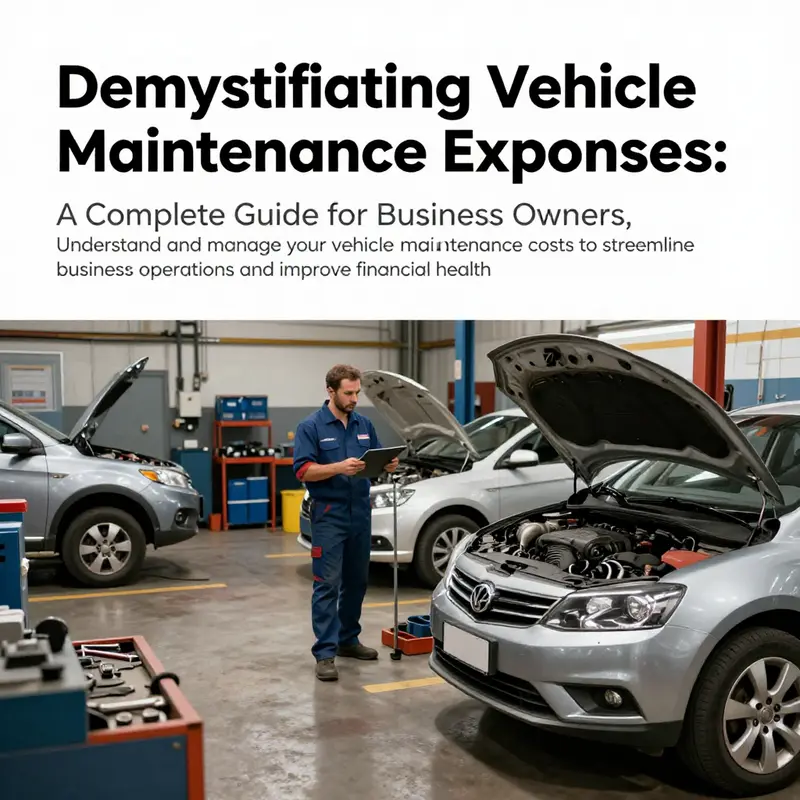
Vehicle maintenance expenses are crucial for any business reliant on transportation. Understanding how these costs are classified, their impact on financial statements, and their tax implications can significantly affect your bottom line. This guide breaks down pertinent aspects of vehicle maintenance expenses, ensuring every business owner is equipped to manage these costs effectively. In the chapters ahead, we’ll explore the nature of these expenses, their classification, their effects on financial health, tax impacts, and best practices for recording them accurately in your accounting system. Mastery over these elements will not only facilitate smoother operations but also enhance overall financial reporting and compliance.
Steering the Ledger: Understanding Vehicle Maintenance Expenses in Accounting

Vehicle fleets sit at the intersection of operations and finance. Every oil change, tire rotation, brake service, or diagnostic check is more than a technician’s appointment. It is a cash outflow that, when read through the language of accounting, becomes a precise data point on the income statement and the balance sheet. Vehicle maintenance expenses are the costs businesses incur to keep their vehicles in safe, reliable condition and ready to perform the tasks they were hired to do. They are typically treated as operating expenses, or period costs, since they do not add long-term value to the asset itself in a way that would justify capitalization. This classification matters. It shapes how profits are reported in the period, how budgets are built, and how tax obligations are estimated. In practice, a line item for maintenance helps managers compare day-to-day costs against revenue from deliveries, service calls, or customer trips, revealing whether a fleet is being kept in a cost-effective manner or slipping toward excessive downtime and emergency repairs. The accounting professional translates the cadence of wrench turns and service bills into a coherent narrative about asset upkeep and overall efficiency, ensuring that the numbers reflect reality on the road and in the ledger.
At the core of this translation is the accrual basis of accounting and the matching principle. Under accrual accounting, expenses are recognized in the period when the service is performed, not when payment is made. If a vehicle repair is completed in March but the bill is paid in April, the expense belongs to March’s financial results. This timing ensures that the cost aligns with the revenues the vehicle helped generate in that period, whether it was delivering goods, transporting clients, or supporting field operations. The result is a clearer picture of gross margin and operating income for the month or quarter, which in turn informs decisions about maintenance scheduling, procurement, and fleet utilization. The discipline of recognizing expenses when incurred also guards against artificial swings in profit caused by payment timing.
A practical distinction worth reinforcing is the difference between maintenance and capital improvements. Routine maintenance, such as oil changes, filter replacements, brake pad servicing, and tire rotations, is expensed as incurred. These activities preserve the vehicle’s current operating condition but do not enhance its value, extend its life beyond the original design, or increase its future earning capacity in a meaningful way. By contrast, expenditures that significantly improve performance or prolong the asset’s life—installing a turbocharger, converting a van into a mobile workshop, or replacing a transmission to extend service life—may be capitalized. Such improving costs are capital expenditures and are depreciated over their estimated useful life. The line between maintenance and improvement is not always crystal clear, and it frequently requires judgment, backed by documentation and policy.
Documentation is the backbone of reliable maintenance accounting. Invoices, receipts, and work orders provide the audit trail that supports expense recognition and category classification. Clear documentation helps ensure that maintenance costs are properly coded in the accounting system, that the period of impact is correctly identified, and that any tax deductions are legitimately claimed. A well-kept trail of paperwork also supports internal controls, making it harder for improprieties to slip through and easier to defend in the event of an audit. When a business relies on modern accounting software to manage vehicle expenses, it can set up standardized categories such as “Vehicle Maintenance,” track associated mileage, and generate service reports that feed into budgeting and depreciation planning. In this sense, software acts as a bridge between the shop floor and the financial statements, translating routine upkeep into measurable performance indicators.
The practical implications extend beyond the general ledger. For many organizations, vehicle maintenance costs are a meaningful driver of cash flow. A high cadence of preventive maintenance—oil changes at recommended intervals, tire tread monitoring, and timely brake services—can reduce the probability of major, disruptive failures. Those failures often carry far higher repair costs and longer downtime. Therefore, the maintenance schedule is not just an operating detail; it is a strategic lever. Fleet managers, accountants, and operations leaders must collaborate to balance the cost of frequent servicing against the risk and cost of unexpected breakdowns. This balance can influence a fleet’s total cost of ownership, its reliability metrics, and even its spare-parts inventory policies. The accounting perspective helps quantify these trade-offs in a way that informs capital planning and budgeting cycles, ensuring resources are allocated where they yield the greatest return in uptime and service quality.
From a tax standpoint, maintenance expenses are typically deductible when the vehicle is used for business purposes. The tax treatment often depends on the proportion of business use versus personal use, and it hinges on proper record-keeping that substantiates the business purpose of each expenditure. The IRS emphasizes documentation and the correct classification of expenses; misclassification can lead to either missed deductions or compliance concerns. For a deeper dive into the tax guidance surrounding vehicle-related expenses, see the official IRS resource. In practice, businesses should maintain a contemporaneous log of business miles, purpose of trips, and maintenance incurred, ensuring the narrative on the financial statements mirrors the tax file.
The way a company captures and analyzes maintenance data also has implications for forecasting and budgeting. When maintenance events are tracked alongside mileage and utilization, managers can identify patterns—such as rising costs on a particular vehicle type or a correlation between age and frequency of service. This information supports more accurate budgeting for future periods, facilitating better cash flow planning and more informed procurement decisions. It also underpins KPI reporting, where metrics like maintenance cost per mile or maintenance as a percentage of operating expenses can illuminate efficiency trends over time. The goal is not merely to record what happened, but to understand why it happened and what can be done to optimize it.
For organizations that operate fleets across multiple sites or regions, consistent coding and centralized reporting become even more critical. A shared framework for recognizing and classifying maintenance expenses ensures comparability across locations and periods. It also helps in benchmarking against industry peers and in negotiating with suppliers and service providers, where consolidated data strengthens negotiating power and supports fleet-wide policy development. In the end, the ledger becomes more than a record of outlays; it becomes a reliable dashboard that reflects the health and efficiency of the fleet, guiding day-to-day choices and longer-term strategy alike.
As a practical reminder for practitioners, a simple, well-designed policy can prevent many common misclassifications. Define maintenance as services that preserve current capability, and reserve capitalization for expenditures that clearly extend life or add substantial new value. Require receipts and work orders for every service, and reconcile the maintenance ledger with the miles driven and the period’s revenue activity. Ensure accrual-based recognition by recording expenses when the service occurs, not when the bill is paid. And, where feasible, use automation to tag, categorize, and report maintenance expenses, while keeping a transparent audit trail available for internal review and external compliance needs. To connect this guidance with a concise primer on what constitutes vehicle maintenance, refer to this overview: What is vehicle maintenance.
Ultimately, understanding vehicle maintenance expenses in accounting means recognizing that every service contributes to a smooth, reliable operation. It means following the rules that ensure the financial statements reflect reality as closely as possible, while also respecting the tax framework that governs business deductions. It means building a data-informed culture where maintenance decisions are weighed not just by the immediate bill, but by their impact on uptime, safety, and long-term cost of ownership. In doing so, a business moves toward cleaner, more insightful reporting and toward fleet performance that can be measured, managed, and improved over time. The road to clarity on maintenance costs is paved with careful classification, disciplined documentation, and a steady commitment to aligning operations with the numbers that tell the true story of the fleet. As you continue to explore the broader landscape of accounting for assets, keep in mind that maintenance is the heartbeat of a vehicle’s reliability. It is, in essence, the quiet workhorse behind every revenue-driven journey.
External resource for further guidance: https://www.irs.gov/publications/p463#enUS2023__ch1
The Ledger on the Road: Classifying Vehicle Maintenance Expenses in Accounting

When a business uses vehicles as a core part of its operations, the day-to-day costs of keeping those vehicles reliable must be translated into numbers that sit comfortably on the income statement and balance sheet. In accounting terms, vehicle maintenance expenses are typically treated as operating expenses. They are costs incurred to keep a vehicle in good working condition and to preserve the asset’s current functionality, rather than to create new value or extend the asset’s life beyond its original design. This distinction—maintenance versus capital improvement—drives how the costs are recorded, reported, and ultimately how they affect taxes and budgets. In practice, the line between preservation and enhancement can be subtle, but the accounting rule is clear: maintenance expenses are expensed in the period in which they are incurred, while capital expenditures, which add to the asset’s value or extend its useful life, are capitalized and depreciated over time. This framework aligns with the accrual basis of accounting, where expenses are recognized when incurred rather than when paid, supporting the matching principle that seeks to align costs with the revenues they help generate. As a result, maintenance costs appear on the income statement as they arise, reducing reported profit for the period, even if the cash payment occurs later. For businesses navigating complex software ecosystems like general ledgers, ERP systems, or specialized accounting packages, the precise categorization into a maintenance expense vs. a capital improvement can guide not only financial statements but also tax reporting and budgeting. The underlying logic is straightforward, yet its practical application requires attention to how each cost preserves the asset’s current condition rather than enhancing it beyond its original design. A tire replacement or an oil change, while essential to ongoing operation, does not extend the vehicle’s life beyond what it was designed to be; thus, these are classic maintenance expenses. By contrast, if a company were to install a completely new engine that significantly increases the vehicle’s lifespan, the cost would typically be capitalized as an asset improvement rather than expensed immediately as maintenance. This distinction matters for depreciation schedules, for the timing of expense recognition, and for the clarity of the financial story told by the books.
From a tax and regulatory standpoint, the classification of vehicle maintenance expenses feeds into deductible expenses and affects how costs are treated for both filings and audits. In the United States, for example, the Internal Revenue Service provides guidance on what constitutes ordinary and necessary business expenses related to vehicles, including maintenance, fuel, and related servicing. While many maintenance costs are deductible when the vehicle is used for business purposes, the precise deductibility can depend on the vehicle’s use, ownership structure, and the nature of the expense. In the United Kingdom, HM Revenue & Customs offers its own framework on vehicle allowances and related expenses, which similarly emphasizes the distinction between routine maintenance and capital improvements for tax purposes. When choosing how to reflect these costs in accounting software, many organizations create a dedicated chart of accounts or cost centers that separate Vehicle Maintenance Expense from depreciation, lease payments, and insurance. This separation supports clearer reporting and smoother tax preparation, especially for businesses with fleets that vary by size, usage, and financing arrangements. For readers seeking a broad, consolidated view of maintenance as a concept, a useful starting point is a dedicated explainer on vehicle maintenance, such as a resource that defines what constitutes ongoing maintenance versus upgrades. What is vehicle maintenance.
Understanding the common types of costs that populate the maintenance expense category helps a company maintain consistency and avoid the temptation to reclassify occasional large repairs as capital improvements simply to alter short-term profits. Typical maintenance costs include repairs that fix damage or malfunctions, servicing tasks performed regularly to preserve efficiency, fuel costs, engine oil and lubricants, and routine inspections required by law or policy. Each of these contributes to the vehicle’s ability to operate safely and reliably in the near term, but none, by itself, should be assumed to extend the asset’s life beyond its original specification unless accompanied by a transformative upgrade. Consider the practical implications of this when reviewing statements: a recurring monthly servicing contract will accumulate into a predictable line item that can inform budgeting and variance analysis, while a sudden, substantial overhaul could indicate a shift in the fleet’s replacement strategy or depreciation schedule.
The above distinctions also interact with how organizations plan for replacements and upgrades. Maintenance costs, by their nature, are variable and often semi-regular, reflecting wear, driving conditions, and usage intensity. They are incurred to preserve the asset’s current functionality and do not convert a worn asset into a more valuable or longer-lasting one. In financial reporting terms, these costs reduce current period profits but do not alter the asset’s recorded value on the balance sheet beyond routine impact (for example, routine servicing may rarely affect carrying amounts; a significant repair could influence impairment considerations if it changes the asset’s recoverable amount). Conversely, when a cost qualifies as a capital improvement—such as a major engine replacement or a retrofit that extends useful life—that amount is capitalized as part of the asset’s cost basis. It is then depreciated over the asset’s remaining useful life, spreading the expense over several periods rather than recognizing it all at once. This difference can alter key metrics such as gross margin, operating income, and return on assets. It can also affect capital budgeting decisions, as capitalization reduces near-term expenses but increases depreciation expense in future periods. The challenge for practitioners is to apply consistent criteria, document the rationale, and adjust depreciation schedules when upgrades occur that cross the line from maintenance to improvement.
Beyond the mechanics of classification, the treatment of maintenance expenses has practical implications for day-to-day accounting practices. In many small to mid-sized organizations, maintenance costs are recorded to a dedicated Vehicle Maintenance Expense account, with subcategories or cost centers for repairs, servicing, fuel, oil, and inspections. This granularity supports more accurate budgeting and more insightful variance analysis against the fleet’s operating performance. When a larger repair or replacement is contemplated, due diligence is required to decide whether to classify the cost as a maintenance expense or a capital expenditure. The decision rests on whether the expenditure preserves the asset’s current condition or enhances its future economic benefits beyond what the vehicle originally provided. The decision is not merely semantic; it determines how the cost flows through financial statements, how it affects taxation, and how it informs capital-replacement strategies. In practice, a policy that delineates criteria for capitalization—such as thresholds for individual repair costs, the extent of structural modifications, or the expected impact on useful life—helps organizations maintain consistency across fleet maintenance activities. The policy should also guide documentation: invoices, approval authorizations, and assessments of whether an expenditure preserves or enhances value. When this documentation is robust, the accounting treatment remains clear, auditors can verify the treatment, and management gains clearer insight into fleet economics.
From a budgeting perspective, maintenance costs can be the wildcard that influences cash flow and profitability in surprising ways. They are inherently tied to usage patterns, driving conditions, and the reliability of suppliers and technicians. A fleet that operates in harsh climates or on rough terrain will incur higher maintenance expenditures, and that reality should be reflected in the budgeting model. Forecasts often incorporate a baseline maintenance rate anchored to historical experience, with allowances for periodic spikes due to seasonal demand or unexpected incidents. In this context, the classification discipline serves not only compliance but also strategic foresight. When finance and operations align on which costs belong to maintenance and which to capital improvements, management gains a clearer lens on fleet lifecycle costs, the timing of replacements, and the pace of capital investment.
For organizations that rely on modern accounting software, the operational nuance becomes part of the configuration. Proper categorization supports accurate financial statements, tax position, and fleet budgeting. A practical takeaway is to maintain a clean separation in the chart of accounts between Vehicle Maintenance Expense and related asset accounts, with explicit guidance on when a maintenance cost should trigger a capitalization entry. As a reminder, the accrual basis of accounting governs the recognition timing: even if a vendor invoice arrives after the period ends, the expense is recognized in the period when the service was provided or the item was delivered. This alignment with the revenue cycle—the essence of the matching principle—helps ensure that profitability is reported in a way that reflects actual asset performance rather than cash timing alone.
For readers seeking additional context on how engine maintenance, fuel, and routine inspections fit into the broader taxation landscape, official sources provide complementary guidance. In the United States, the IRS outlines deductible business expenses related to motor vehicles, including fuel, oil, repairs, servicing, and interest on a vehicle loan, as part of ordinary business deductions. In the United Kingdom, HMRC offers guidance on vehicle allowances and related expenses, reinforcing the importance of distinguishing routine maintenance from capital improvements for tax purposes. These external perspectives complement the internal accounting framework and remind practitioners that, while classification methods may vary by jurisdiction, the core principle remains consistent: maintenance preserves the asset’s current utility, while improvements create additional value over and above the original state.
Ultimately, the chapter on classification of vehicle maintenance expenses sits at the intersection of prudence, compliance, and strategic planning. It requires a disciplined approach to recognize costs in the right period, the right category, and with the right supporting documentation. It is a practical discipline that makes the fleet’s economics legible to managers, auditors, and policymakers alike. To explore more about the foundational concept of vehicle maintenance itself, you can consult the linked explainer: What is vehicle maintenance. For readers looking to connect the discussion to broader regulatory guidance, official resources such as HMRC’s vehicle allowances guidance offer an external perspective on how maintenance, lease costs, insurance, and other related expenditures are treated for tax purposes. External resource: https://www.gov.uk/government/publications/vehicle-and-vans-allowances
Maintaining the Balance: The Accounting Impact of Vehicle Maintenance Expenses
Vehicle maintenance expenses occupy a pivotal, if often understated, position in accounting. They are not the large, disruptive capital outlays that redefine a balance sheet, but they are essential to maintaining the daily cadence of a business that relies on vehicles. These costs are incurred to keep assets in working condition and to preserve their current functionality, rather than to improve them beyond their original design. In accounting terms, maintenance expenses are typically treated as operating costs; they are recognized in the period when the service is performed, in alignment with accrual accounting and the matching principle. This means an oil change performed this month is expensed in the same period as the revenue that the vehicle helps produce during that month, rather than being capitalized to the asset and depreciated over several years. The distinction between maintenance and capital improvements lies at the heart of correct financial reporting, because it changes not only the timing of expense recognition but also the presentation of the asset base and cash flow implications across periods. For instance, replacing worn tires is a maintenance expense that preserves the vehicle’s current condition, whereas installing a new engine, if it meaningfully extends the vehicle’s life, would be classified as a capital improvement and depreciated over time rather than expensed outright. This boundary preserves the integrity of the financial statements, ensuring they reflect the ongoing costs of operating the fleet without overstating the asset’s value or understating the current period’s expenses.
When organizations adopt this framework, the practical implications ripple through the income statement, the balance sheet, and the broader view of cash flow and planning. On the income statement, maintenance costs reduce net income for the reporting period. They directly influence operating margins and, by extension, several profitability metrics that stakeholders rely on to assess efficiency. The more a company spends on routine upkeep, the tighter its operating margin can become, assuming revenues hold steady. Yet the flip side is equally important: regular maintenance can prevent catastrophic failures that would unleash far larger one-time charges later. A disciplined maintenance program reduces the risk of unexpected downtime and sudden, large outlays that could distort quarterly results or complicate forecasting. In that sense, maintenance is not merely a cost; it is a risk management tool embedded in the financial narrative of the business. A well-tuned fleet supports steadier revenue generation and more predictable earnings, which can improve investor confidence and budget accuracy for future periods.
On the balance sheet, maintenance costs typically do not appear as assets because they do not create enduring value beyond the current period. They are expensed as incurred, which keeps asset values aligned with their underlying wear and usage. However, there are scenarios where the line between maintenance and capital expenditure blurs. If a repair or a series of repairs constitutes a project that significantly extends the vehicle’s useful life or improves its capacity beyond its original condition, those costs can be capitalized. In such cases, the asset’s depreciation schedule is adjusted to reflect the recognized increase in value or extended life. Routine items—oil changes, filter replacements, tire rotations, brake pad replacements—remain current-period expenses, while major overhauls, substantial refurbishments, or replacements that restore the asset to like-new condition might be capitalized. This approach preserves the balance between current period performance and the long-term value embedded in the fleet.
The long-run financial impact of a maintenance program hinges on preservation rather than improvement. Consistent upkeep tends to stabilize asset reliability, reduce the probability of expensive, unplanned downtime, and guard against sudden asset impairment or accelerated depreciation due to neglected wear. In a fleet context, where vehicles operate repeatedly for deliveries, service calls, or logistical support, the cumulative effect of timely maintenance can be substantial. Better-maintained vehicles tend to perform more efficiently, consume fuel more predictably, and experience fewer breakdowns that interrupt service and erode customer satisfaction. These operational benefits translate into steadier cash flows and more reliable budgeting, which are highly valued by lenders, investors, and internal stakeholders alike.
For readers seeking a concise primer that grounds these concepts, see What is Vehicle Maintenance. This resource offers a practical overview of how maintenance activities translate into accounting entries, reinforcing the distinction between expense and capitalization and illustrating how routine upkeep fits into broader financial statements. As with any accounting topic, the key is clarity in classification, consistency in application, and an ongoing link between operational discipline and financial reporting integrity. If your organization tracks maintenance in a general ledger, ensure that the chart of accounts clearly differentiates routine maintenance from capital projects and that depreciation policies reflect any substantive changes in asset life caused by major overhauls. In this way, the numbers on the income statement and the figures on the balance sheet work in harmony to tell the same story: a fleet that remains reliable, cost-conscious, and aligned with the company’s strategic goals.
In sum, vehicle maintenance expenses are more than a line on a ledger. They are a lens through which a business reveals how it preserves its productive capacity, manages risk, and plans for the future. Properly recognized and tracked, these costs support clearer profitability analysis, more accurate asset valuation, and more resilient cash flow planning. The accounting treatment—expensing routine upkeep and capitalizing major improvements when appropriate—serves as a mechanism to maintain truthful financial reporting while providing the flexibility to reflect the evolving life of the fleet. This integrated view helps accountants, financial analysts, and management alike to navigate the interplay between operating performance, asset preservation, and strategic investment decisions. External readers can deepen their understanding by exploring the linked resource that frames operating expenses in a broader financial context, further enriching the conversation about how maintenance costs fit into the discipline of accounting and the art of budgeting.
Tax Implications of Vehicle Maintenance Expenses in Accounting: Navigating Deductions, Capital Costs, and Compliance
Vehicle maintenance expenses sit at the intersection of everyday business operations and the more formal demands of tax compliance. In accounting terms, these costs are not simply a ledger entry that trims a monthly profit; they reflect how a business recognizes the ongoing costs essential to keeping its transportation assets functional. The tax implications are equally important, because the way these costs are classified—whether as ordinary operating expenses or as capital expenditures—directly affects taxable profits, cash flow planning, and long-term asset management. A thoughtful approach to maintenance expenditures helps ensure that financial statements present a true picture of performance while tax filings reflect allowable deductions in a timely and compliant manner. To ground this discussion, consider the distinction between routine upkeep and upgrades that alter a vehicle’s value. Routine oil changes, tire replacements, brake repairs, and inspections are typical maintenance activities. They preserve the current functionality of the asset and are generally treated as operating expenses incurred in the period when the work is performed. This treatment aligns with the core accounting principle that expenses should be matched to the revenues they help generate—the matching principle—and with the general practice of recognizing operating costs as they arise under accrual accounting. In many jurisdictions, including the UK, these routine costs are deductible against taxable profits as ordinary business expenses, provided the vehicle is used for business purposes and the expenses are properly documented. For a practical primer on what counts as vehicle maintenance, see What is vehicle maintenance? What is vehicle maintenance?. The guidance emphasizes that the costs must be necessary to preserve the asset’s functionality and that they do not extend the asset’s life beyond its original design or increase its value in a way that would constitute a capital improvement.
The navigation from maintenance to capital cost is subtle but consequential. When a business undertakes a repair that restores a worn component to its previous working condition, the cost is typically expensed immediately. But if the expenditure upgrades the asset—installing a new engine, for instance, which significantly extends the vehicle’s useful life or enhances its value—the item is more correctly treated as a capital expenditure (CAPEX). In accounting terms, CAPEX is not expensed in one period. Instead, it is capitalized and depreciated (or amortized, in other asset classes) over the asset’s estimated life. The net effect is a slower, staged recognition of expense through depreciation charges, rather than a single year deduction. This distinction matters for tax purposes as well as for the presentation of financial results. A misclassification can distort profitability in the short term and alter the depreciation profile that tax authorities scrutinize.
From a practical standpoint, the line between maintenance and improvement hinges on the fundamental question: does the expenditure merely preserve the asset’s current condition, or does it enhance the asset’s value or extend its life beyond what was originally intended? Replacing worn tires or repairing a failing brake system is maintenance; installing a high-performance brake package that reduces stopping distance and prolongs the asset’s life is more akin to an upgrade and would usually be treated as CAPEX. In addition, certain jurisdictions impose specific rules about what qualifies for depreciation versus immediate deduction. For businesses using accrual accounting, the rule of recognizing expenses when incurred is consistent with both maintenance deductions and depreciation schedules. In practice, this means that a maintenance cost should be recorded in the period in which the service is performed, not when payment is made, which reinforces timely reporting and aligns with the matching principle. The importance of correct timing cannot be overstated; a mis-timing can obscure true operating performance and complicate year-end tax calculations.
The role of technology in managing maintenance expenses should not be underestimated. In modern accounting environments, software platforms like Tally or QuickBooks enable precise categorization of each maintenance item, tagging entries as either OPEX or CAPEX, and attaching supporting documentation. A well-structured chart of accounts ensures that routine services—oil changes, servicing, tire replacements—flow into operating expenses, while purchases that meet the threshold of capital improvements are captured within asset records and depreciated accordingly. This clarity supports robust financial reporting and simplifies tax reporting, audit readiness, and budgeting processes. It also makes it easier to generate year-end reports that reveal the true cost of vehicle operations, which in turn informs decisions about fleet maintenance programs, outsourcing versus in-house servicing, and capital planning for fleet upgrades.
In the UK context, the tax treatment of vehicle maintenance relies heavily on the guidance from HM Revenue & Customs. Routine maintenance and repair costs for vehicles used in business are typically allowable deductions against taxable profits. These deductions reduce the amount of profit on which tax is charged, thereby improving cash flow and after-tax profitability in the year they are incurred. The overarching principle is straightforward: if a cost is necessary to keep the vehicle operational for business use, and it does not add lasting value to the asset, it should generally be deductible as an OPEX. The critical caveat is that the claim must reflect the actual use and purpose of the vehicle. When a vehicle serves both business and private needs, the deductible portion should correspond to the business-use proportion. Accurate apportionment requires reliable records of mileage and usage, which can be supported by mileage logs, fuel records, and vehicle maintenance histories. For readers seeking a formal overview of how HMRC views vehicle expenses, the official guidance on vehicle expenses for businesses provides detailed criteria and examples that help distinguish eligible deductions from non-allowable costs. The guidance also covers how to handle VAT treatment on these expenses when the vehicle is used for business purposes.
For practitioners seeking practical application, the intersection of accounting entry and tax relief becomes a daily discipline. When maintaining a vehicle, a business should document every service with a clear description of the work performed, the date, the cost, and the business purpose. If the vehicle is owned, the cost of routine maintenance is generally expensed; if a repair resolves a latent defect that restores functionality, it is still typically expensed in the current period. If a major upgrade occurs, carefully assess whether the expenditure constitutes a repair (OPEX) or an improvement (CAPEX). In cases of doubt, consult the company’s tax advisor or the HMRC guidance, and ensure that the accounting records reflect the decision with appropriate notes. Timeline-based discipline—recording expenses as incurred and maintaining a consistent policy for OPEX versus CAPEX—facilitates transparent financial reporting and reduces the risk of misreporting at year-end.
From a budgeting perspective, maintenance costs can be a significant and somewhat unpredictable component of vehicle ownership. A robust budgeting framework considers the expected service intervals, tire aging curves, and potential repairs that may arise as the fleet ages. Anticipating these costs helps avoid sudden budget overruns and supports more accurate forecasting of profitability. In addition, the use of internal controls, such as requiring reasonable approvals for CAPEX classifications and periodic reviews of asset registers, helps ensure that maintenance and upgrade decisions align with the organization’s financial strategy. The consequences of misclassification can be substantial: expensing a true CAPEX item in the year of purchase reduces reported profits and deprives the company of depreciation tax shields in future periods, while capitalizing a routine repair could inflate asset values and misstate earnings. The risk is not merely academic; it can trigger tax authority inquiries and require restatements if discovered in audits.
To weave together the accounting and tax dimensions, consider the broader implications for financial reporting and tax planning. Maintenance expenses influence not only the income statement but also cash flow and tax payable calculations. In the short term, deducting maintenance reduces current-year taxable income and improves cash flow. In the long term, decisions about upgrading or replacing vehicles alter the asset base and the depreciation profile, affecting tax deductions over multiple years. A coherent approach integrates maintenance planning with capital budgeting: a schedule of anticipated maintenance helps the finance team assess when a vehicle will likely require more costly repairs or upgrades, enabling better timing of CAPEX and the corresponding depreciation plan. In this way, maintenance management becomes an important lever in both financial stewardship and tax optimization, rather than a routine administrative task.
As businesses navigate these issues, it is helpful to remember that the precise rules can vary by jurisdiction and by specific circumstances such as vehicle type, usage, and ownership structure. Therefore, ongoing education and consultation with tax professionals are advisable. Establishing a clear policy on how to categorize maintenance versus improvement, how to document business use, and how to handle mixed-use scenarios provides a foundation for consistent treatment year after year. Such a policy, embedded in the company’s financial policies and reflected in the chart of accounts, supports accurate reporting, smoother audits, and more predictable tax outcomes. It also aligns with best practices in corporate governance, ensuring that maintenance decisions are data-driven and tax compliance is built into ordinary course operations.
For readers who want a quick touchpoint on maintenance as a driver of financial decisions, engaging with the broader literature and practice notes can be useful. The linked resource on vehicle maintenance basics provides context for what kinds of costs typically fall into maintenance versus capital projects and why treatment matters for financial statements. The integration of practical maintenance management with formal tax guidance helps bridge the gap between day-to-day vehicle care and the longer arc of tax optimization and asset stewardship. Ultimately, the objective is to maintain accurate records, comply with applicable rules, and reflect the real economics of running a business fleet.
External resource for further reading: HMRC’s guidance on vehicle expenses for businesses offers authoritative detail on allowable deductions and the treatment of mixed-use vehicles. You can consult the official guidance here: https://www.gov.uk/government/publications/vehicle-expenses-for-businesses
Tending the Fleet’s Books: Best Practices for Recording Vehicle Maintenance Expenses in Accounting

Every business that relies on vehicles to move goods, serve customers, or enable field operations faces a common accounting question: when does a cost spent on keeping a vehicle running belong in the income statement, and when should it be capitalized as part of the asset? The way a company records maintenance expenses shapes not only monthly results but also future depreciation, tax deductions, and budgeting decisions. Maintenance expenses are the costs necessary to preserve a vehicle’s current functionality. They are period costs, generally expensed in the period in which they are incurred. This treatment aligns with the matching principle, which aims to pair the costs with the revenues they help generate in the same period, so the income statement reflects a true snapshot of operating performance. In practice, routine items such as oil changes, tire replacements when they wear out, brake repairs, and standard inspections fall into this category. When a repair or service does not restore or enhance the asset’s value beyond its original design, it remains a maintenance expense rather than a capital improvement. A simple way to keep this distinction clear is to remember that maintenance preserves current condition, while capital improvements extend life or add value. For example, replacing worn tires is a maintenance expense because it restores performance without extending the vehicle’s overall life. Installing a rebuilt engine, however, could significantly extend life and would typically be treated as a capital improvement. The accrual basis of accounting requires recording these costs when the service is performed or when the related liability arises, not necessarily when payment funds leave the bank. This approach ensures that expenses are matched to the periods in which the vehicle contributes to revenue generation and aligns with robust financial reporting. When a business uses accounting software, the correct categorization of these costs becomes essential for reliable statements, coherent tax reporting, and meaningful budgeting. The IRS recognizes that many vehicle-related costs are deductible business expenses if the vehicle is used for business, and the precise deduction depends on how the vehicle is used and how the expenses are allocated. For a concise definition and context, readers can refer to What is vehicle maintenance?, which helps anchor the concept of maintenance versus improvements and clarifies how these costs fit into a broader maintenance policy. This chapter builds on that understanding by outlining a practical, light-footed approach to recording vehicle maintenance expenses that remains faithful to accounting standards while supporting tax compliance and sound financial planning.
The core practice is simplicity married to precision. Categorization matters because it influences both internal reporting and external compliance. When expenses are correctly categorized—oil changes under a maintenance cost bucket, tire replacements under the same umbrella when they do not extend life, and brake repairs under a maintenance category—management gains a clearer view of where money goes and why. Over time, this clarity supports trend analysis: are maintenance costs rising due to aging fleets, or are there recurring service issues that signal suboptimal procurement or scheduling? The first layer of best practice is to set up a small set of durable categories that cover the common maintenance activities while allowing for occasional special items. Consistency is the bedrock of strong reporting, and consistency starts with a written policy that defines each category and the criteria for moving an expense out of maintenance into capital improvements. A well-defined policy reduces the risk of misclassification, whether entries are made by a bookkeeper, a fleet manager, or a third-party maintenance provider.
In the practical daily routine, every maintenance expense should be documented with a complete record trail. This means retaining receipts, invoices, service dates, and, crucially, the mileage on the vehicle at the time of service. The mileage data is not merely a nice-to-have; it is a key element in substantiating business use percentages when a vehicle serves both personal and business purposes. The documentation should describe what was done and why. A simple line on a receipt is rarely sufficient; a short service description in the accounting notes helps future readers understand the nature of the expenditure and its relation to the vehicle’s ongoing operation. In today’s digital environment, these documents can be stored within a central repository inside the accounting system or a connected document management tool. The goal is a single, auditable trail that can be retrieved quickly during a compliance review or an internal audit. This practice is particularly important for tax purposes, where the IRS emphasizes substantiation of business vehicle expenses and the need to separate personal use from business use when calculating deductions. The documented trail also supports budget management, enabling leadership to see how maintenance cycles correspond to service intervals and vehicle life cycles.
A closely related best practice is tracking vehicle usage with disciplined mileage logs or usage records. When a vehicle is used for both business and personal purposes, only the business portion of the expense is deductible, and the exact allocation must be supported with reliable data. The logs should record not only the miles driven for business but also the dates and purpose of each trip. This information is essential for applying either the standard mileage rate or the actual expense method, depending on what yields a more favorable outcome for tax purposes and aligns with IRS guidelines. The choice between methods has a cascading effect on how maintenance costs are allocated and how depreciation on the vehicle is calculated over time. A robust mileage tracking process helps avoid disputes with tax authorities and ensures that the business pays its fair share of expenses related to travel and vehicle use.
As organizations mature in their financial practices, the use of accounting software becomes a natural advancement. A modern platform—without naming specific brands—can automate categorization, preserve receipts, and generate relevant reports. The automation reduces manual data entry errors and streamlines the reconciliation process. When a maintenance invoice arrives, the system can map it to the correct maintenance category, attach the digital copy of the receipt, and log the date and mileage if provided. Automation also supports integration with bank feeds, so transactions arrive with minimal manual intervention, while rules-based workflows help ensure that repeated maintenance patterns are captured consistently as the vehicle ages. The end result is a cleaner general ledger, more precise expense tracking, and more timely insights for budgeting and forecasting. At the same time, organizations should maintain a governance layer that ensures exceptions are reviewed, especially in cases where a single service provider bills for multiple maintenance items or where unusual repairs occur.
The distinction between personal and business use becomes especially important in mixed-use scenarios. When a fleet is shared among departments or between employees, it is essential to allocate costs to the appropriate cost centers or departments. A well-designed policy guides this allocation, whether it is based on miles driven, hours of use, or a fixed percentage tied to the vehicle’s overall business use. The accounting treatment should reflect this allocation so that the statements reveal the true cost of operating the fleet for business purposes. The IRS requires that only the business portion be claimed as deductions, which makes the accuracy of the allocation not just a matter of internal discipline but a tax compliance issue as well. A precise allocation supports fair budgeting across departments and can highlight opportunities to optimize routes, schedules, or vehicle assignments to reduce maintenance burdens.
Regular review and reconciliation are essential to keeping the vehicle expense accounts trustworthy. A monthly or quarterly housekeeping routine ensures entries align with actual transactions, identifies duplicate charges, and catches misclassifications before they cascade into misreported results. This practice also creates a feedback loop: trends in maintenance cost can prompt preventive measures, such as adjusting service intervals, negotiating better terms with service providers, or investing in preventive parts that reduce the likelihood of expensive repairs later. The goal is ongoing accuracy rather than periodic corrections.
Staying compliant with tax rules is not a one-time task but an ongoing discipline. The tax rules surrounding vehicle expenses are nuanced. Routine maintenance is generally deductible if the vehicle is used for business purposes; however, major repairs or improvements may have different rules and timelines for deductibility. IRS Publication 463 (Travel, Gift, and Car Expenses) provides the authoritative framework for what constitutes a deductible vehicle expense and how to substantiate it. It is wise to stay current with the publication’s guidance because tax rules evolve and can affect the optimal accounting treatment of a given expense. A practical approach is to build a checklist into the monthly close that confirms the business-use portion, the method chosen for deduction, and the supporting documentation required for each class of maintenance expense. For businesses with multiple vehicles or mixed-use scenarios, obtaining guidance from a qualified accountant or tax advisor can prevent costly missteps and ensure that deductions maximize legitimate savings while remaining fully compliant.
Executing these best practices yields tangible benefits beyond compliance. Clean categorization and disciplined documentation provide a clear narrative for stakeholders who rely on the financial statements to understand how the fleet affects profitability. The insights from maintenance expense data—when viewed over time—inform decisions about fleet renewal, supplier contracts, and preventive maintenance programs. They also underpin more accurate budgeting, as management can forecast maintenance needs, anticipate cash flows for large repairs, and adjust capital expenditure plans accordingly. In this way, maintenance expenses serve not only as current period costs but as signals about asset management strategy and operational efficiency.
As you consider the broader article on vehicle maintenance expenses in accounting, keep in mind that the specifics may vary by jurisdiction and industry. The overarching principle, however, remains: treat routine upkeep as a cost of doing business, maintain rigorous documentation to support deductions and internal reporting, and use technology to reinforce consistency and accuracy. By adhering to these practices, organizations can produce financial statements that truly reflect the cost of keeping the fleet on the road and provide a reliable foundation for strategic decisions. For readers seeking a concise primer on the topic, a quick reference point is the general definition of vehicle maintenance and its place in the accounting framework available at the linked resource above, and for authoritative tax guidance, consult the IRS publication linked below.
External resource for further guidance: IRS Publication 463 (2024), Travel, Gift, and Car Expenses. https://www.irs.gov/publications/p463
Internal link for a quick refresher on maintenance concepts: What is vehicle maintenance?. This link helps anchor the discussion in a practical context and reinforces the distinction between ongoing maintenance and capital improvements.
Final thoughts
Vehicle maintenance expenses play a critical role in maintaining the functionality and reliability of your business vehicle fleet. A nuanced understanding of these expenses allows you, as a business owner, to make informed decisions that influence not only operational excellence but also financial health. By classifying and recording these expenses accurately and recognizing their impact on financial statements and taxes, you can optimize your budgeting and enhance fiscal responsibility. Prioritizing effective management of vehicle maintenance expenses is fundamental—fortifying your business against unforeseen disruptions and ensuring compliance with tax regulations.