
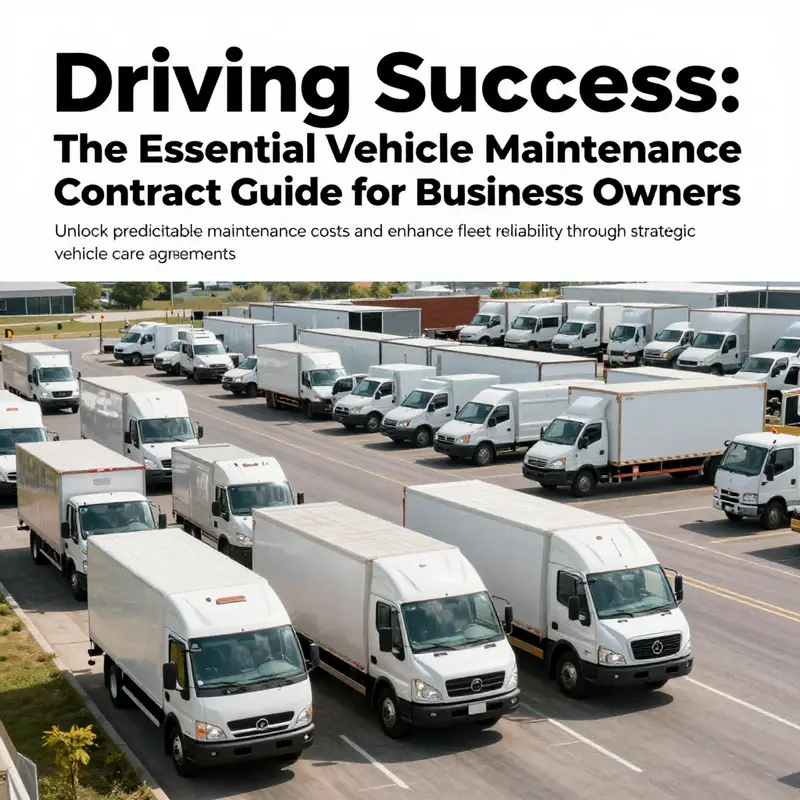
The management of a business fleet can be challenging, particularly when it comes to maintaining vehicles in peak condition. A vehicle maintenance contract serves as a crucial tool for business owners, ensuring regular upkeep and necessary repairs while also allowing for budget predictability. This article delves into the significance of a vehicle maintenance contract, exploring its scope, economic advantages, and essential terms and conditions. Each chapter aims to build your understanding of how this contract can play an integral role in optimizing your business operations and enhancing vehicle longevity.
Why a Vehicle Maintenance Contract Is the Smart Choice for Safety, Value, and Predictable Costs

A vehicle maintenance contract turns routine upkeep into a planned, enforceable process. It does more than schedule oil changes and tire rotations. It creates a formal relationship between the vehicle owner and a service provider. That relationship brings clarity, accountability, and measurable benefits over the vehicle lifecycle.
At its core, a maintenance contract defines what services will be performed, when they will occur, and who pays. These simple details resolve common questions. Which parts will be used? Are labor charges included? Who authorizes additional repairs? When are services due by mileage or time? A clear contract answers all of these questions in writing. That clarity prevents surprise bills. It also prevents service actions that the owner did not approve.
A well-constructed contract follows the manufacturer schedule where appropriate. Regular inspections of brakes, tires, suspension, fluids, filters, and belts reduce the risk of sudden failures. When a component is inspected on schedule, technicians catch wear early. Early detection means lower repair costs and less downtime. Routine maintenance preserves fuel efficiency and keeps emissions systems functioning correctly. Over time, those savings add up and reduce the chance of a roadside breakdown.
Beyond the maintenance calendar, the contract protects rights and finances. When the agreement specifies parts quality and labor standards, the owner gains leverage. If the provider installs inferior parts or charges for unauthorized work, the contract is the record to demand remediation. Contracts typically include cost estimates and payment terms. That makes expenses predictable and helps owners budget maintenance into monthly finances. For owners who prefer certainty, this predictability is one of the clearest advantages.
Safety improves under a maintenance contract for two reasons. First, regular attention keeps safety-related systems in top condition. Brakes, tires, lights, and steering components receive routine checks and servicing. Second, the contract creates a documented maintenance history. A documented history shows that the owner took reasonable steps to keep the vehicle safe. In the event of an accident or warranty dispute, maintenance records strengthen an owner’s position with insurers or legal parties. Those documents show diligence rather than neglect.
Preserving resale value is another tangible benefit. Prospective buyers want assurance that a used vehicle was cared for. A complete, verifiable maintenance record is often the deciding factor. It can reduce haggling and even justify a higher asking price. For owners who intend to sell, transferability of a maintenance contract or a full service record can be a compelling selling point in the used-car market.
Maintenance contracts also fit well with wider vehicle ownership strategies. For drivers who lease, manage company cars, or operate small fleets, formal maintenance agreements simplify compliance and reporting. They help keep vehicles within legal safety standards. They also minimize downtime for businesses. When service is scheduled and managed centrally, fleets stay productive. That reduces the hidden cost of idled vehicles and rushed, costly repairs.
Not all maintenance contracts are identical. Owners should review key contract elements before signing. Look for clearly stated service schedules and a list of covered services. Confirm whether parts and labor are fully covered. Understand any exclusions or limits, such as caps on part costs or restrictions on wear-and-tear items. Check whether the provider uses original-equipment parts, certified aftermarket parts, or rebuilt components. Quality of parts affects both performance and long-term value.
Service location and technician qualifications matter. Contracts that require work at authorized facilities provide consistent standards. Ask whether mobile or third-party repairs are allowed, and whether remote service providers must meet the same standards. Check whether the contract allows work at multiple locations and whether those locations offer the same warranty on repairs.
Another critical area is dispute resolution. Good contracts spell out how disagreements will be handled. They specify timelines for complaints, steps for inspection, and remedies if work fails to meet standards. A contract may include provisions for refunds, rework, or arbitration. Without these procedures, owners can struggle to get prompt fixes when the provider falls short.
Transferability is often overlooked but valuable. If a contract transfers to a new owner, it enhances resale appeal. A transferable maintenance contract signals continuity of care. If the contract is nontransferable, the record of maintenance still helps, but the buyer loses the security of contract-covered repairs.
Some contracts include extras that change ownership convenience. Roadside assistance, loaner vehicles during service, priority scheduling, or discounts on future repairs can make the agreement worth more than basic service coverage. Evaluate these extras against their additional cost. For some owners, the convenience of a loaner vehicle or a guaranteed tow is worth the premium.
Owners should also understand cancellation and renewal terms. How easy is it to cancel? Are there penalties? Does the contract renew automatically? What notices are required to avoid charges? These practical details affect the contract’s value and fit for the owner’s plans.
A maintenance contract is not a substitute for owner vigilance. Keep personal records of odometer readings and service receipts. Confirm that scheduled services occurred on time. A contract strengthens the owner’s position, but the best protection comes from active participation in the maintenance process.
When comparing contracts, consider total cost of ownership. Factor in service frequency, parts quality, extras, and likely repair scenarios for the vehicle model. Predictable costs reduce financial stress, but an overpriced contract with poor coverage delivers little value. Shop wisely and request a breakdown of likely costs over the contract term.
There are red flags to watch for. Vague language about what is covered, ambiguous pricing, or commitments that sound too good to be true deserve scrutiny. Ensure any oral promises are included in the written contract. Beware of contracts that allow unilateral changes by the provider without owner consent. Finally, confirm that the provider carries appropriate insurance and certifications.
A maintenance contract can strengthen a vehicle warranty or serve as a bridge after that warranty expires. Understand how the contract interacts with existing warranties. Some contracts void certain manufacturer warranties if the owner uses unapproved service providers. Others complement a warranty by covering routine items that the warranty excludes. Clarify this interaction before committing.
Recordkeeping is central to the contract’s long-term benefits. A structured contract usually includes a service log. When technicians sign and date each service entry, the record becomes an audit trail. That trail proves due diligence. It also makes troubleshooting easier. Future technicians can see past interventions and avoid redundant work.
For fleet managers, a maintenance contract becomes part of an operational playbook. Centralized tracking, scheduled preventive maintenance, and uniform repair standards reduce variability. Predictable service intervals optimize vehicle availability. A formal contract enables data collection on failure patterns. That data informs replacement cycles and purchasing decisions.
Choosing a provider is as important as choosing the contract. Look for a provider with a solid track record, clear communication, and transparent billing. Seek references from current customers. Ask about technician training programs and parts sourcing. A reliable provider will welcome questions and provide written answers.
Owners who prefer a do-it-yourself approach should consider which tasks the contract covers. Some contracts leave minor maintenance, like simple filter changes or detailing, to the owner. Others include almost all routine items. Make sure the contract aligns with the owner’s willingness to perform minor tasks and with the vehicle’s maintenance demands.
Negotiation is possible. Providers often tailor contracts for long-term customers or fleets. Ask for concessions on price or added services. In many cases, providers will offer a trial period or a short initial term. That trial allows owners to evaluate service quality before committing long term.
A final practical note connects maintenance to fuel efficiency and everyday savings. Properly maintained engines, correct tire pressures, and clean filters reduce fuel consumption. For more on how maintenance affects fuel expenses, review the discussion on how vehicle maintenance saves on gas expenses. That resource expands on the specific maintenance actions that cut fuel costs and improve daily driving economy. (https://vehicletricks.com/blog/how-vehicle-maintenance-saves-on-gas-expenses/)
A maintenance contract transforms maintenance from guesswork into governance. It gives owners legal recourse, predictable costs, and operational peace of mind. It supports safety, preserves resale value, and helps businesses manage resources. For those who value certainty and long-term protection, a well-drafted maintenance contract is a practical and strategic investment.
For authoritative guidance on maintaining vehicles and keeping records, see the Consumer FTC resource on maintaining your vehicle. (https://www.consumer.ftc.gov/articles/0275-maintaining-your-vehicle)
Scope and Services of a Vehicle Maintenance Contract: What It Covers and Why It Matters
A vehicle maintenance contract is more than a promise to change oil or rotate tires. It is a formal roadmap for keeping a vehicle safe, reliable, and efficient over time. At its core, the contract defines a set of routine and preventive services, the intervals at which they must be performed, who performs them, and who pays. That simple framework shapes how a vehicle will age, how often it will need repair, and how predictable ownership costs will be.
Understanding the scope of a maintenance contract begins with the routine items most owners expect. These contracts typically list services that preserve basic drivability and safety. Regular inspections and scheduled oil changes lead that list. Tire rotations, brake inspections, and fluid replacements follow. The scope may include checking and topping engine coolant, brake fluid, and transmission fluid, as well as replacing filters and spark plugs when required. A well-drafted contract explains these items clearly, often tying them to mileage or time intervals. When the vehicle hits a specified mileage or a calendar milestone, the next service becomes due.
Beyond that foundation, many contracts stipulate checks on critical components. Brakes, suspension parts, drive belts, hoses, and steering linkages are frequently named. These checks are not mere formalities. They catch wear patterns early. Early detection prevents small faults from becoming expensive breakdowns. The document may require specific diagnostic procedures when warning lights appear or performance degrades. That diagnostic clause lets technicians identify issues before they cause failure.
Coverage levels vary widely. Some contracts present a comprehensive package that bundles almost every major maintenance task. Others offer a leaner plan that covers only essential work. For a vehicle owner, the difference matters. Comprehensive plans reduce out-of-pocket surprises but cost more upfront. Essential-only plans lower the initial price but leave gaps for larger repairs. The contract often spells out who pays for parts and who pays for labor. Some plans include both. Others limit coverage to labor only, or offer a parts allowance rather than full replacement cost. Reading those distinctions carefully avoids surprises.
Many vehicle maintenance contracts also add value through supplementary services. A common extra is nationwide emergency roadside assistance. This benefit can include towing, emergency fuel delivery, flat tire changes, and lockout services. For drivers who travel, that nationwide aspect is important. It ensures help is available away from home. Other extras might include a courtesy loaner vehicle while repairs occur, rental car reimbursement, or discounts on future repairs not covered by the plan. When evaluating a contract, weigh those extras. A loaner car or guaranteed tow service can eliminate an immediate inconvenience that otherwise adds hidden cost.
For businesses and fleet operators, maintenance contracts serve a strategic function. They provide consistency and predictability across many vehicles. A centralized contract can standardize inspection intervals, enforce compliance with safety regulations, and reduce downtime. Contracts for fleets often include tracking tools or reporting capabilities. Those tools show maintenance histories, upcoming service windows, and cost patterns. That visibility helps managers plan budgets and avoid compliance lapses that could result in fines or liability.
Aside from the services listed, contracts typically list what is excluded. Exclusions are where misunderstandings arise. Common exclusions include cosmetic items, damage from accidents, and failures caused by misuse or lack of proper maintenance. Wear-and-tear items such as tires, brake pads, wiper blades, and light bulbs are sometimes excluded or covered only under specific conditions. Consumables—like engine oil consumed between intervals or fuel system cleaners—are often excluded as well. Contracts may also exclude repairs required by modifications or aftermarket parts. Knowing those limits prevents unexpected bills and helps owners choose the level of coverage they truly need.
Terms around authorized facilities and technicians matter as well. Some contracts require service at a specified dealership or network of approved shops. Others allow visits to independent repair shops but impose documentation rules. The contract might require that the service provider use manufacturer-approved parts, certified technicians, or particular diagnostic tools. Those conditions are intended to maintain repair quality and protect the vehicle’s performance. They can also affect convenience and cost. If a contract forces owners to travel far for warranty work, the practical value diminishes.
Documentation is a hidden but crucial element. Contracts almost always require service records—detailed, dated receipts that show the work performed. These records verify that the owner met the maintenance schedule and used authorized facilities. Without them, a claim may be denied. The contract may specify acceptable documentation formats and retention periods. Owners should maintain a separate folder of service invoices and work orders. This habit preserves eligibility and simplifies eventual claims.
Financial mechanics in a maintenance contract deserve careful review. Many contracts include deductibles or service fees per visit. Some impose annual coverage caps or per-component limits. Others limit the number of service events per year. There may be waiting periods before coverage begins, particularly for certain repairs. Prepaid plans require upfront payments that may be refundable under limited circumstances. Others charge monthly or per-service fees. All these structures influence the real cost-benefit calculus. A low monthly fee can become expensive if the plan caps lead to out-of-pocket expenses after a few repairs.
Transferability and cancellation offer another layer to consider. Some contracts are transferable to a new owner, enhancing a vehicle’s resale value. Transferability often requires notification and a small fee. Cancellation terms determine the owner’s options if they sell the vehicle or change circumstances. A prorated refund may be available, but there are usually administrative fees or limits. Understanding these terms helps owners plan a sale or change in vehicle use without losing money.
Claims and dispute processes define how disagreements are resolved. Contracts will describe steps for filing claims, timelines for repair authorization, and appeal processes for denials. They may require pre-authorization for certain repairs and specify how long the provider has to respond. A responsive claims process reduces downtime and maintains trust between owner and provider. If the contract lacks clear dispute resolution language, owners should ask for clarification before signing.
Electric and hybrid vehicles are changing the nature of maintenance. They have fewer moving parts related to the internal combustion engine, which reduces some traditional service items. However, they have unique needs such as battery health checks, high-voltage system diagnostics, and software updates. Contracts tailored for these vehicles should explicitly address those areas. Owners of electric vehicles should confirm whether battery replacement, degradation, or software-related repairs fall within the contract scope. A plan that ignores these differences may provide less value for such vehicles.
Choosing the right maintenance contract also involves evaluating provider reputation and qualifications. Certifications, consumer reviews, and the size of the service network matter. A broad network increases convenience. Certified technicians and manufacturer-approved parts improve service quality. Independent plans sometimes offer competitive pricing, but owners must verify the provider’s financial stability and track record for honoring claims.
Reading the fine print remains essential. Watch for clauses that void coverage, such as failing to follow the manufacturer’s maintenance schedule, using non-approved fluids, or performing unauthorized repairs. Some contracts require periodic re-inspection or adherence to specific maintenance checklists. If the contract links coverage to the vehicle’s manufacturer warranty, confirm how the two interact. Overlaps or conflicts between warranty and maintenance coverage can complicate repair approvals.
Finally, small practices amplify the value of any contract. Keep a consistent service history. Use authorized providers when required. Photograph damage or system warnings and document conversations about coverage decisions. When a repair is denied, request a written explanation and keep that with service records. These habits reduce friction during claims and protect the owner’s investment.
A vehicle maintenance contract frames the relationship between a vehicle owner and a service provider. It outlines what preventive care will occur, who will do it, and who pays. It can transform ownership from reactive repairs to a predictable maintenance rhythm. For fleets, it provides operational stability. For individual owners, it offers peace of mind and often convenience. But the real value lies in the details: the list of covered services, the exclusions, the financial terms, and the administrative processes. Reading the contract, comparing coverage levels, and matching options to the vehicle type and driving habits will reveal whether a specific plan makes sense.
If you want a straightforward primer on standard maintenance tasks and why they matter, this resource on what is vehicle maintenance provides a helpful overview of routine care and its benefits: https://vehicletricks.com/blog/what-is-vehicle-maintenance/. For official guidance about vehicle maintenance contracts and their terms, consult the government resource here: https://www.transportation.gov/vehicle-maintenance-contract
Turning Maintenance into Margin: The Economic Case for Vehicle Maintenance Contracts
Turning Maintenance into Margin: The Economic Case for Vehicle Maintenance Contracts
A vehicle maintenance contract converts uncertainty into a financial plan. For businesses that rely on vehicles, this conversion is not small. It affects cash flow, capital allocation, service continuity, and ultimately, the bottom line. A well-structured contract replaces intermittent, high-impact repair bills with predictable, scheduled costs. That predictability alone changes how a business budgets and makes investment decisions. Beyond budgeting, these agreements influence operational uptime, resale value, regulatory compliance, and fuel efficiency. Together, those effects compound into measurable economic gains.
At the heart of the value proposition is the reduction of unforeseen expense spikes. Emergency repairs are expensive for several reasons. Parts and labor costs typically rise for out-of-plan repairs. When a vehicle breaks down unexpectedly, a business may pay overtime labor rates. It may also incur towing fees and expedited parts charges. Those bills appear as single-line shocks against a monthly budget. A maintenance contract, by contrast, spreads similar costs across predictable intervals. That smoothing enables accurate forecasting and lowers the risk premiums a business must hold in cash reserves. With lower reserve requirements, capital becomes available for revenue-generating uses.
Maintenance contracts also target the root causes of expensive failures. Scheduled inspections catch wear and tear early, avoiding the cascade of component damage that follows neglect. A failing seal can lead to fluid loss, which degrades other systems. A small electrical fault, left unchecked, can damage sensors and cause expensive diagnostics. By enforcing manufacturer-recommended service intervals, maintenance contracts reduce the probability of expensive, multi-system breakdowns. Fewer sudden failures mean fewer disruptions to operations and fewer emergency repair invoices.
Minimizing downtime is a direct economic advantage. Vehicles that remain in service generate revenue or support essential operations. When trucks or service vans are sidelined, the business may need to reassign routes, delay deliveries, or hire temporary replacement capacity. Those responses cost money. A maintenance contract that schedules preventive work during low-demand windows and provides access to prompt service reduces the average out-of-service time per vehicle. The cumulative effect for a fleet is significant: higher utilization rates, improved delivery consistency, and lower per-mile operating costs.
Extending vehicle life is another tangible benefit. Regular maintenance slows degradation and preserves both performance and safety. When vehicles last longer, businesses delay capital expenditures. That delay improves return on investment for each vehicle. The avoided cost of replacement is often larger than the annual maintenance spend. Moreover, vehicles maintained under a formal plan command higher resale prices. Detailed service histories prove diligence to buyers and leasing companies. That proof translates into better trade-in values and lower total cost of ownership across the fleet.
Fuel economy responds quickly to good maintenance. Clean filters, correct tire pressures, and well-tuned engines reduce fuel burn. Even modest improvements in miles per gallon compound over miles and years. For high-mileage fleets, a small percentage improvement translates into large, recurring savings. If fuel is a major line item, the outcome of regular servicing can be a material reduction in operating expense. For a deeper look at how maintenance lowers fuel costs, read this detailed explanation on how vehicle maintenance saves on gas expenses.
Access to professional technicians matters. Maintenance contracts typically ensure that certified, experienced technicians perform work. Those technicians follow factory procedures and use the right diagnostics. Proper repairs reduce rework and prevent errors that create more cost. Expertise also shortens diagnostic time. Faster diagnostics reduce shop hours billed and get vehicles back on the road sooner. A formal relationship with a provider often includes standardized processes. Those processes lead to consistent service quality and lower variance in repair outcomes.
Volume purchasing and procurement benefits scale with fleet size. Contract providers often buy parts in bulk, unlocking discounts not available to individual businesses. Those discounts reduce parts cost per repair. Contracts also streamline parts logistics. Faster parts procurement reduces repair lead times. Lower inventory carrying costs follow when a provider manages stocking and replenishment. The combination of lower unit costs and shorter turnaround times lowers overall maintenance expense and reduces the time vehicles spend idle waiting for parts.
Detailed maintenance records are an underrated economic tool. Contracts typically include documentation of every service event, replaced part, and diagnostic finding. That data becomes a management asset. Businesses can track recurring failures and identify chronic issues with specific models or routes. Analytics help optimize replacement cycles, prioritize vehicle retirements, and negotiate better terms with suppliers. Reliable records also simplify regulatory audits and help meet fleet safety requirements. Clear documentation reduces the risk of fines and insurance complications, which are otherwise unpredictable financial drains.
Risk transfer and compliance benefits also influence cost. When a contract covers scheduled maintenance, some liability related to service quality shifts toward the provider. That shift can reduce internal administrative burdens and legal exposure. Providers often build compliance with safety inspections and regulatory standards into their workflows. For businesses operating across jurisdictions, this reduces the time and cost required to track multiple requirements. The result is fewer regulatory fines and less administrative overhead.
Operational planning improves under a maintenance contract. With predictable service intervals, managers can schedule vehicles more effectively. Planned downtime can be matched to off-peak hours. Training for drivers and dispatchers can incorporate maintenance cycles. This alignment reduces last-minute route changes and lost productivity. In turn, labor costs fall because fewer overtime hours are needed to cover missed work. The business improves reliability for customers, which supports retention and may lead to new contracts.
Evaluating return on investment for a maintenance contract requires looking beyond the sticker price. Compare the annual contract cost with the sum of expected emergency repairs, lost revenue from downtime, depreciation accelerated by neglect, higher fuel costs, and the administrative time spent arranging unscheduled repairs. Include the resale premium associated with a documented maintenance history. For many fleets, the comparison favors contracts once you account for indirect savings and operational continuity. A spreadsheet model that captures these dimensions usually shows lower total cost of ownership when proactive maintenance is in place.
Implementation matters. Contracts should be clear about covered services, exclusions, response times, and performance metrics. Understand whether parts and labor are included for specific failures. Confirm how diagnostics and emergency call-outs are handled. Request service-level metrics such as average repair time and percent of preventive services completed on schedule. Ensure the provider can integrate with your fleet management systems to share records and alerts. A poorly structured contract can create new costs, so attention to detail at signing is essential.
Contracts can also be tailored to strategic goals. If resale value is a priority, emphasize documentation and OEM procedure adherence. If uptime is critical, build in faster response targets and access to loaner vehicles. If fuel is the largest cost, require optimized preventive tasks that target efficiency. The flexibility of contracts allows businesses to align maintenance with corporate strategy, not just mechanics.
Finally, consider the behavioral impact. A formal contract imposes discipline on maintenance practices. Drivers and managers are more likely to follow service schedules when a contract defines expectations. That discipline reduces shortcuts and deferred maintenance. Over time, disciplined fleets show better reliability and lower cost per mile. The contract becomes a governance tool as much as a purchasing mechanism.
For businesses that operate vehicles, a maintenance contract is more than a protection plan. It is a financial instrument that reshapes risk, timings, and expenditures. By moving costs from unpredictable to planned, improving uptime, preserving asset value, and capturing procurement efficiencies, these contracts can deliver measurable economic benefits. For an expanded discussion on how professional fleet maintenance drives cost savings, see this resource: https://www.meineke.com/fleet-services/.
Decoding the Fine Print: How Terms and Conditions Shape a Vehicle Maintenance Contract

Key Contract Elements and How They Affect You
A vehicle maintenance contract is more than a list of services. It is a legal framework that defines expectations, costs, and recourse for both the vehicle owner and the service provider. Understanding the terms and conditions prevents surprises, preserves coverage, and helps maintain the vehicle’s long-term value. Read carefully. Know what is promised, what is limited, and which actions you must take to keep protection in force.
The first section of nearly every maintenance contract outlines the scope of services. This is the core promise. Items listed usually include routine tasks such as oil changes, tire rotations, brake inspections, filter replacements, and fluid top-ups. Contracts will often specify service intervals tied to mileage or time. When the contract says an oil change is covered every 6 months or 6,000 miles, that detail determines when you must schedule service to comply. Some agreements group services under tiers, where basic maintenance covers only scheduled items and higher tiers include wear items or minor repairs. Read the list. Confirm whether parts and labor are included or billed separately. Ambiguity here leads to billing disputes.
Closely linked to the scope is the coverage period. This clause defines the contract’s start and end dates, and often the triggers that begin coverage. Coverage may start on the contract purchase date, vehicle delivery date, or at a specified mileage. Some plans also require activation within a set window after vehicle purchase. Equally important is the definition of expiration. Contracts may end at a mileage cap, a calendar date, or both. If your driving habits change, verify how the contract handles early mileage overages. Some contracts prorate coverage or limit specific services after an excess mileage threshold. Understand how and when services must be used to remain valid.
Responsibilities of each party form the backbone of enforceable obligations. On the owner side, the common expectations are timely service, presentation of the vehicle at approved locations, and retention of records that document the work performed. Many contracts require that maintenance follow the vehicle manufacturer’s recommended schedule. Failing to follow those schedules can void coverage. Owners also usually must use parts and fluids that meet specified standards. For fleets, the contract can demand centralized scheduling, routine inspections, and adherence to preventive maintenance logs. Service providers, in turn, must deliver services with reasonable skill, use compatible parts, and keep clear records. They may also be required to provide written estimates for non-covered repairs and seek consent before proceeding. A well-drafted contract balances these duties and includes remedies for breach.
Limitations and exclusions are where many disputes begin. These clauses list what the contract does not cover. Typical exclusions include damage from accidents, abuse, neglect, unauthorized modifications, and failures caused by non-covered parts. Wear-and-tear limits are common; items that degrade with normal use, like brake pads or wiper blades, may be excluded unless a specific tier covers them. Environmental damage and off-road use often fall outside standard coverage. Contracts also commonly exclude failures resulting from improper repairs or the use of incorrect parts. Look for lists of excluded components and read the definitions carefully. Some contracts use broad terms like “mechanical failures” or “electrical components” without specifics. Ask for examples if language feels vague.
A related and critical area covers conditions for voiding the contract. Many agreements explicitly state behaviors that will nullify coverage. Missing scheduled services is the most frequent cause. If a contract requires documentation of every service, failing to keep records can lead to denied claims. Unauthorized modifications that alter original performance can also void protection. Using the wrong type of oil, running the vehicle with known faults, or ignoring manufacturer recalls are additional triggers. Contracts may permit the provider to void coverage after repeated noncompliance or after evidence of misuse. Knowing the triggers lets owners avoid unintentionally losing protection.
Industry standards are often woven into contract language. References to recognized maintenance standards create objective benchmarks for service quality and intervals. Contracts may cite national or international standards, or the vehicle manufacturer’s specifications, to set maintenance expectations. Such references protect both sides: they give providers a clear technical basis for service and give owners assurance that work follows accepted practice. One notable technical reference that may be cited is a national automotive maintenance standard that clarifies inspection and diagnostic protocols. When a contract references an external standard, you can read that standard to verify obligations and performance criteria.
Documented maintenance records are frequently the deciding factor when a claim arises. Contracts commonly require verifiable logs showing dates, mileage, and the work performed. These records establish that required services occurred at the correct intervals and that proper parts and fluids were used. Acceptable documentation may include signed service invoices, digital records from certified shops, or entries in a manufacturer-approved service app. Keep receipts, ask for itemized invoices, and retain any diagnostic reports. Failure to produce records often leads to denied claims, even when the service actually occurred. Treat documentation as an ongoing obligation rather than optional paperwork.
Pricing structure and payment terms deserve top attention. Some contracts are prepaid, while others bill on a periodic basis. Prepaid plans sometimes lock in current rates but might have cancellation penalties. Contracts can include deductibles or limits per visit. Look for caps on parts or labor charges, annual limits, and whether taxes and administrative fees are included. If discounts are promised, ensure the document specifies how and when they apply. Clarify whether the contract covers the cost of towing, roadside assistance, or a loaner vehicle during service. Hidden fees are a frequent source of dissatisfaction, so demand clarity on cost allocation.
Dispute resolution and cancellation provisions determine how conflicts are handled. Many maintenance contracts include an arbitration clause or require disputes to go through a specified complaint process. Others allow cancellations within a defined rescission period for a full refund, often with a prorated refund thereafter. Note the provider’s obligations to honor warranty or repair work if you cancel mid-term. Contracts should also define notice periods and acceptable methods for sending claims. If a contract forces arbitration in a distant forum or limits legal remedies, consider whether the tradeoff is acceptable.
Special considerations exist for leased vehicles and fleets. Leaseholders often face obligations to return vehicles in specified condition. Maintenance contracts can reduce lease-end charges by ensuring routine service is current and documented. For fleet operators, contracts should address minimum service volumes, priority scheduling, and reporting for regulatory compliance. Fleet agreements may include audits, centralized billing, and penalties for missed appointments. In leased scenarios, consult lease terms to confirm who pays for maintenance. If uncertainty exists, seeing the contract can prevent overlapping liabilities. For general guidance about maintenance responsibilities, refer to this overview on what vehicle maintenance entails: what is vehicle maintenance.
Finally, practical steps to protect your interests are simple and effective. Read every clause before signing. Ask the provider to clarify ambiguous terms in writing. Insist on a written schedule showing exactly which services are included and when they must be performed. Keep a dedicated service folder with invoices, diagnostic reports, and digital backups. If the contract references a technical standard, review it so you understand service expectations. When using independent shops, confirm they meet the contract’s qualifications. If the agreement includes routine inspections, ensure they are completed by an approved facility. Request notifications for upcoming service windows and keep service reminders on your calendar.
Understanding terms and conditions transforms a maintenance contract from a vague promise into a practical tool. It helps you plan expenses, avoid coverage pitfalls, and maintain vehicle reliability. Contracts that clearly define scope, coverage period, responsibilities, exclusions, and documentation requirements reduce conflict and support vehicle longevity. When in doubt, ask for clarifications and insist on written amendments. An informed owner keeps the vehicle well-maintained and retains the protections the contract intended.
For more precise technical guidance referenced in many contracts, consult the official maintenance standard available here: https://std.samr.gov.cn/gb/standard/18344
Final thoughts
In conclusion, a vehicle maintenance contract is not only a safeguard for your fleet but also an intelligent strategy for business growth. By ensuring your vehicles receive consistent and professional care, you enhance their longevity and performance while maintaining predictable costs. Understanding the terms, services, and economic advantages of these contracts empowers you as a business owner, ensuring that your investments in the fleet contribute positively to your bottom line. Prioritizing vehicle maintenance can lead to improved efficiency, reduced downtime, and greater peace of mind.