
Preventive maintenance is a crucial strategy for business owners managing vehicle fleets, as it proactively addresses potential issues before they escalate into significant repairs. By adopting scheduled inspections and servicing, business owners can ensure greater reliability, safety, and longevity of their vehicles, which are vital assets for their operations. In the following chapters, we will explore the essence of preventive maintenance in vehicles, discuss its key components, delve into the latest technological advancements, evaluate its economic benefits, and identify the challenges and best practices associated with its implementation.
Guardians on the Road: The Practical Art and Science of Preventive Vehicle Maintenance
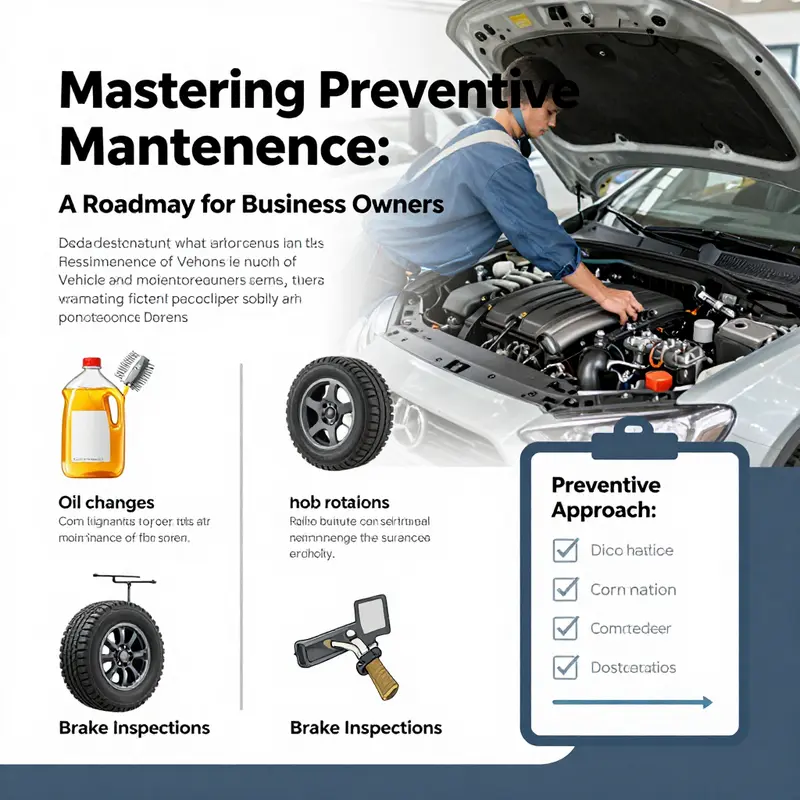
Preventive maintenance of vehicles is a proactive discipline, not a reactive habit. It treats wear and potential failures as predictable companions of time, mileage, and environment, and it builds a schedule around that understanding rather than waiting for the engine light or a roadside emergency to decide the next move. In its simplest form, preventive maintenance means inspecting, servicing, and replacing parts before they fail. In practice, it is a careful choreography—oil and filters changed on a routine cadence, tires rotated to equalize wear, brakes checked for effectiveness, and cooling and lubrication systems kept in check so that every journey begins with reliability rather than risk. The goal is not merely to avoid inconvenience; it is to safeguard safety, preserve performance, and extend the vehicle’s useful life, all while avoiding the heavy costs that come with preventable breakdowns. When this approach is understood and applied consistently, a vehicle becomes less a roll of the dice and more a well-tuned system whose parts age in concert with their duties on the road.
At the heart of preventive maintenance lies a simple but powerful principle: maintenance that aligns with how a vehicle actually wears and uses itself is typically more economical and effective than maintenance based on a hollow schedule or, worse, on guesses made after a failure. The manufacturer’s recommended maintenance schedule embodies this principle. It is built from a robust understanding of how specific components behave under typical operating conditions and how fluids degrade, parts wear, and systems drift from their optimal states. The tasks on that schedule—oil changes, tire rotations, brake inspections, coolant checks, and transmission service—are chosen because they address the most common failure modes and the most consequential safety concerns. Oil plays a dual role. It lubricates moving parts and cleans sludge that can form when oil ages or becomes contaminated. If the oil is degraded, overheating and excessive wear can follow, undermining engine life and performance. Tire rotations keep tread wear even, ensuring stable traction, predictable handling, and longer tire life. Brake inspections are about reaction time and stopping power; worn pads or compromised hydraulics can turn routine stops into dangerous situations, especially at highway speeds or in adverse weather. Coolant checks prevent overheating, protect the engine from thermal stress, and help maintain efficiency. A transmission that shifts smoothly preserves power delivery and reduces the risk of drivability issues that could ripple into costly repairs.
These routine checks may sound mundane, yet they create a dependable baseline. For many drivers, the value of preventive maintenance becomes most apparent not in dramatic failures but in the quiet assurance that a vehicle will start when needed, perform reliably, and return predictable fuel economy. The logic extends beyond personal cars into fleets and commercial operations, where reliability translates directly into uptime, on-time delivery, and safer work environments. In fleet contexts, preventive maintenance can become a competitive advantage by reducing unscheduled downtime, extending component life, and lowering overall operating costs. The observable benefits—fewer roadside breakdowns, steadier maintenance budgeting, and improved resale value—are the practical proof that a well-kept vehicle is a better investment over the long haul.
Yet preventive maintenance is not a single protocol but a spectrum of strategies that react to how a vehicle ages and speaks to its operator’s needs. Time-based or periodic maintenance is the most familiar approach. It fixes a renewal point on the calendar or mileage as a reminder to perform certain services, regardless of the exact condition of each part. This method works well when degradation follows predictable patterns and where parts have known service lifetimes. However, time-based maintenance can lead to unnecessary work or, conversely, missed signals if conditions vary widely—such as a vehicle that operates in extreme temperatures, carries heavy loads, or endures rough road surfaces. In response, technicians and engineers increasingly supplement fixed intervals with data-driven methods that monitor the actual state of a system.
Condition-based maintenance uses real-time information gathered from sensors, diagnostics, and routine inspections to assess component health. This approach acknowledges that the same model of vehicle may experience different wear in different climates or usage profiles. Onboard diagnostics can detect engine faults, coolant temperature anomalies, abnormal vibration, or oil pressures that drift from the norm. When signs of wear or impending failure appear, maintenance is scheduled with the exact urgency needed. The result is fewer unnecessary services and more timely interventions that protect reliability.
A more advanced and transformative approach is predictive maintenance, which uses data analytics and machine learning to forecast when a part will fail or when performance will degrade below a threshold. Rather than reacting to symptoms or relying on rigid calendars, predictive maintenance envisions maintenance as a future-aware activity. It depends on continuous streams of data from vehicle subsystems, often collected via sensors and connected to a broader data ecosystem. In modern transport sectors, such as rail, predictive maintenance has become a catalyst for efficiency. Real-time data on engine temperature, vibration patterns, wear indicators, and component aging enables maintenance teams to schedule work just before a problem would disrupt operations. This timing minimizes downtime, reduces unnecessary repairs, and aligns maintenance activities with a fully integrated ecosystem that includes suppliers, engineers, and technicians working in concert. The shift from fixed-interval preventive maintenance to predictive maintenance reflects a broader truth about maintenance in the digital era: better information, paired with smarter analysis, yields smarter decisions about when to intervene.
The practical implications of these approaches extend into day-to-day life. For the individual driver, adopting preventive maintenance means developing a habit of routine checks that matches the vehicle’s operation, climate, and workload. It means keeping a well-maintained log, not just for compliance but to understand how a vehicle behaves over time. The log can track oil changes, filter replacements, tire wear, and fluid levels, and it can note irregular noises, changes in braking feel, or unexpected vibrations. This record becomes a personal diagnostic tool, helping the owner recognize when something shifts out of its normal pattern and when to seek professional advice. For those who use vehicles for work or long-distance travel, the responsibility scales up: maintenance becomes a reliability metric, a factor in safety planning, and a line item in cost management. When a fleet adopts sensors and analytics, the promise grows even stronger: maintenance planning can be scheduled with a precision that once belonged to the realm of large-scale industries, and the average road user can benefit from the same principles.
It is also worth highlighting a practical set of routine tasks that anchors preventive practice. Regular oil changes remain foundational; they protect engine bearings, reduce friction, and help prevent sludge formation. Tire health is not merely about tread depth; it extends to consistent inflation, alignment, and rotation, all of which influence handling, fuel efficiency, and tire longevity. Brake systems deserve ongoing scrutiny because braking is the primary safety interface between a vehicle and the road. Coolant and other vital fluids deserve regular attention; low levels or degraded fluids can compromise temperature control, hydraulics, and overall system performance. Transmission health, although often less visible than the engine or brakes, is crucial for smooth operation and long life. Each of these elements forms part of a broader philosophy: treat the vehicle as a connected, interacting system rather than as a collection of independent parts.
This perspective becomes even clearer when considering how technology reshapes what preventive maintenance looks like in practice. IoT sensors, connected diagnostics, and data analytics enable continuous health monitoring, enabling maintenance teams to respond to changes as they occur rather than after a problem becomes obvious. In rail and other heavy-transport contexts, this capability translates into continuous monitoring of critical components, anomaly detection, and proactive interventions that minimize downtime and optimize resource use. A fully realized maintenance ecosystem—where suppliers, engineers, and technicians share data and insights—emerges as a practical and advantageous model. The human element remains essential, of course: skilled technicians interpret data, perform repairs, and verify that systems perform within safe limits after maintenance. The combination of human expertise and data-driven insight creates a robust framework for sustaining safety, reliability, and efficiency across diverse vehicle types and operating environments.
For readers seeking concrete guidance, the essential idea is to start with a clear maintenance baseline rooted in the manufacturer’s recommendations, then augment that baseline with a thoughtful, data-informed approach as resources allow. A simple starting point is to review the vehicle’s service schedule, establish a routine for inspections that align with local climate and driving patterns, and keep a log of all maintenance actions. When possible, leverage sensor data and diagnostics to refine that plan, particularly for components with known wear patterns under your usual operating conditions. Even without high-end analytics, the discipline of consistency—regular checks, timely service, and attention to signs of abnormal operation—delivers tangible benefits in safety, reliability, and cost efficiency. A practical way to anchor this habit is to connect the routine to broader learning about vehicle maintenance, whether through official resources, reputable guides, or accessible, well-curated articles that translate technical detail into actionable steps. For a concise overview, see What is vehicle maintenance, which frames the concept in terms of everyday practice and long-term value.
In sum, preventive maintenance of vehicles is a spectrum that ranges from fixed, schedule-driven care to sophisticated, data-informed forecasting. Each approach has its place, and many drivers will benefit from a blended strategy that honors the manufacturer’s recommendations while embracing condition-based checks and, where feasible, predictive insights. The payoff is real: greater reliability on the road, safer operation, improved fuel economy, and a longer, more dependable life for the vehicle. As technology advances, the line between maintenance as a cost and maintenance as a strategic capability continues to blur, empowering everyday drivers to protect their mobility with the same precision once reserved for the world of heavy transport. For further context on the value and practicalities of keeping a car running smoothly, the U.S. Department of Energy offers practical guidelines and tips that translate maintenance concepts into everyday actions and budgeting decisions.
External reference: U.S. Department of Energy maintenance guide
null
null
null

null
null
null
From Fixed Calendars to Intelligent Care: Challenges and Best Practices in Preventive Vehicle Maintenance

Preventive maintenance has long stood as the backbone of reliable mobility. Yet as vehicles become smarter and more interconnected, the path from routine checks to data‑informed foresight reveals a landscape of challenges and opportunities. A traditional schedule—oil changes, brake inspections, tire rotations—still matters, but it is increasingly overlaid with streams of telemetry, sensor data, and predictive logic. The shift is not merely about more data; it is about building a durable maintenance culture that can translate information into action without triggering a cascade of unnecessary service or costly downtime. In that sense, preventive maintenance today is as much about organizational maturity as it is about technical capability. The journey from fixed intervals to condition‑based strategies requires a careful balance of data quality, scalable processes, and human judgment, all anchored in a clear understanding of the vehicle’s mission, its operating environment, and the risks that come with each mile traveled. When these elements align, preventive maintenance becomes less about chasing failures and more about preserving reliability, safety, and asset value across a fleet or a single, mission‑critical vehicle alike.
The first challenge that dominates many fleets and workshop ecosystems is data quality and availability. Modern vehicles generate an astonishing variety of signals: temperature profiles, vibration spectra, lubrication metrics, wear indicators, and fluid states, to name only a few. Yet sensor quality and data integrity are not guaranteed. Gaps in data streams, noisy measurements, and inconsistent sampling rates can undermine diagnostic confidence and erode the effectiveness of predictive models. A single corrupted data point can skew an entire analysis, leading either to missed maintenance needs or to false alarms that waste resources. The governance of data—how it is collected, stored, cleaned, and labeled—becomes foundational. Without robust data pipelines and clear data dictionaries, even the most advanced analytics will struggle to deliver reliable maintenance decisions.
Scalability follows closely behind data quality as a dominant constraint. Fleet operators often manage hundreds or thousands of vehicles, each with its own usage pattern, climate exposure, loading condition, and maintenance history. This diversity complicates the design of uniform maintenance schedules. A one‑size‑fits‑all policy fails when vehicles in harsh winter climates demand more frequent brake inspections than those in milder regions, or when the same model experiences different wear rates across urban and rural operation. Scalability is not just about processing power or storage capacity; it is about building maintenance logic that can accommodate heterogeneity without devolving into manual ad hoc planning. It requires modular analytics architectures, configurable rule sets, and governance that can scale from a single depot to a global operating footprint. In practice, this means investing in data standardization, flexible data models, and dashboards that highlight exceptions without drowning managers in alerts.
A third and closely related hurdle concerns the integration of AI and machine learning into existing maintenance workflows. The promise of AI‑driven predictive maintenance is clear: correlate real‑time telematics with historical service data to forecast impending failures and optimize the timing of interventions. But the path to realizing this promise is fraught with friction. Legacy maintenance systems, spreadsheet‑based planning, and siloed data repositories often resist seamless integration. Technical obstacles include interoperability between telemetry platforms, maintenance management systems, and enterprise resource planning tools. Then there are organizational barriers: limited in‑house expertise in advanced analytics, concerns about model interpretability, and the anxiety that data‑driven decisions may undermine technician expertise or operational instincts. Even when models perform well in controlled tests, their practical value hinges on how well they are presented to decision makers, how transparent the reasoning behind a forecast is, and how easily technicians can translate a prediction into a concrete service task.
Against this backdrop, best practices have begun to crystallize around several core strategies. The central thread is a shift from calendar‑based or mileage‑based servicing to condition‑based maintenance that leverages data to guide timely, proportionate interventions. AI‑driven predictive maintenance sits at the heart of this approach. By integrating real‑time telematics, engine performance metrics, wear patterns, and historical service records, fleets can forecast failures with greater precision and schedule interventions just before a breakdown would occur. The value lies not only in reducing unexpected downtime but also in avoiding unnecessary servicing, which conserves resources and minimizes disruption to operations. This shift requires careful calibration: a model should alert for genuine risk signals while avoiding alert fatigue that could desensitize teams. It also demands robust validation, ongoing monitoring of model drift, and fallback procedures that keep maintenance decisions reliable even when data streams falter.
Another best practice is the prudent use of publicly available datasets to train and test predictive models. Repositories from reputable sources offer diverse, real‑world examples of vehicle behavior under various operating conditions. These datasets provide a practical means to bootstrap predictive capabilities, especially for organizations that are still building internal data archives. They help engineers test hypotheses, benchmark model performance, and accelerate proof‑of‑concept implementations without waiting for years of private data. When used thoughtfully, public data complements sensitive, proprietary data, enabling more robust models while preserving confidentiality and safety considerations.
Standardized data collection protocols are essential to maintain data quality across a large and dispersed fleet. Consistency in what is measured, how measurements are timed, and how data is labeled ensures that analytics speak a common language. A shared data schema reduces misinterpretation and simplifies cross‑vehicle comparisons, which in turn supports more accurate predictions and fair performance evaluations. This standardization extends beyond the data itself to the workflows surrounding it. Clear procedures for data validation, anomaly handling, and model retraining create a reliable loop that sustains predictive accuracy as vehicles age and operating conditions evolve.
Continuous monitoring systems play a pivotal role in early detection of wear and imminent failure. Rather than rely solely on scheduled inspections, continuous monitoring operates as a constant, unobtrusive observer of vehicle health. This approach is particularly valuable for critical systems where a minor change in a signal could herald a significant risk, such as brake hydraulics, steering, or propulsion components. Real‑time alerts empower maintenance teams to act quickly, often before the vehicle leaves the depot or before the next run. The benefits extend to safety, reliability, and customer satisfaction, because a fleet that demonstrates fewer unplanned events tends to deliver steadier performance and lower total cost of ownership.
Collaboration among OEMs, fleet managers, and technology providers emerges as a fourth essential component. No single actor owns all the pieces of a predictive maintenance puzzle. Effective integration requires alignment on data governance, interoperability standards, and shared objectives. When OEMs contribute trusted diagnostics and baseline health models, fleets gain access to domain knowledge about component wear and failure modes. At the same time, third‑party technology providers can supply specialized analytics, data visualization, and decision‑support tools. The strongest programs are anchored by formal collaboration frameworks, with joint pilots, clearly defined success metrics, and governance that keeps data sharing purposeful and secure. This ecosystem mindset helps translate sophisticated analytics into practical maintenance decisions that technicians can implement with confidence.
In practice, successful preventive maintenance programs often emphasize a few guiding principles that tie together these practices. First, maintenance should be risk‑based, prioritizing interventions where the payoff—reliability, safety, or uptime—is greatest. Second, planning should be dynamic, updating schedules as new data arrives and as the operating context shifts. Third, there must be a feedback loop that closes the gap between predictions and outcomes. When a predicted fault occurs or when a sensor signal proves inconsequential, the data history for that case should feed back into the model to improve future forecasts. Fourth, there is no substitute for human judgment. Data can reveal patterns, but technicians and engineers interpret signals within the broader context of vehicle age, mission requirements, and maintenance history. The strongest programs respect this synthesis, using analytics to inform decisions rather than replace professional expertise.
As a practical note, this blend of technology and human insight should be designed with the realities of maintenance facilities in mind. Real‑world constraints—labor availability, spare parts lead times, and budget cycles—shape how predictive insights translate into action. A robust program translates forecasts into prioritized work orders, with clear root causes, recommended corrective actions, and estimated impact on uptime. It also provides traceability: a complete audit trail from data collection through decision to service, which supports continuous improvement and accountability. In other words, the most effective preventive maintenance programs are not just technical architectures; they are organizational capabilities that normalize data‑driven decision making across the lifecycle of the vehicle.
For readers seeking a concise primer on maintenance concepts that dovetail with these strategies, consider the resource on vehicle maintenance basics, which offers a helpful groundwork for the terminology and concepts discussed here: what is vehicle maintenance.
Ultimately, preventive maintenance is moving toward an era where the question is not whether a vehicle should be serviced on a set calendar, but when a vehicle should be serviced to minimize risk and maximize value. The answer depends on data quality, scalable processes, capable analytics, and a culture that supports proactive care. In the chapters that follow, the focus narrows to specific technologies, case studies, and future directions that illustrate how these principles play out in practice. When data, people, and practices align, preventive maintenance ceases to be a reactive safeguard and becomes a strategic asset that underpins safety, efficiency, and sustained performance in an increasingly complex mobility landscape. For researchers and practitioners alike, the challenge is to translate the promise of AI and real‑time monitoring into reliable routines that technicians can trust, managers can justify, and operators can rely on day after day.
External resource for deeper insights: Artificial Intelligence Driven Predictive Maintenance in Vehicles: Technologies, Challenges, and Future Research Directions.
Final thoughts
Investing in preventive maintenance is not just a cost—it’s a strategic approach that protects your vehicles and ensures your business operates smoothly. By implementing regular check-ups and leveraging technology, business owners can avoid the pitfalls of unexpected breakdowns, increase vehicle lifespan, and ultimately save on repair costs. Understanding and adopting preventive maintenance practices is essential in driving business success and enhancing operational efficiency across the board.