

As a business owner, maintaining a fleet of vehicles is not just about keeping the wheels turning; it’s about maximizing efficiency, ensuring safety, and minimizing costs. Telematics emerges as a pivotal tool in transforming traditional vehicle maintenance methods into a proactive and data-driven approach. In this guide, we will delve into how telematics enhances vehicle maintenance across various facets: from real-time health monitoring that preempts breakdowns, to predictive maintenance innovation that shifts the paradigm of scheduled servicing. We will explore the significance of streamlining remote diagnostics for timely repairs, integrating fleet management software for seamless operations, and enhancing compliance and record-keeping for a more organized approach. Join us as we uncover the multifaceted benefits that telematics brings to vehicle maintenance in the USA.
Real-Time Signals, Predictive Precision, and Proactive Care: How Telematics Transform Vehicle Maintenance Across the USA

The way fleets and drivers think about maintenance has shifted from routine calendar checks to a constant conversation with data. In the United States, telematics platforms sit at the center of this shift, turning streams of sensor information into actionable insight. Every mile traveled becomes an input, every fault code becomes a potential fix. The result is a maintenance culture that acts before trouble becomes downtime, preserving safety and uptime for commercial fleets and enabling wiser ownership for private drivers alike.
Real-time health monitoring sits at the core of this transformation. Modern telematics pull data from a vehicle’s onboard diagnostics and its broad network of sensors to track engine performance, tire pressure, brake wear, battery health, and transmission status. The data flows in near real time to a central dashboard or cloud portal, where it can trigger instant alerts to the driver and the fleet manager if a threshold is crossed. A sensor reporting abnormal engine temperature, for instance, can prompt an immediate alert and suggested actions such as reducing load, diverting to a service center, or initiating a coolant check. Because the data is continuous rather than episodic, patterns become visible over weeks and months: a small but persistent uptick in idle fuel use, a gradual decline in battery health, or an unusual tire temperature profile that hints at a developing issue. These insights enable interventions long before a failure occurs, effectively turning downtime into a last resort rather than a frequent event.
Beyond real-time monitoring, predictive maintenance shifts maintenance from a calendar or mileage ritual to a data-driven discipline. By fusing historical maintenance records with live telemetry, sophisticated algorithms forecast when a component is likely to fail and when it should be serviced to prevent that failure. This approach yields maintenance that aligns with actual wear rather than arbitrary schedules, ensuring parts and technicians are engaged only when necessary. In practice, predictive maintenance can surface anomalies such as abnormal engine temperatures, irregular fuel consumption, or creeping transmission wear, prompting proactive service before comfort and performance degrade. The promise of this approach is underscored by industry analyses: predictive maintenance via telematics can deliver substantial cost reductions and reliability gains, with studies across diverse fleets showing notable improvements when the system is tuned to local operating conditions.
The value of remote diagnostics is felt most acutely in repair efficiency. When a fault code arises, technicians can remotely access diagnostic trouble codes and live subsystem data, allowing triage and often pre-diagnostic planning without a vehicle at the shop. This capability shortens diagnostic cycles and ensures the right parts and tools are ready when the vehicle arrives, shaving hours off downtime. In practice, fleets employing remote diagnostics have reported meaningful reductions in repair time, as technicians can direct attention to the precise subsystem at fault rather than performing broad inspections. The practical upshot is a vehicle that spends less time sidelined and more time in service, a benefit especially meaningful for time-sensitive operations and last-mile logistics where every minute counts.
Even maintenance scheduling itself becomes more precise through dynamic planning. Telematics systems leverage GPS data and insights about road conditions, weather, terrain, and traffic patterns to tailor maintenance intervals to actual driving experiences. Harsh weather, mountainous routes, and dense urban traffic can accelerate wear and stress on components in ways fixed schedules cannot anticipate. By accounting for these realities, dynamic maintenance scheduling aligns workload with real need, optimizing labor allocation and parts inventory while keeping safety standards front and center. The outcome is a maintenance program that avoids unnecessary service while still protecting fleet reliability and road safety.
All these capabilities feed into a broader ecosystem that ties maintenance to broader fleet management goals. Telematics data feed maintenance reports into fleet management software, automating work orders, tracking compliance with regulatory standards such as FMCSA requirements for commercial vehicles, and ensuring audit trails that simplify inspections and reporting. In the United States, where regulatory scrutiny and safety expectations are high, this integration reduces administrative friction while enhancing accountability. The result is not only more reliable vehicles but also a clearer, evidence-based view of fleet health that supports strategic decisions about replacement timing, capital expenditure, and service contracts.
The shift to a data-driven maintenance paradigm has broad implications for both commercial operations and personal use. For commercial fleets, uptime and total cost of ownership rise in importance, and telematics deliver tangible returns through reduced downtime and more efficient maintenance workflows. For individual vehicle owners, real-time health indicators and remote diagnostics provide a safety net that makes preventive care easier to manage, potentially extending vehicle life and preserving resale value. Yet adoption is not automatic. It requires trustworthy data practices, robust cybersecurity, and a clear return on investment model that justifies the initial and ongoing platform costs. As operators scale up their telematics programs, they also learn to balance the granularity of data with practical workflows, ensuring that the insights generated are translated into timely, actionable maintenance actions rather than data that sits idle in dashboards.
From a learning and culture perspective, the shift is as important as the technology. Fostered by real-time signals and predictive insights, maintenance teams begin to operate as data-informed problem solvers. They develop patterns, set alerts aligned with business priorities, and continually refine models based on outcomes. In this environment, the line between maintenance and operations blurs in a productive way: decisions about spare parts, technician scheduling, and roadside assistance become guided by statistically grounded expectations rather than purely reactive responses. Even drivers experience a change in how maintenance is managed; proactive notifications encourage timely maintenance actions, which in turn supports safer driving and more predictable vehicle performance.
The practical reality of these systems is that the value compounds over time. Early adopters who calibrate predictive models to their specific driving profiles and maintenance histories report not only fewer unplanned breakdowns but also smoother maintenance workflows and better asset utilization. The financial logic follows this pattern: predictive maintenance reduces the expensive costs of emergency repairs and unscheduled downtime, while dynamic scheduling minimizes labor inefficiency and parts waste. In aggregate, the United States benefits from a maintenance landscape that is more resilient to disruption, more responsive to actual wear patterns, and more aligned with safety imperatives that govern both commercial operations and everyday driving. As the technology matures and data ecosystems mature, the potential for broader benefits grows—especially as telematics begin to integrate with advanced driver assistance systems and connected infrastructure in a seamless, secure way.
For readers seeking a quick grounding in the fundamentals of maintenance as it relates to this shift, a concise overview is available here: What is Vehicle Maintenance. This resource helps anchor the discussion in a shared understanding of routine maintenance concepts as telematics extends them into a data-rich future. In addition to practical benefits, the scholarly underpinnings of these advancements are explored in depth in recent research, which emphasizes real-time data transfer, remote diagnostics, and broader integration with emerging vehicle technologies. The path forward is not merely about watching dashboards; it is about turning streams of data into reliable, repeatable, and auditable maintenance success that improves safety and lowers cost across the country. For a deeper scholarly grounding, see the ScienceDirect overview at https://www.sciencedirect.com/science/article/pii/S2666578X24001252.
Predictive Maintenance at Speed: Telematics, Data, and the Future of US Vehicle Care
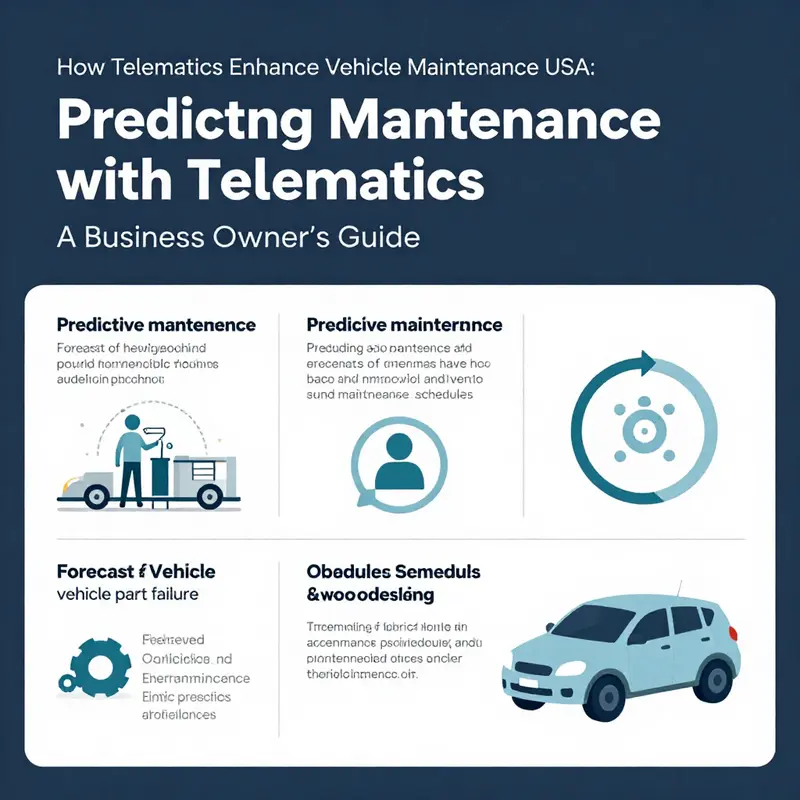
Telematics networks have become the nervous system of vehicle maintenance in the United States. Real-time data from telematics devices feeds maintenance teams with a steady stream of health indicators. These indicators come from the vehicle’s onboard diagnostic system and include engine performance, battery voltage, tire pressure, brake wear, and fluid levels. The data travels to centralized dashboards that fleets monitor around the clock. This visibility lets managers spot subtle shifts before a breakdown happens. If a sensor detects an engine temperature spike, an alert goes to the driver and the fleet manager. The response might be a safety maneuver, a nearby service check, or a planned repair. Maintenance becomes a continuous, data-driven discipline rather than a series of isolated fixes. The result is higher reliability across the operation and less uncertainty on every trip. Over time, the cumulative effect is fewer roadside incidents and smoother schedules for drivers who depend on consistent uptime.
Predictive maintenance innovations
At the core is predictive maintenance. Telematics collect history and live readings to forecast failed components. Machine learning models analyze trends across thousands of miles and dozens of vehicles. The goal is to replace fixed schedules with condition-based servicing. When engine temperature or vibration patterns deviate from normal, the system can flag a potential issue and schedule service before harm occurs. Industry studies back this shift. McKinsey & Company (2023) reports that predictive maintenance powered by telematics can cut maintenance costs by as much as 40 percent and reduce breakdowns by about 50 percent. Other research notes that predictive approaches can cut unscheduled downtime by up to half and lower overall maintenance costs by about a quarter. In practice, this translates to fewer surprise repairs, longer component life, and more consistent service levels across fleets.
Remote diagnostics
Remote diagnostics extend the reach of maintenance teams. When a fault code appears, technicians can access data remotely and review live vehicle information. They can often push software updates or calibration changes over the air. This minimizes unnecessary shop visits and times repairs to the actual condition, not an arbitrary interval. The U.S. Department of Energy notes fleets using remote diagnostics report shorter diagnostic times and faster repairs, with average time-to-repair reductions around 30 percent. The benefit goes beyond speed. Technicians arrive with a precise list of parts and tools, designed around the vehicle’s real problem. That accuracy reduces wasted labor and repeat visits. In practice, remote diagnostics accelerates the entire repair timeline and improves first-time fix rates, which helps drivers stay on the road and fleets stay on plan.
Integration with fleet management software and compliance
Teaming telematics with fleet management software creates a seamless maintenance ecosystem. Data feeds automatically generate maintenance work orders when thresholds are crossed. That automation eliminates manual reminders and helps fleets keep regulatory records up to date. For commercial operations, this is essential for inspections and audits. Recordkeeping now reflects actual vehicle health, not rough estimates. The integration also supports performance dashboards that help drivers adopt improved habits, such as gentler acceleration, smoother braking, and proper tire care. The result is a more resilient schedule that aligns maintenance with real wear and usage patterns across different routes and climates. In short, data-driven maintenance becomes a governance tool as much as an operational advantage.
Enhanced maintenance scheduling
Beyond alerts, telematics refines service cadence. By calculating correction coefficients based on driving conditions, road climate zones, terrain elevation, and usage intensity, fleets tailor maintenance intervals to real wear. Dynamic modeling improves the precision of both timing and labor requirements. The outcome is better resource planning, fewer unnecessary replacements, and quicker access to needed repairs. Researchers emphasize that context matters: a vehicle climbing hills in alpine valleys wears brakes differently from one cruising on plains. By capturing these nuances, maintenance forecasts become more accurate. The broader result is a data-informed discipline that respects the diversity of routes, weather, and loads across the United States.
Practical implications for fleets and drivers
Different fleets feel telematics in different ways. Commercial fleets gain steadier uptime, lower unexpected breakdowns, and clearer cost control. Small fleets and owner-operators benefit from fewer trips to repair shops and more predictable maintenance budgets. Personal vehicles can gain through maintenance reminders, remote diagnostics, and safety alerts that are usually bundled into consumer-ready apps. The essential advantage is decisions grounded in data rather than guesswork. When teams watch a long arc of measurements, they balance preventive tasks with actual needs, avoiding both under-maintenance and over-maintenance. This balance translates into safety on the road, more reliable schedules, and a better sense of readiness for peak seasons, heavy routes, or emergency deployments.
OTA updates, data security, and the human element
Over-the-air updates are a natural extension of predictive maintenance. Software and calibration can be deployed without a service visit. This keeps control systems aligned with the latest safety and efficiency updates. However, OTA brings security considerations. Strong data protections, encryption, and access controls are essential. The growing maturity of telematics also requires broader training. Technicians, fleet managers, and drivers must interpret dashboards, recognize early warnings, and respond quickly. Data is a tool, not a substitute for judgment. When teams combine clear dashboards with disciplined procedures, maintenance becomes a proactive culture that reduces risk, extends vehicle life, and keeps fleets resilient as conditions shift across the country.
For a grounding in maintenance fundamentals, see What is vehicle maintenance.
Taken together, telematics transforms maintenance in the USA from reactive repairs to proactive care. Real-time health monitoring, predictive scheduling, and remote diagnostics converge into a cohesive system that improves safety, reliability, and cost efficiency. The outcome is consistency: fewer surprises, longer vehicle life, and better returns on each mile. This isn’t a single upgrade but a transformation that aligns maintenance with actual wear, real-world usage, and the varied conditions on American roads. The next chapter explores how these data-driven practices intersect with sustainability goals and worker training across fleets.
External resource for further reading: https://www.fleetmanagementtoday.com/predictive-maintenance-trends-us-fleets-2025
From Real-Time Health to Real-World Uptime: How Telematics Elevate Vehicle Maintenance Across the USA

The maintenance story in the United States is being rewritten not by louder alarms or louder sirens, but by the quiet, relentless hum of data streams that travel from vehicle sensors to centralized dashboards. Telematics, once a niche capability for fleets with high mileage, has become the backbone of a maintenance philosophy that treats uptime as a core asset. Across commercial operations and even personal fleets, the shift toward continuous monitoring, predictive insight, and remote diagnostics is transforming how vehicles are cared for, how problems are found, and how repairs are scheduled. The result is not just fewer breakdowns, but a fundamental rethinking of what it means to keep a vehicle fit for service in a country with vast distances, varied climates, and a dense patchwork of road conditions.
Real-time health monitoring sits at the heart of this transformation. Modern telematics platforms collect a steady stream of data from a vehicle’s onboard diagnostic system, tracing engine performance, battery voltage, tire pressure, brake wear, and fluid levels. This stream travels to a centralized, often cloud-based, analytics layer where it is interpreted against thresholds, historical baselines, and patterns of wear. The moment a sensor detects an abnormal engine temperature, a spike in exhaust readings, or a slipping battery voltage, the system can ping the driver with a caution and alert the fleet manager that attention is needed. This is not about replacing a mechanic’s expertise; it is about surfacing the right signal at the right time so the right intervention occurs before a fault becomes a failure. In practical terms, real-time visibility shortens the distance between warning and action, reducing the chance that small anomalies evolve into costly, unscheduled downtime.
Yet the most powerful advantage lies in the convergence of continuous data with predictive analytics. Predictive maintenance reframes the maintenance calendar from calendar-based or mileage-based triggers to condition-based servicing driven by evidence. Machine learning models digest a blend of historical data, current sensor readings, and usage patterns to forecast when a component is likely to fail. It is a shift from “keep the shop busy on a fixed schedule” to “service based on condition,” with parts replaced only when necessary rather than on a clock. The business case for this approach has been quantified in industry analyses: McKinsey & Company reported that companies leveraging predictive maintenance through telematics can realize up to a 40% reduction in maintenance costs and a 50% decrease in breakdowns. That is more than a cost saving; it is a reliability dividend that translates into steadier operations, fewer emergency repairs, and greater predictability in scheduling.
Remote diagnostics extend this capability even further. When a fault code surfaces, technicians can remotely access diagnostic trouble codes and view live vehicle data before a technician even touches the vehicle. They can confirm which subsystems are implicated, what the fault likely means, and which parts and tools will be needed for a repair. This reduces diagnostic time in a way that traditional, in-shop diagnosis cannot, and it ensures that when the vehicle does come in, the shop has the right parts and the right expertise ready. The U.S. Department of Energy highlights that fleets using remote diagnostics report an average repair time reduction of about 30%. That reduction compounds with predictive maintenance to push the entire maintenance workflow toward a streamlined, data-driven cycle rather than a sequence of reactive events.
All of these capabilities are not isolated features; they integrate with broader fleet management ecosystems to generate robust maintenance programs. When telematics data feeds into fleet software, maintenance histories become comprehensive and auditable. Work orders can be automatically generated when thresholds are crossed or when retirements approach in the predictive model. Compliance with regulatory standards—such as FMCSA requirements for commercial vehicles—becomes a traceable, auditable process rather than a memory-based routine. Comprehensive reporting supports everything from safety inspections to audits, and the data archive serves as a living record of maintenance decisions and their justifications. This integration is particularly valuable in the United States, where fleets navigate a mosaic of state regulations, mileage demands, and service bay availability. The digital thread—from a sensor in the engine to a maintenance log in a software system—creates a continuous improvement loop for maintenance practices.
The practical implications of this shift extend beyond the fleet’s bottom line. Proactive maintenance improves vehicle reliability, safety, and performance. When technicians can anticipate wear and plan interventions around actual usage, vehicles spend more time in service and less time in the shop. This is especially important for operators who rely on predictable schedules, such as delivery networks and service fleets that must meet tight timetables across sprawling geographies. The integration of GPS and navigation data into maintenance planning further refines this process. By layering in road conditions, climate zones, elevation, and driving behavior, telematics can forecast how real-world operating environments accelerate wear on specific components. A cold climate, steep grades, and high-speed highway miles all contribute differently to brake wear, tire inflation demands, and coolant load. With these contextual factors, maintenance planning becomes sharper, reducing unnecessary service while ensuring critical components are tended to at the optimal time.
The advantages of telematics in maintenance stretch beyond precision and timeliness. They also improve the accuracy of maintenance periodicity and labor forecasting. When technicians see a live fault or a trend toward failure, they can allocate the right expertise and the exact parts needed for a repair. The net effect is a tangible reduction in vehicle downtime and a trimming of repair costs. In everyday practice, a fleet manager learns to schedule maintenance that aligns with actual wear profiles rather than generic intervals. This alignment reduces both wasted maintenance events and the risk of late interventions, creating a smoother overall lifecycle for each vehicle.
For practitioners seeking a concrete sense of how this translates into everyday decisions, consider the broader literature on the topic and the way it translates into real-world savings. In a narrative of practical applications, the Fleet Maintenance Magazine article on telematics and remote diagnostics paints a picture of fleets across the USA leveraging telematics to achieve greater reliability, lower operating costs, and enhanced safety. The article highlights case studies where remote diagnostics and predictive analytics shorten diagnostic time, optimize repair planning, and elevate maintenance outcomes. These stories underscore how data-driven maintenance is not a theoretical advantage but a daily reality for many operators who depend on consistent vehicle availability and predictable service expenses.
As these capabilities become more widely adopted, the maintenance conversation also shifts to a human-centric view. Telematics does not remove the mechanic from the equation; it augments the technician’s toolkit with precise data and faster access to the vehicle’s evolving state. In the hands of skilled technicians, remote diagnostics and predictive insights become a proactive diagnostic partnership. The technician arrives not with a roll of guesswork but with a data-informed hypothesis and a tailored parts list. This collaboration accelerates problem resolution, minimizes the risk of misdiagnosis, and reduces the total time a vehicle spends out of service. The result is a maintenance ecosystem that respects the realities of the road while elevating the standards of care.
To connect this broader narrative to a practical, day-to-day perspective, it helps to recall a familiar facet of maintenance culture: cost control. Telematics-enabled maintenance drives efficiency not just through fewer breakdowns, but through smarter spending. The ability to forecast needs means fewer last-minute parts purchases and less idle labor time wasted waiting for the right component to arrive. It also means a more disciplined approach to maintenance budgeting, where decisions are anchored in real operating data rather than best guesses. This is a quiet, disciplined transformation that pays off in reduced total cost of ownership and steadier capital planning over the vehicle’s life cycle. For readers curious about how this translates into tangible savings in a broader maintenance context, a discussion of how vehicle maintenance can save on fuel expenses offers a connected line of inquiry and a practical reminder that every maintenance decision has a downstream effect on operating costs. how-vehicle-maintenance-saves-on-gas-expenses
As telematics mature, the differentiation between commercial and personal fleets begins to blur. The same principles that enable a logistics operator to anticipate tire wear and brake service translate to individual owners who want a safer, more reliable vehicle. Real-time health data, predictive alerts, and remote diagnostics are equally applicable whether a fleet is composed of dozens of semis or a handful of family cars. The scale of impact is large in the aggregate: fewer unscheduled repairs, less downtime on the road, and more time spent on the things that matter to operations, whether that is meeting a delivery window, maintaining a service schedule, or simply keeping a vehicle ready for daily use. The American maintenance landscape is being redefined by the disciplined, data-infused approach that telematics enable, a shift that aligns with broader trends in industrial digitalization while remaining firmly grounded in the practical realities of miles driven, weather faced, and the miles yet to be traveled.
In the end, telematics do more than catch faults earlier or optimize a maintenance calendar. They construct a continuous, evidence-based conversation about vehicle health across the United States. The data that streams from engines, brakes, tires, and batteries becomes the vocabulary by which maintenance decisions are made. It is a conversation that blends predictive foresight with hands-on expertise, scheduling with availability, and regulatory compliance with operational realities. The maintenance future is not hypothetical; it is here, threaded through with real-time alerts, data-rich diagnostics, and proactive service plans that keep vehicles safer, more reliable, and more cost-efficient as they traverse the country’s diverse roads.
External reference for further perspective: https://www.fleetmaintenance.com/telematics-remote-diagnostics-maintenance
Data-Driven Turnaround: Telematics and Fleet-Software Synergy in U.S. Vehicle Maintenance
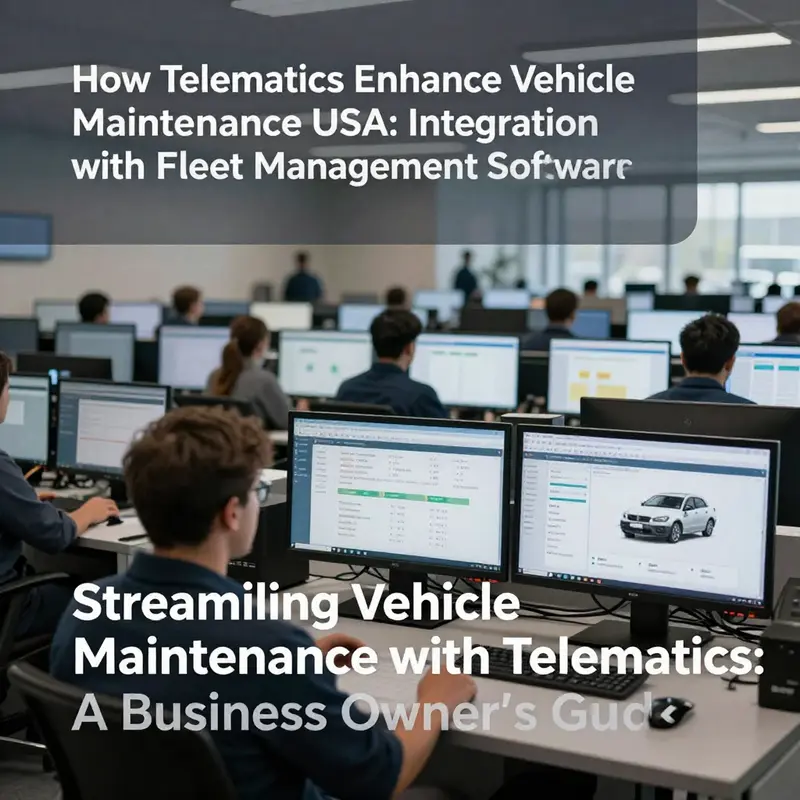
Data has moved from a peripheral detail to the central nervous system of vehicle maintenance. In U.S. fleets, telematics turn streams of sensor data into actionable insight, enabling maintenance that is continuous, proactive, and aligned with operations.
Real-time health monitoring collects signals from the vehicle’s OBD interface, engine sensors, battery health, tire pressure and wear, brake pad thickness, fluid temperatures, and electrical system indicators. When a parameter drifts, alerts can be sent to drivers and fleet managers, enabling scheduling before a fault becomes a roadside emergency.
Predictive maintenance uses historical trends and machine learning to forecast failures and optimize service windows. This shifts maintenance from fixed miles to condition based planning, delivering reductions in costs and breakdowns. While the exact numbers vary by fleet, many organizations report meaningful savings through timely interventions and reduced unplanned downtime.
Remote diagnostics allow technicians to access diagnostic trouble codes and live vehicle data remotely. This capability enables right sized parts and tools during on site visits, reducing repair times and enabling more predictable scheduling for road operations, service bays, and warehousing of spare parts.
Integration with fleet management software creates a closed loop in which telematics feed maintenance calendars, work orders, and compliance logs. Automated work orders can be generated when a threshold is crossed or a predictive window approaches, with parts reserved and schedules adjusted to minimize disruption to service and delivery timetables.
Adaptive scheduling uses correction coefficients based on terrain, climate, load, and operating hours to tailor maintenance intervals. Vehicles that routinely operate in steep, cold climates with heavy payloads may need maintenance earlier, while light use in temperate conditions can extend intervals without compromising reliability. This adaptive approach makes inventory management more efficient and reduces surplus stock.
For managers, the payoff is higher uptime, better utilization, and clearer visibility into maintenance costs. Unified dashboards reveal engine, brake, tire, and transmission health across the fleet, supporting strategic decisions about replacements, route optimization, and staffing. The resulting audit trails support regulatory compliance and internal governance, especially in operations with complex routes or strict reporting requirements.
Ultimately, the promise of telematics lies in turning data into disciplined action. Real time monitoring detects incipient issues, predictive analytics forecast needs before failures occur, remote diagnostics accelerate repair, and seamless integration with fleet software converts signals into automated workflows, optimized schedules, and compliant record keeping. The outcome is a maintenance culture anchored in evidence and execution, delivering reliability, safety, and value at scale.
Real-Time Compliance Engine: How Telematics Redefines Vehicle Maintenance in the USA
Real-Time Compliance Engine: How Telematics Redefines Vehicle Maintenance in the USA
In the modern landscape of the United States, telematics sits at the intersection of maintenance, safety, and accountability. It is not merely a tool for tracking location; it translates miles driven, engine signals, and service histories into a single auditable record. This shift matters most for compliance. Federal and state regulators demand precise logs of vehicle usage, timely maintenance, and transparent maintenance records. Telematics collects real-time data from the vehicle’s onboard systems and sensors and stores it in a digital ledger that travels with the fleet across routes, shifts, and maintenance cycles. The result is a continuous, auditable narrative of how each vehicle is cared for, why a service was performed, and when it is due again. The practical effect is that maintenance planning becomes a regulatory ally rather than a bureaucratic burden.
The data stream underpinning this narrative is robust. Telematics gathers mileage, engine diagnostics, hours of operation, idle time, tire pressures, brake wear indicators, fluid levels, vehicle speed history, and service events. Each data point is time-stamped and linked to a unique vehicle. When a pattern points toward wear or imminent failure, alerts trigger a conditional maintenance workflow. This is where the shift from calendar-based schedules to usage-based maintenance becomes visible. Instead of replacing a part on a fixed mileage mark, the system flags the part for service when operating conditions indicate higher risk. The organization benefits by avoiding unnecessary service while ensuring critical components are addressed before they threaten safety or uptime. As a result, fleets achieve more predictable maintenance windows and improve capital planning. The central repository also makes regulatory reporting less fragmented, since data can be filtered by date ranges, vehicle groups, or each driver’s duty cycles. McKinsey & Company (2023) reports that fleets leveraging predictive maintenance through telematics can see up to a 40% reduction in maintenance costs and a 50% decrease in breakdowns, underscoring the financial payoff of data-driven repairs.
Remote diagnostics extend the benefits beyond the workshop. When a fault code or abnormal data is detected, technicians can access remote diagnostics and view live data before the vehicle arrives. They can confirm which subsystem is affected, check related sensor readings, and prepare the right parts and tools. This reduces diagnostic time and speeds up the repair process. In practice, remote access often shortens total repair time by a sizable margin, while ensuring the diagnostic effort aligns with actual needs rather than guesswork. The driver experiences less downtime and a smoother maintenance handoff. The fleet manager benefits too, receiving a precise, testable rationale for each repair and a clear record that can be audited during regulatory reviews. This is especially valuable when hours-of-service logs and vehicle maintenance logs must align under FMCSA oversight, and it supports better duty-cycle tracking for long-haul operations. In addition, the capability to pre-qualify service needs helps shops prepare with the exact parts and tools, reducing the congestion of back-to-back repairs and keeping the schedule predictable for drivers and planners alike.
The centralization and standardization of maintenance records are perhaps the most tangible compliance advantages. Telematics platforms generate a continuous audit trail that documents every maintenance action, the reason for service, who authorized it, and the parts used. The log becomes a living document that travels with the vehicle through ownership changes, depots, and vendors. For fleets, this means easier inspections, more accurate regulatory reporting, and a dramatic reduction in the effort required to produce proof of compliance. Departments responsible for safety, regulatory oversight, and financial control can rely on a single source of truth rather than stitching together data from disparate systems. The result is less risk of misreporting, fewer delays in inspections, and greater confidence that the fleet meets federal hours-of-service requirements and vehicle maintenance standards. The automated capture of maintenance events also helps demonstrate due diligence during audits, with a clear chain of custody for each entry and a defensible timeline that regulators can follow with minimal ambiguity.
Beyond the mechanics, there is a governance story. Data governance matters when the stakes include fines, suspensions, or increased regulatory scrutiny. Telematics providers emphasize secure data storage, role-based access, and retention policies that preserve records for periods required by regulation. Because maintenance histories are part of compliance, any gaps in data become vulnerabilities. Replacing or retrofitting a log with ad hoc notes may seem expedient, but regulators expect consistency and traceability. Telematics helps maintain discipline by preserving an immutable chain of events: alarm, action, and outcome. In the U.S., regulators care about the integrity of maintenance logs and the alignment of hours-of-service data with actual activity. The more complete and transparent the data, the easier it is to defend decisions during audits and investigations. As compliance expectations tighten and digital audits become standard practice, the value of a trustworthy data backbone grows, turning what used to be a paper chase into a streamlined, auditable process that supports continuous improvement rather than episodic compliance.
The practical implications extend to different stakeholders. Drivers gain peace of mind knowing routine service is triggered by usage, not arbitrary schedules. Technicians receive precise fault codes and live data streams before arrival, reducing guesswork and accelerating repair. Fleet managers gain a dashboard view of maintenance health across operations, with automated reminders and standardized reporting templates. Compliance teams acquire a defensible, up-to-date repository that demonstrates due diligence. The cultural effect cannot be overstated: a data-informed maintenance culture fosters proactive thinking, continuous improvement, and a shared language about safety and accountability. In this environment, preventive maintenance becomes a strategic asset that protects people, cargo, and reputations. And when fleets operate across multiple jurisdictions, the centralized data view helps harmonize maintenance practices with differing state requirements, minimizing the administrative load while preserving regulatory integrity.
A final dimension concerns integration with broader fleet management ecosystems. Telematics does not live in isolation; it speaks to maintenance management modules, scheduling tools, and reporting systems. When you couple live vehicle health with route data and driver behavior analytics, you gain insight into the true cost of maintenance per mile, seasonality effects on wear, and the efficiency of repair workflows. Automated work orders can be created the moment a sensor trips, with parts requests, technician assignments, and service bay reservations in a single, auditable sequence. The dataset becomes a living policy document: when a regulator asks how a maintenance decision was made, the record shows a traceable chain of data, analysis, and action. This transparency strengthens compliance programs and reduces the friction of audits while preserving operational resilience.
For readers seeking a familiar touchstone, a simple portal into the broader maintenance conversation is useful. See What is Vehicle Maintenance. This anchor helps link the regulatory and operational elements of telematics to everyday practice, ensuring the narrative remains practical and accessible to managers who must balance safety, uptime, and cost. The reference is intentionally straightforward, reminding readers that the technology exists to support, not replace, the fundamentals of maintenance discipline.
As the U.S. fleet landscape evolves, telematics will continue to shape how compliance and maintenance intersect. The ongoing challenge is to keep data accurate, secure, and usable for decision making. With real-time monitoring, predictive maintenance, and remote diagnostics, the maintenance function becomes a disciplined, proactive practice rather than a reactive necessity. The file of evidence expands beyond a single document or repair receipt; it becomes a comprehensive, context-rich testimony about how a fleet manages risk, maintains service quality, and meets the expectations of regulators, customers, and drivers. In this sense, telematics is not a substitute for human judgment but a powerful amplifier of it. It provides high-quality signals that guide timely actions, align fleets with regulatory standards, and drive cost efficiency through precise, evidence-based maintenance planning.
The takeaway is clear: telematics elevates maintenance from a compliance checkmark to a strategic capability. It aligns usage, health, and service within a coherent, auditable framework that thrives on data integrity. In the United States, where regulatory oversight is nuanced and increasingly sophisticated, the ability to demonstrate maintenance diligence through trustworthy data is not optional. It is a foundation for reliability, safety, and sustainable operations. By transforming maintenance records into living, machine-generated histories, telematics helps fleets anticipate failures, minimize downtime, and sustain performance across seasons, routes, and fleets of all sizes. The implications extend to insurance costs, resale value, driver retention, and public confidence. If maintenance decisions are made with real-time health signals and a clear audit trail, the entire operation gains in clarity, speed, and accountability.
External resource: For a comprehensive overview of how telematics improve compliance and record keeping in the U.S. fleet management context, refer to the official resource provided by the American Trucking Associations: https://www.trucking.org/telematics-and-compliance
Final thoughts
The integration of telematics into vehicle maintenance represents a significant shift towards efficiency and proactive management for business owners. By leveraging real-time monitoring, predictive maintenance, streamlined diagnostics, and integrated fleet management software, businesses can reduce operational costs while enhancing reliability and safety across their fleet. The transition from reactive to proactive maintenance not only improves vehicle uptime but also ensures a more organized approach to compliance and record-keeping. As the landscape of vehicle maintenance continues to evolve, adopting telematics technology stands out as an essential step for modern businesses aiming for increased efficiency and successful fleet management.