
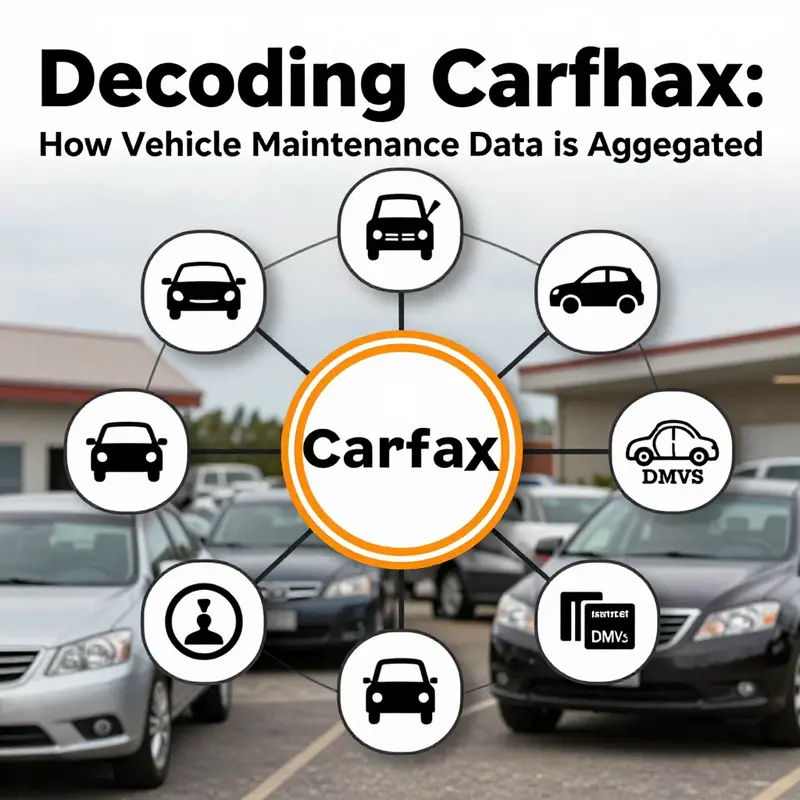
Understanding the vehicle maintenance history is crucial for business owners who rely on automobiles for their operations. Carfax, a leading name in vehicle history reporting, aggregates information to create a comprehensive overview of a vehicle’s maintenance and repair background. This article will delve into how Carfax obtains this important data from multiple sources, including automotive manufacturers, dealerships, repair shops, insurance companies, and state DMVs. Each chapter will shed light on specific data sources and their significance, ultimately providing you with a clearer picture of Carfax’s data acquisition process and its importance in informed vehicle purchasing or leasing decisions.
The Maintenance Mosaic: How Carfax Reconstructs a Vehicle’s Service History from Manufacturers, Dealers, and DMV Data

Carfax builds a maintenance timeline by stitching together data from manufacturers, dealers, service centers, insurers, and DMVs. This multi-source approach creates a verified chronology of service events linked to a vehicle’s VIN, helping buyers assess how well the car has been cared for. Manufacturer-sourced records are highly reliable because they come from authorized facilities in standardized formats that capture service type, mileage, date, and parts used. Dealerships and independent shops contribute additional entries that are cross-checked to prevent duplicates. Insurance claims add context for accident-related repairs, while DMV data provide odometer readings and title history that anchor the timeline across jurisdictions. While not every oil change makes it into Carfax, the overall mosaic offers a practical view of maintenance patterns and reliability, especially when paired with a professional inspection. The VIN remains the unifying key, ensuring continuity across owners and borders. In short, Carfax’s maintenance mosaic combines multiple data streams into a coherent history, with the caveats that reporting gaps remain and a thorough inspection is still advised. For readers seeking more context, external resources on vehicle history reporting can provide additional background.
From Service Slips to the History Log: How Carfax Builds Vehicle Maintenance Records
Carfax doesn’t merely collect a list of repairs; it curates a living timeline of a vehicle’s care. The backbone of maintenance data is a vast, diversified network that stretches across North America. The company reports drawing from more than 151,000 data sources, a breadth designed to capture both broad trends and the small, telling details of how a car has been kept. These sources span familiar categories: automotive manufacturers that log warranty services at authorized dealerships; dealerships and independent repair shops that voluntarily share service histories; insurance companies that record claims and repairs; state Departments of Motor Vehicles that provide title information, registration data, and odometer readings; as well as towing and rental companies that document incidents during which a vehicle enters a shop. Auto recyclers and salvage yards contribute by flagging vehicles declared totaled or salvaged, information that can alter how a maintenance history is interpreted. Each stream does not operate in isolation. Carfax’s systems merge them, align them under a common vehicle identity, and present them as a coherent history rather than a scattered set of notes. Buyers are drawn to the maintenance section of a Carfax report because it promises a narrative of care, not just a ledger of fixes. Yet the reality is nuanced. Not every maintenance event gets reported, and the absence of a record doesn’t prove the absence of care. The most reliable signals often arise from dealership or manufacturer channels, but a service performed at an independent shop that doesn’t feed data into Carfax may remain invisible. The challenge for Carfax is to separate signal from noise, to determine which events matter for risk and value, and to present them in a format that is readable alongside the mileage curve and title history. In practice, this means the system continually tests entries against known patterns of maintenance and vehicle behavior, using established data rules to reduce duplication and to flag anomalies that might warrant closer inspection. The goal is not to replace professional judgment but to give buyers a firm foothold from which they can plan a more informed inspection or negotiation. That foothold rests on the trust that the maintenance timeline reflects real care: regular oil changes, timely brake work, and the kind of preventive service that extends a car’s life. It also rests on an understanding of what maintenance data does not prove. A missing oil-change entry does not confirm neglect, just as a long gap between services does not automatically predict failure. The Carfax narrative, then, is best read as a guidepost—a map of care that should be cross-checked with receipts, service records, and a competent pre-purchase assessment. The result is a stronger, more transparent picture of a vehicle’s past, one that helps buyers gauge future reliability without pretending a single document can capture every moment of a car’s life.
Signals from the Claim: How Insurance Data Shapes Carfax’s Maintenance History
When people set out to buy a used car, they often turn to a vehicle history report to understand what happened to the car before they met it. Carfax has built a history by gathering data from a wide network of sources across North America, and among the most influential are insurance companies. These insurers become a conduit for information about the maintenance and repairs that follow after an incident or covered event. The chain of data begins with a claim and ends with a documentation trail that, once integrated into Carfax’s database, helps prospective buyers form a more complete story about a vehicle’s recent life. The logic is practical: a claim filed for a collision or a covered damage event triggers a set of records that describe the repairs, the parts replaced, and the work performed. When this information is shared with Carfax, it enters the vehicle’s history as a verified data point. In this sense, insurance data functions as a bridge between what happened to a car and what was done to fix it, a bridge that makes the history report more revealing than a simple odometer reading or an owner’s memory could be alone. The trust in this bridge rests on the premise that insurers compile meticulous documentation, with timestamps, service codes, and repair notes that anchor the narrative to specific dates and events. Carfax then cross-references these entries with other data streams to minimize duplication and to place repairs within the broader arc of the vehicle’s maintenance timeline. The result is a story that can highlight major work tied to an incident, such as airbag replacement after a collision, structural repairs following a frame-repair protocol, or weather-related damage that required significant restoration. Yet a reader should also recognize where this data stops short. Insurance claims are not a universal stamp for every routine service. They capture events that were claimed under a policy, not every oil change, tire rotation, or brake service performed during the vehicle’s lifetime. The maintenance narrative Carfax presents through insurers is therefore selective, foregrounding the work that reached the claims process, not the perfectly ordinary maintenance that keeps a car running between incidents. For buyers, this means Carfax provides critical insight into the car’s resilience and the quality of its post-accident repairs, which matters when evaluating structural integrity or the likelihood of hidden issues stemming from a high-impact event. It also means that the absence of an insurance claim in Carfax is not a guarantee that a vehicle had no maintenance at all; it simply reflects what insurers submitted through their networks. The broader maintenance story tends to be richer when paired with other sources, such as dealer service records and independent shop reports, where available. To understand how this data fits into the larger mosaic, it helps to acknowledge the life cycle of an insurance claim. After an incident, the insurer documents the damage, assigns a claim number, and orchestrates the repair work with approved service providers. Those repairs often generate invoices, work orders, and parts lists. When these records are shared with Carfax, they become visible as maintenance entries, sometimes including the type of service, the dates, and even the estimated costs. This specificity is valuable because it gives a sense of how aggressively a vehicle was repaired after damage and whether repairs were comprehensive enough to restore original performance. The same mechanism applies to non-collision repairs that fall under an insurance policy, such as weather-related damage or theft-related repairs that involve police notification and subsequent claim processing. Each entry adds a thread to the vehicle’s maintenance tapestry, helping future owners assess how the car was cared for after a service interruption. For readers, the nuance lies in recognizing that this thread is part of a larger fabric. It must be interpreted in context with normal maintenance patterns, which Carfax does not intend to replace but rather to illuminate where a claim-driven patchwork of repairs intersects with routine upkeep. This nuance becomes especially important when evaluating cars that have frequent claim activity. If a vehicle shows multiple insurance-driven repairs over a short window, a buyer might reasonably investigate whether the car experienced recurring damage. Conversely, a single major repair tied to an accident need not be a red flag if it was properly handled, documented, and followed by diligent maintenance. The key is to read these data points as evidence of repair history rather than a complete maintenance ledger. In practice, Carfax’s reliance on insurers helps deliver a more trustworthy view of major service events rather than an exhaustive catalogue of every oil change. It is precisely this emphasis that makes the insurance channel a powerful lens for buyers seeking to understand risk, while still requiring corroboration from a trusted mechanic’s inspection or from direct service records when possible. Carfax’s approach also entails rigorous data handling to ensure accuracy. Insurance data arrives through a network of partners that share standardized formats to facilitate matching with a vehicle’s unique identifiers—such as VINs and registration details. Once ingested, the system cross-references the claim data against other reported events, matching dates, service codes, and repair descriptions. This cross-checking helps to reduce duplicates and to place each maintenance entry into a coherent timeline. The care taken in verification matters. When a buyer sees a maintenance event tied to an insurer, they can be more confident that the entry reflects a real repair or service that was connected to a claim rather than a miscategorized note. Yet even with verification, the picture remains incomplete by design. Not every repair is claimed, not every insurer participates in the same data-sharing network, and not all independent repair work is captured unless linked to a claim or reported directly by the shop or dealer. This reality underscores the value of supplementing Carfax with professional inspections and, where possible, direct service records from the shops that worked on the vehicle. The result is a more robust, layered understanding of how well a car has been cared for after incidents and how that care translated into continued reliability. For someone evaluating a specific vehicle, the insurance-driven maintenance entries should prompt questions. What was repaired, when, and to what standard? Were parts replaced with original equipment or aftermarket alternatives? Did the repairs align with a manufacturer’s recommended repair path? A diligent buyer or technician can use Carfax as a guide to identify points of interest and then pursue deeper verification. This is where the narrative converges with practical due diligence. The maintenance clues from insurance claims become part of a larger investigative process: reviewing service intervals, inspecting the quality of repairs, and assessing whether the vehicle’s structural or mechanical integrity was preserved after a claim. It’s also a reminder that maintenance history is not a solitary verdict but a dialog between information sources. Carfax’s data is not intended to replace professional evaluation; instead, it serves as a compass that points toward areas of focus for further inspection. For readers who want to navigate this landscape with a practical mindset, it helps to think about how claims-oriented data complements routine maintenance records. If the car has been through a major repair process, a buyer should expect to see follow-up maintenance that supports long-term durability. If a vehicle shows a clean claim history but limited routine maintenance records, the buyer may want to verify consistency through current service records and an independent inspection to confirm there are no latent issues hidden beneath the surface. The broader takeaway is that insurance data offers a credible, event-driven substory within Carfax’s broader history. It highlights what happened and how it was addressed, which is often more consequential than a mere log of regular services when assessing repair quality and future risk. This substory, when understood in concert with other sources, equips buyers to form a more informed judgment about a car’s past and its probable trajectory. For readers who want to deepen their understanding of what maintenance means in practice, a good starting point is to explore a general definition that frames routine care versus repair-driven work. See what is meant by vehicle maintenance and how it differs from repairs by consulting a foundational overview of maintenance concepts. What is vehicle maintenance?. While you read, keep in mind that Carfax’s insurance-linked data is just one lens among many, and the most reliable assessments balance historical records with professional inspection. External corroboration can help distinguish a well-kept repair from a patchwork fix. For those who want to explore how this data fits into the broader landscape of vehicle history reporting, the official Carfax details provide additional context on data sources and reporting practices: https://www.carfax.com/vehicle-history
null
null
The Fine Print of Carfax Maintenance Data: How Records Are Gathered, What They Show—and What They Might Miss
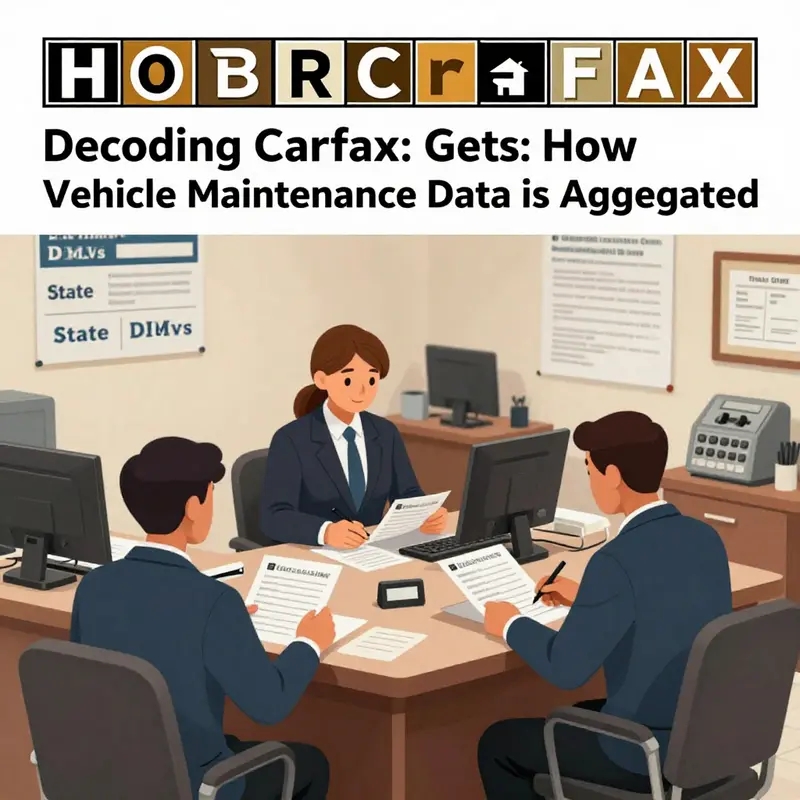
Carfax presents itself as a chronicle of a vehicle’s life, a ledger that strings together the moments a car was serviced, repaired, or involved in a claim. Yet the maintenance chapter within that ledger is not a complete diary. It is a curated mosaic built from a broad, multi-source network, designed to deliver a coherent view of a vehicle’s history while acknowledging that some pages remain unwritten. To understand how Carfax gets vehicle maintenance, it helps to follow the chain of data and the logic that binds seemingly disparate scraps into a usable narrative for buyers, sellers, and inspectors alike. Carfax collects maintenance and repair information from a diverse ecosystem that spans manufacturers, dealers, independent shops, insurers, and government agencies. In North America, this network includes auto manufacturers that record warranty service or scheduled maintenance performed at authorized service centers; dealership service departments and certified repair shops that voluntarily share service events; insurance providers that report claims, repairs, or total-loss events; state DMVs that supply title history, registration data, and sometimes odometer readings; and even towing and rental outfits that document incidents or vehicle damage. In practice, each of these sources contributes a fragment of evidence, a timestamp and a service code that the Carfax system later stitches together with other fragments. The value of this mosaic lies in cross-referencing. If the same service event appears across several data streams, it gains credibility; if an inconsistency pops up, it triggers scrutiny and potential correction. The goal is accuracy, but the reality is more nuanced. Not every maintenance action makes it onto Carfax’s radar, and not every entry that lands in the system is equally informative. The scope of reporting matters as much as the reporting itself. For instance, many manufacturers provide service history when a vehicle comes in for warranty work or for routine maintenance at an authorized dealership. Dealerships and repair shops that participate in Carfax’s network submit service and repair records, which helps fill in gaps left by other sources. Insurers contribute claims data, which can reveal costlier events tied to accidents or comprehensive damage. DMVs contribute title histories, registrations, and odometer data that help anchor the vehicle’s timeline and prevent fraud. Towing and rental agencies can document incidents that affect a vehicle’s history, while auto recyclers and salvage yards alert buyers to total-loss designations or salvage events. All of this adds up to a dataset that can illuminate maintenance milestones and major events alike. Yet the same network that enriches the history also introduces limitations, especially when it comes to routine, everyday upkeep. Carfax’s documented maintenance tends to reflect what is reported through participating channels. Routine oil changes, tire rotations, brake pad replacements, and other regular services performed at independent, non-participating shops may never appear in a report. The degree to which these routine services are captured varies with geography, ownership of the shop, and the shop’s willingness to share data. In some regions, independent shops may participate more actively in Carfax’s system than in others, which can create geographic skews in the maintenance record. These gaps matter because a history that omits regular maintenance can obscure patterns buyers might otherwise use to gauge vehicle care. The timing of entries is another practical challenge. There can be delays between when a service is performed and when the record appears in Carfax. Weeks or even months can pass, especially if the service occurs at a smaller shop or if the information travels through several intermediaries before reaching Carfax. Delays complicate the interpretation of a vehicle’s maintenance momentum, particularly for buyers who are evaluating a recent purchase and rely on up-to-date information. Carfax also faces limitations tied to vehicle type and origin. Older vehicles, certain imported models, or vehicles with non-standard identifiers can present tracking complications. If a VIN has a complicated history, or if a vehicle has passed through jurisdictions outside Carfax’s primary operating regions, some maintenance events may not be captured, or they may be misattributed. While cross-referencing helps, it cannot fully compensate for missing data. A further linguistic and informational constraint lies in the level of detail that maintenance records provide. Carfax notes that it does not typically capture the quality of workmanship, the parts used, or whether a service was preventive or problem-driven. A generic entry like “Brake Service” tells you that brakes were serviced, but not whether rotors were resurfaced, pads were replaced with OEM or aftermarket parts, or whether a particular defect was corrected. In other words, the maintenance entries describe the occurrence of a service, not the quality or outcome of that service. This distinction is important for buyers who use the report to assess risk. A record of service demonstrates that a vehicle has been attended to at various points, but it does not certify that every service was performed to the highest standard or that no subsequent issues arose from it. At the same time, the report tends to emphasize non-routine events that carry significant implications—accidents, title issues such as salvage or flood designations, odometer concerns, recalls, and major repairs. Routine maintenance is more likely to be visible when it intersects with a larger event. For example, a brake repair linked to an accident or a recall-related replacement may surface more readily than a routine oil change performed years earlier. The driving logic behind this prioritization is practical: high-impact events are easier to verify across multiple sources and more consequential for a vehicle’s value and safety. But it also underscores a critical caveat for readers. Carfax should be used as a tool within a broader due-diligence process. It is most powerful when integrated with a professional inspection, a hands-on assessment of the vehicle’s condition, and a review of any available maintenance receipts from participating sources. Those receipts can sometimes provide granularity that the Carfax entry does not, such as the exact parts used or the service interval details that the manufacturer recommends. For readers seeking a deeper understanding of what the maintenance concept encompasses, a broader definition can help place Carfax data in context. Maintenance includes routine services that aim to prevent problems and extend life, not just repairs after failures. To explore this dimension, consider the concept of maintenance as a practice rather than a single event, and examine how it aligns with preventive care versus reactionary fixes. See a concise overview of the maintenance idea here: what is vehicle maintenance. This framing helps readers interpret Carfax entries against a broader lifecycle view of a vehicle’s care. Another lens is to consider the data gaps as a natural consequence of a decentered maintenance ecosystem rather than a failure of the system. Carfax’s strength lies in its aggregation from many credible streams, offering a reasonably comprehensive history for most vehicles. Yet the real world of car care involves thousands of independent technicians, small shops, regional networks, and non-reporting repair events. In that sense, the Carfax history is a robust, curated narrative rather than a complete diary. Buyers should read it with a critical eye, noting both what it reveals and what it cannot reliably attest to. The absence of routine maintenance in some records does not automatically signal neglect; it may simply reflect a lack of reportable data from non-participating shops. Conversely, the presence of a repair entry can be an invitation to probe further, asking the seller or a mechanic about the context of that service, the parts used, and whether other associated services were performed in nearby intervals. In practice, this means Carfax is best used as a starting point for investigation. Use the report to spot red flags—sudden gaps in history, unusual clusters of events, or discrepancies in odometer readings—and then corroborate with receipts, inspection notes, and the vehicle’s own maintenance schedule. The layered approach—Carfax data supplemented by physical inspection and, when possible, direct maintenance records from participating providers—offers the most reliable pathway to understanding a vehicle’s true care history. As you navigate this terrain, you’ll find that the Carfax data story mirrors the broader reality of vehicle care: a useful, often illuminating record that is not a guarantee, and a reminder that the most trustworthy assessment comes from triangulating multiple sources. For readers, that means treating maintenance data as one informative strand in a larger tapestry, not the sole determinant of a vehicle’s worth or condition. The Carfax history remains a valuable lens through which to view maintenance milestones and major events, but the careful buyer will always pair it with professional insight and, where possible, direct documentation from service providers. External resource: https://www.carfax.com
Final thoughts
In summary, Carfax plays a pivotal role in aggregating vehicle maintenance history, providing valuable insights for business owners contemplating vehicle purchases or leases. By tapping into a diverse array of sources—from automotive manufacturers to insurance companies—Carfax assembles a thorough report that highlights a vehicle’s past. However, understanding the limitations of this data is equally important to paint a complete picture of a vehicle’s condition. As you make decisions for your business, utilize Carfax’s comprehensive insights alongside professional inspections to ensure informed choices that align with your operational needs.