

As a business owner, understanding the financial implications of vehicle maintenance can significantly impact your bottom line. Whether you operate a delivery service, run a mobile business, or simply use your personal vehicle for work-related tasks, knowing the ins and outs of tax deductions related to vehicle maintenance is crucial. This article delves into how you can write off vehicle maintenance costs, emphasizing the importance of business use, types of deductible expenses, record-keeping practices, and methods of deduction. Each chapter equips you with knowledge to optimize your tax strategy and enhance your financial efficiency.
The Ledger of Upkeep: How Vehicle Maintenance Becomes a Legitimate Business Write-Off

Vehicles often wear two hats in a business: they are tools of productivity and, for many owners, portable offices. The costs to keep that vehicle running—oil changes, tire rotations, brakes, and unexpected repairs—are not merely maintenance; they are investments in reliability that enable work to get done. When you review your tax position, the question shifts from whether maintenance is a cost to how much of that cost you can legitimately offset against business income. The answer hinges on two threads: how the vehicle is used for business and how meticulously you document that use. The goal is to align accounting with reality, not to fit a single rule to every situation. In practice, most small business owners find that properly attributed maintenance costs can meaningfully reduce taxable income, but only when the use and the expenses are clearly connected to business activity and supported by solid records.
To understand the mechanics, it helps to keep straight what people often confuse: writing off maintenance costs versus writing off the vehicle itself as a total loss after damage. The latter describes an impairment that ends a vehicle’s economic utility in a given year and is treated as a different tax event. What we’re focusing on is the deductibility of maintenance expenses tied to business use. In many jurisdictions, the answer is yes, but it comes with important caveats. A vehicle used primarily for business, with careful traceability of travels and expenses, can yield meaningful deductions. The practical criterion is that the vehicle must be used more for business than for personal purposes, and the reflections of that use must be well documented. If you log the miles and keep receipts, you lay the groundwork to justify the deduction should questions arise.
There are two main routes to claim these deductions, and which route you pick can shape your year more than you might expect. The first is the standard mileage rate. This method allows you to deduct a fixed amount per business mile driven. It is simple: one number per mile, designed to cover all costs associated with operating the vehicle for business purposes, including maintenance, depreciation, insurance, and fuel. The second route is the actual expense method. Here, you tally every operating cost—fuel, insurance, registration, repairs, maintenance, and depreciation—and apply the business-use percentage to determine how much of those costs you can deduct. The math changes depending on how much you rely on the vehicle for business and how you choose to allocate costs.
For a grounded sense of what maintenance actually encompasses, consider the practical definition of upkeep and repairs. The routine tasks—oil changes, tire replacements and rotations, brake services, battery replacements, and fluid flushes—are typical candidates for deduction when they are tied to business use. More specialized services and repairs that restore the vehicle after wear and tear can also be included if they are necessary to keep the vehicle in service for business purposes. Even car washes or detailing can enter the mix, but only if those services are directly related to presenting a professional appearance or ensuring the vehicle is suitable for business use. The essential principle remains: the costs must be attributable to business activity, not to purely personal trips. A helpful way to frame this is to view maintenance as a mechanism that preserves the vehicle’s capacity to generate business income, rather than as a personal luxury.
To ground the theory in a concrete workflow, you begin with documentation. You should maintain receipts, invoices, and a mileage log that distinguishes business miles from personal miles. The documentation should clearly connect each maintenance expense to the vehicle and to a business purpose. If you have multiple vehicles, you should track each one separately, ideally with a vehicle-specific log that notes the business use percentage for that specific asset. This practice becomes particularly important if you use more than one vehicle for different business activities—such as client visits, deliveries, or transporting equipment. In such cases, your deduction becomes a proportion of total costs, allocated according to the share of business use per vehicle. The precise calculation depends on the method you choose, but the requirement for clean, auditable records remains constant.
Under the standard mileage rate, the temptation lies in simplicity. You do not need to itemize every maintenance bill, but you do need to be confident that your miles are accurately recorded and that the chosen rate reasonably approximates the costs of operating the vehicle for business. Rates are set annually and can change; for example, the 2024 rate hovered around 67 cents per mile in many jurisdictions. If you drive 5,000 business miles in a year, the calculation with that rate would yield a deduction of roughly $3,350, assuming your business miles align with that figure. The standard method is particularly appealing when maintenance costs spike less than your mileage or when you prefer not to maintain meticulous expense records for every repair. It also provides a cushion for smaller or fluctuating repair bills because those costs are folded into the flat per-mile deduction. Nevertheless, you still must maintain credible mileage logs and receipts to substantiate the business purpose of the trips and the overall usage pattern.
The actual expense method offers a different kind of precision. Here you tally every eligible operating cost—fuel, insurance, registration, maintenance, repairs, and depreciation if applicable—and then apply the business-use percentage to that total to determine your deductible share. If your vehicle costs $12,000 in a year when you allocate 60 percent of its use to business, you could deduct $7,200 of those costs as business expenses. Maintenance plays a key role in this calculation, and the depreciation component often carries substantial weight if the vehicle is new or fairly new. This method rewards diligence when business use is steady and maintenance expense is high, or when you have a few large, deductible repairs that push the expenses higher than the mileage depreciation alone would suggest. It requires more meticulous accounting, a careful apportionment of expenses, and robust records to defend the figures during any review.
The scope of deductible maintenance can be wide. Oil changes, tire work, brake repairs, and battery replacements are the staples, but more nuanced services—such as fluid flushes or transmission services—can also be included if they are part of keeping the vehicle in service for business activities. Even routine servicing, which might feel purely personal at first glance, can be counted if you allocate it to business use and can show the link to business operations. Car washes and detailing often appear in audits, especially for professionals who rely on client-facing appearances, but the deduction hinges on the business relevance of the appearance, not simply on the fact that a car was cleaned. The key test is business connection and documentation.
One of the more challenging aspects is how to treat personal use. The rule is straightforward: you cannot deduct maintenance that serves only personal purposes. The business-use percentage governs what portion of maintenance you may deduct. If your vehicle is 60 percent used for business, you would typically deduct 60 percent of the maintenance costs under the actual expense method, or apply the business miles to determine the proportion under the standard mileage approach. If you must, you can adjust the mix year to year based on actual usage changes, but you should document any shifts in business use and justify them with logs and records.
Some readers face a different, country-specific reality. In the United States, the Internal Revenue Service offers similar guidance, emphasizing substantiation, mileage logs, and proper allocation of mixed-use vehicles. In Australia, recent reforms around instant asset write-offs provide another mechanism for businesses to count eligible assets in the year of purchase or first use, subject to cost thresholds and intended use. The primary takeaway across jurisdictions is consistent: the deduction rests on truthful representation of business use and rigorous record-keeping. As a practical matter, it is wise to separate business and personal trips in your logs, preserve receipts and invoices by vehicle, and reconcile these figures regularly against your accounting records.
A disciplined approach to vehicle maintenance deductions yields more than tax relief; it clarifies the true cost of running a business vehicle. With solid records, you can prepare for audits, justify the allocation, and demonstrate that your maintenance choices support business productivity rather than personal convenience. For small businesses with a steady stream of client interactions, deliveries, or equipment transport, the actual-expense route may offer the most favorable outcome, especially when maintenance costs are substantial and depreciation plays a meaningful role. Those with higher or more predictable mileage but modest maintenance bills might prefer the simplicity and predictability of the standard mileage rate—while still maintaining logs to show business use.
If you are exploring these decisions at any scale, a practical, rule-of-thumb approach is to set your method at the start of the year and stick with it, unless you have a compelling business reason to switch. Then, track your miles and expenses with discipline, periodically reviewing whether your chosen method still delivers the best deduction given your actual driving pattern and maintenance needs. In this way, writing off vehicle maintenance becomes less about gaming a system and more about aligning accounting with how your business truly operates on the road. For anyone seeking a quick primer on the concept of maintenance and its place in business accounting, the resource mentioned earlier—What is Vehicle Maintenance—offers a concise framework for understanding typical upkeep tasks and their relevance to business use. It can serve as a reliable starting point as you translate general principles into your own numbers and regulations.
In summary, yes, you can write off vehicle maintenance costs as a business expense if the vehicle is used for business and you keep accurate records. The method you choose—standard mileage or actual expenses—determines how the deduction is calculated and documented. The journey from receipt to deduction hinges on clear links between business use and maintenance, careful allocation of costs, and a commitment to thorough, auditable record-keeping. For readers who want to explore formal guidance beyond this chapter, consult your local tax authority or a qualified professional, and consider how recent updates or country-specific provisions may affect your deductions. External resources can provide the official framework to ensure compliance while maximizing the legitimate benefits available to your business.
External resource: https://www.ato.gov.au/Business/Small-business-entities/Instant-asset-write-off/
Miles that Count: How Business Use Determines Vehicle Maintenance Deductions
When people ask whether they can write off vehicle maintenance, they’re really asking how the costs of keeping a car on the road fit into the bigger picture of a business’s finances. The term write off, in this context, isn’t about declaring a car a total loss or erasing it from the registry. It’s about translating a portion of operating costs into a deductible expense against income. The practical answer hinges on one simple fact: the more a vehicle serves the needs of the business, the more of its maintenance costs you may be able to claim. Yet the exact regulations vary by country and by how the vehicle is used. A solid starting point is to understand that maintenance costs are not automatically deductible in full for every driver. They become deductible only to the extent that the vehicle is used for business rather than personal purposes, and only under the method your tax authority permits for calculating those deductions.
In many jurisdictions, the central rule is that business use must be proven and consistent. In the United States, for example, the common guideline is that a vehicle must be used more than 50% of the time for business to qualify for certain deductions. That threshold matters because it determines whether you can claim only a percentage of costs or a larger portion when the business use rises. In Australia, the framework is different again: if a car is used exclusively for business, you may deduct a large share of ownership and operating costs, including maintenance. For mixed use, the deduction is proportional to the share of business use. The key takeaway across borders is the same: meticulous records are the backbone of any write-off, and the business-versus-personal-use split is the decisive factor. To avoid surprises, consult a tax professional who understands the rules that apply to your jurisdiction and your specific situation.
From a practical perspective, the mechanics of deduction fall into two broad pathways. The first is the Standard Mileage Rate, which many small businesses find appealing for its simplicity. Rather than tracking every receipt for every maintenance item, you apply a single per-mile figure that covers maintenance, depreciation, insurance, and other costs. The second pathway is the Actual Expense Method, which requires you to tally the real, total costs of operating the vehicle and then allocate a portion to business use based on your driving logs. The choice between these methods isn’t merely about convenience; it changes what you can deduct and how precisely you must document your business use. The standard mileage rate is straightforward but sometimes less flexible, while the actual expense method can offer a more precise picture of the costs that truly stem from business activity, including wear-and-tear on the car and ongoing maintenance.
Let’s ground these ideas with the maintenance-specific lens. Maintenance costs—oil changes, tire rotations, brake work, battery replacements, fluid flushes, and routine servicing—are classic examples of expenses that can be deductible when the vehicle is used for business. In many tax systems, you don’t separate maintenance from other operating costs; you roll maintenance into the broader operating expense category. If you’re using the actual expense method, the portion of maintenance you deduct aligns with the percentage of business use. For instance, if your vehicle is used 60% for business and 40% for personal tasks, you could deduct roughly 60% of your maintenance costs. If you’re using the standard mileage rate, maintenance is already bundled into the per-mile deduction, so your focus would be on keeping a reliable log of business miles to support the claim.
A crucial piece of the puzzle is keeping records with care. Receipts for maintenance and repairs, together with a detailed mileage log, form the documentary backbone of any deduction. The general rule is straightforward: you must be able to substantiate the business portion of the use. If a vehicle sometimes doubles as a personal weekend car, you’ll need to demonstrate, with a credible log, how many miles were driven for business purposes versus personal use. Without solid records, many tax authorities will disallow the deduction or scrutinize it, potentially triggering penalties or adjustments later on. Rigid documentation isn’t a burden so much as a protection against disputes when the numbers matter most.
An important nuance is depreciation when you opt for the actual expense method. Depreciation accounts for the loss in value of the vehicle over time and can be a substantial element of the deduction, especially for a newer or more expensive vehicle. Maintenance costs themselves are ongoing operating expenses, but depreciation represents the capital cost of holding the vehicle as an asset. If your business use is, say, 70%, you would apply that same 70% to the vehicle’s depreciation deductions, along with a corresponding share of maintenance, insurance, and registration costs. This can be a powerful component of the tax picture, particularly for businesses that rely heavily on a well-maintained vehicle fleet.
Within this framework, it’s worth noting a practical nuance: maintenance is not a free pass for pure personal use. If a vehicle is used solely for personal errands and never for business activities, maintenance costs should not be deducted as business expenses. The logic is simple: the deduction is a business incentive built on activity that generates income. If that activity doesn’t exist in the business context, the deduction has no basis. The line between business and personal use, however, can blur in practice. Fieldwork that occasionally requires travel, client visits, or transport of equipment will often be allocated to business use, strengthening the case for a deduction. The more you can demonstrate direct business relevance for each mile driven and each service performed, the stronger your position when claiming deductions.
The broader takeaway, then, is that there is no one-size-fits-all answer. The decision to write off maintenance costs, and the method you choose to quantify the deduction, should reflect both the actual use pattern of the vehicle and the tax rules that govern your location. In some contexts, the rules permit a generous deduction if business use is significant and well-documented. In others, the inclination is to be more conservative, rewarding careful reporting and incremental savings through a standard method. Either way, the core discipline remains consistent: document, allocate, and reconcile. In the narrative of running a business, a well-kept set of maintenance records is not merely a ledger item; it is a passport to legitimate cost recovery that aligns with how the vehicle helps the enterprise grow.
For readers seeking a practical touchstone, consider how a typical month unfolds for a vehicle that serves a business. You might begin with the routine maintenance that keeps the car reliable: an oil change, tire check, a brake inspection, and some fluid top-ups. When the vehicle is in high-demand service—say, a delivery route or a sales client visit—the business-use share increases. Each receipt then corresponds to a slice of that business activity. If you’re operating under the actual expense method, you would tally the fuel, insurance, registration, maintenance, and the depreciation allocation, then apply the business-use percentage to arrive at the deductible figure. If you opt for the standard mileage rate, you would track business miles and multiply by the rate, letting maintenance implications ride along as part of the bundled deduction. Either path rewards precise, consistent logging and a disciplined approach to categorizing expenses. And if you’re ever unsure, a tax professional can help you map your real-world usage to the most advantageous deduction. For a concise reminder of what counts as maintenance in this framework, you can explore a clear explanation of vehicle maintenance concepts here: What is Vehicle Maintenance.
In sum, the question isn’t simply whether you can write off maintenance; it’s how you justify and measure the business share of those costs. The right answer hinges on the proportion of business use, the method chosen for deduction, and the diligence of your record-keeping. When these pieces align, maintenance expenses become a rational, defensible component of your business costs, helping to reduce the true cost of doing business while preserving capital that keeps your operations moving forward. This approach honors the reality that a vehicle is not merely a tool for transportation; it is a workhorse that, when used appropriately, can contribute directly to the bottom line.
External resource: For a broader regulatory perspective that applies in many jurisdictions, see the Australian Taxation Office guidance on the business use of cars. This resource underscores the principle that the deduction is typically proportional to business use and subject to specific limits and conditions. https://www.ato.gov.au/business/topic-510-business-use-of-car
Beyond the Oil Change: The Types of Deductible Vehicle Maintenance That Support Your Business

When people ask whether they can write off vehicle maintenance, they’re really asking how the costs keep their business running while staying within the tax rules. The concept is straightforward in use: you can deduct maintenance costs that are tied to business use. But the picture becomes more nuanced when you consider how much you drive for work, how you track expenses, and which cost categories actually qualify. It’s not about declaring your entire car bill as a deduction every year. It’s about identifying the portion that relates to business use and handling it with careful records and the right method of calculation. Understanding this distinction forms the backbone of a practical approach to vehicle maintenance deductions that helps a freelancer, a small business owner, or an employee who uses a personal vehicle for work—without inviting needless audits or missed opportunities.
The starting point is often the simplest: your vehicle must be used for business more than it is used for personal purposes. The general rule in many tax systems is that business use should predominate your vehicle activity. In practice, this means keeping a clear log of miles driven for business versus personal reasons. A clean mileage log not only supports your deduction claim but also clarifies how much maintenance relates to business use. It’s common to measure business use in terms of percentage rather than a flat amount. Once you know the business-use percentage, you can apply it to your maintenance costs to determine the deductible portion. This is where the two main deduction methods diverge, and where your strategy can meaningfully affect your bottom line. For readers seeking a touchstone, a reliable place to start is official guidance from tax authorities; it outlines the general rules for what counts as business use and how to apply the deduction. What is vehicle maintenance
Two avenues exist for claiming vehicle expenses: the standard mileage rate and the actual expense method. The standard mileage rate offers simplicity. It uses a fixed per-mile deduction that already factors in a portion for wear and tear, maintenance, depreciation, insurance, and other operating costs. The rate changes periodically, so you’ll find annual updates that reflect the cost of owning and operating a vehicle. Under this method, you don’t have to track every receipt for each maintenance item. You record business miles, multiply by the rate, and you’re done in terms of the calculation. The actual expense method, by contrast, requires you to tally every business-related cost you incur for the vehicle. This includes fuel, insurance, registration, depreciation, and, crucially, maintenance and repairs. You then apply the business-use percentage to those totals to arrive at the deductible portion. This method can yield a larger deduction in some situations, but it demands meticulous records and a robust system for apportioning costs between business and personal use. Your choice between these methods can affect which maintenance costs are most valuable to track and how you present your case if questioned.
Maintenance expenses fall into a spectrum of deductible costs, but not every expense you pay is automatically deductible. The typical categories include repairs and replacements, tires and tire rotations, oil changes and fluids, battery replacements, and other mechanical services. Repairs and replacements cover things that restore or maintain operation, such as fixing an engine component, renewing brakes, or addressing transmission issues. Tire-related costs—new tires and rotations—are deductible when the vehicle is used for business, because tire wear is a direct consequence of keeping the vehicle on the road for work. Routine maintenance like oil changes, coolant flushes, brake fluid, and other essential fluids are also eligible, as they’re necessary for vehicle performance during business activity.
Washing and detailing present a subtler case. In some tax frameworks, these costs are deductible if cleaning the vehicle is necessary to preserve its condition for business use or to maintain a professional appearance for client interactions, presentations, or transporting goods. The line between personal pride and business necessity can blur here, so it’s wise to document the business justification when you claim these deductions. Battery replacement and alternator repairs enter the same category of ongoing upkeep required to keep a vehicle viable for business use. Mechanical services—labor costs for diagnostics, tune-ups, and similar maintenance—are clearly connected to keeping the vehicle in working order for business purposes and thus qualify when properly allocated to business use.
One fundamental caveat stands out: you must separate personal use from business use. If the vehicle sees substantial personal driving, you cannot deduct maintenance costs that pertain solely to personal use. The business-use percentage becomes the key in this case. Under the actual expense method, you deduct the business share of every cost, including maintenance. Under the standard mileage rate, you are effectively spreading a portion of maintenance costs across the mileage factor embedded in the fixed rate. Either way, precise records matter. Receipts, invoices, and a clear log of miles drive a wedge between what you paid and what you may claim.
Depreciation deserves special attention within the actual expense framework. When you own the vehicle, a portion of its cost is allocated to depreciation each year. If you claim actual expenses, you can deduct a proportionate share of depreciation corresponding to business use. In many cases, depreciation represents a substantial piece of the deduction, sometimes overshadowing out-of-pocket maintenance costs. This is one reason the actual expense method can be attractive for owners who keep their vehicles longer and drive for business more than half the time. However, depreciation adds complexity and requires careful documentation, including the vehicle’s cost basis, recovery period, and the chosen method of depreciation.
What does this mean in practical terms? Consider a scenario where a self-employed contractor uses a personal vehicle for client meetings, site visits, and material pickups. Over the year, maintenance costs total several thousand dollars, and business use accounts for, say, 60 percent of the vehicle’s total use. Under the standard mileage rate, you would apply the rate to your business miles to determine the deduction, with maintenance folded into that rate. Under the actual expense method, you would tally every maintenance expense, apply the 60 percent business-use share, and also include 60 percent of depreciation and other operating costs. The result can differ materially, which is why many practitioners recommend a test drive of both methods to see which yields a larger deduction for your circumstances.
To maximize deductions while staying compliant, good record-keeping is essential. Use a dedicated logbook or digital tracking method to capture business miles and the purpose of each trip. Save all maintenance receipts and annotate them with the business-use percentage they relate to, or at least note the times when the vehicle clearly served business activities. If you have a business credit card or separate account for vehicle-related expenses, that can simplify allocations. The goal is not to bend the rules but to provide a transparent, auditable trail that demonstrates how and why each expense is tied to business use.
Within this framework, there is room for thoughtful judgment about what counts as maintenance versus what counts as capital expenditure, which affects depreciation. Simple preventive maintenance and repairs to keep the vehicle running typically fall under maintenance, while major upgrades that extend the vehicle’s life or improve its value can be depreciable assets. This distinction matters because it determines whether an expense reduces net income in the current year or is recovered over several years through depreciation deductions. When in doubt, consult a tax professional who can interpret the specifics of your jurisdiction and your business structure. The tax code—whether in the United States or elsewhere—contains nuances about caps, mileage thresholds, and what qualifies as a deductible maintenance expense that a qualified accountant can translate into action for your books.
For readers who want a snapshot of the rules, the official guidance from tax authorities is the best compass. It lays out what vehicle expenses are deductible and how to calculate them based on business use. Keeping this in mind helps you approach maintenance with a clear strategy rather than an improvised snapshot. In practice, you’ll find that the most reliable deductions come from consistent, well-documented records, honest categorization of expenses, and a disciplined approach to choosing the deduction method that best aligns with your driving patterns and financial goals. The willingness to revisit your method as your business evolves can pay dividends in compliance and in the accuracy of your tax return. For those who prefer a structured starting point, the guidance you’d consult covers both typical maintenance categories and the mechanics of allocation between business and personal use.
In sum, yes, you can write off vehicle maintenance costs when the vehicle serves business needs, provided you meet the business-use criteria and maintain solid records. The exact deduction you claim depends on whether you rely on the standard mileage rate or the actual expense method. Each approach has its advantages and demands appropriate documentation. The categories of deductible expenses—ranging from routine oil changes to tire replacements and mechanical services—underscore the practical reality that staying road-ready for business is also a legitimate financial consideration. The careful, transparent handling of these costs protects your cash flow while aligning with the letter of the law. And as you map out your year, a simple question can guide your actions: what portion of my vehicle maintenance is truly tied to business use? Answering that question with discipline is the surest route to a deduction that reflects the true costs of keeping your business moving.
External resource: https://www.irs.gov/publications/p587
The Maintenance Write-Off: Mastering Records to Claim Vehicle Upkeep for Your Business
Writing off vehicle maintenance costs is not about hiding a vehicle’s value or declaring it a total loss. It’s about turning legitimate upkeep into a business deduction, and doing it in a way that stands up to scrutiny. For many small-business owners, contractors, and professionals who rely on a vehicle to meet clients, travel between sites, or deliver goods, maintenance costs can creep up quickly. When the vehicle serves a business purpose, those expenses are eligible for deductions, but only if you can prove two essential things: that the vehicle is used for business and that you attribute costs to that business use. The practical challenge is not the concept but the execution. You must log use, preserve receipts, and allocate costs with care. You may have the option to deduct via a standard mileage rate or by calculating actual expenses. Each path has its own advantages and limitations, and the choice often hinges on the pattern of your driving, the level of maintenance your vehicle requires, and your appetite for record-keeping. The aim here is to provide a coherent, auditable narrative that supports a legitimate deduction rather than a shortcut to savings that won’t survive review. With disciplined records, the deduction becomes a straightforward reflection of business activity on wheels rather than a gray area in your finances.
Two clear pathways usually dominate the conversation: the standard mileage rate and the actual expense method. The standard mileage rate offers simplicity. You tally the miles driven for business and multiply by a fixed per-mile rate that changes every year. The rate is designed to cover a broad spectrum of operating costs, including maintenance, depreciation, insurance, and fuel. The exact figure shifts annually; for 2024, the rate hovered around 0.67 per mile, though you should verify the current rate each tax year. The upside is predictable, minimal record-keeping for maintenance-specific costs, and a straightforward deduction that farmers, freelancers, and consultants often favor when their maintenance bills are moderate. The trade-off is flexibility. If your maintenance bills are unusually high relative to your miles, or if your fleet’s wear and tear doesn’t fit neatly into the per-mile expectation, the standard rate may understate your true business costs. For those who find the standard method restrictive, the actual expense method offers a path to larger deductions in the right circumstances, but it demands meticulous documentation of every cost. This starts with a clear business-use fraction and extends to a careful ledger of all maintenance, fuel, insurance, registration, and depreciation. Either path begins with a simple premise: prove business use and maintain complete expense records. You should keep those records organized year after year so they tell a consistent story about how your vehicle supports income.
A central requirement in both approaches is a robust system for documenting business use and maintenance expenses. Receipts and invoices form the backbone of your file. Each document should show the date of service, a description of the work performed, and the total amount paid. A service history, whether in a binder or in a digital log, helps you track maintenance events over time and makes it easier to connect specific repairs to business use. For vehicles that serve both personal and business purposes, you must separate business miles from personal miles to determine the deductible share of maintenance and other costs. A straightforward mileage log—whether kept in a notebook, a spreadsheet, or a dedicated app—serves this purpose well, provided the entries are precise and consistent. In the actual-expense method, this business-use percentage applies to every category of cost, from fuel and maintenance to insurance and depreciation. In the standard mileage method, the miles themselves are converted into a per-mile deduction, reducing the need to track each expense in detail. Either way, you cannot ignore the allocation problem: improper or inconsistent allocation invites questions during audits, and it erodes the credibility of your entire deduction. The quality of your records, more than the total dollars, determines whether your deduction stands up under tax scrutiny.
Maintenance costs cover more than big-ticket repairs. A realistic approach to deductions includes everyday items that keep a vehicle functioning and safe. Typical maintenance costs that people often deduct include oil changes, tire replacements and rotations, brake repairs and replacements, battery replacements, and routine fluid flushes, such as coolant or transmission fluid. These are standard upkeep items that, over a year, accumulate in meaningful ways for a business fleet or a vehicle used heavily for client visits. It’s worth noting that car washes and detailing can count in some tax situations if the service directly supports the business appearance of a vehicle that clients see as a representation of your brand. However, the key qualifier is business purpose: the maintenance must be linked to business use. If a service improves reliability or safety for business trips, it’s a better candidate for deduction than a purely cosmetic upgrade that serves personal travel. When you review a maintenance bill, ask yourself whether the service directly supports income production—does it enable you to keep appointments, deliver goods, or meet clients reliably? If the answer is yes, you’re more likely to justify the deduction, especially when the cost is proportionally allocated to business use under the method you’ve chosen.
Choosing between the standard mileage rate and the actual expense method shapes your approach to depreciation and the treatment of long-term costs. If you select the actual expense method, depreciation on the vehicle becomes a major component of your deduction. Depreciation recognizes that a vehicle is a capital asset whose value erodes over time, and you reclaim a portion of that loss through your taxes each year. The business-use share governs how much depreciation you can claim. If you drive 60 percent of the year for business purposes, you generally apply that 60 percent to depreciation as well as to your other capital costs and maintenance items. It’s a proportionate allocation that can maximize deductions in high-use scenarios, but it also requires careful documentation of miles and the vehicle’s expected life. On the other hand, the standard mileage method sidesteps explicit depreciation calculations by folding most long-term costs into the mileage deduction. It simplifies the process but doesn’t guarantee that your total deduction matches the actual expenses you incur. Regardless of method, sound records underpin your claim. If you prefer a straightforward approach or if your maintenance outlay is modest, the standard mileage path is attractive. If you operate a fleet or routinely incur major repairs, the actual-expense route may unlock larger deductions, provided you can justify the business-use percentage across all cost categories.
From a practical standpoint, most small-business owners benefit from establishing a repeatable workflow that keeps papers, numbers, and narratives aligned. Start with a habit of collecting every service receipt in a dedicated folder, digital or physical. Building a monthly cadence to reconcile mileage logs with fuel purchases and repair bills helps prevent a pile-up at tax time. For those who drive extensively for work, a reliable mileage log is essential. Whether you choose a simple spreadsheet or a dedicated app, include the date, starting and ending odometer readings, the purpose of the trip, and the miles driven for business. When you pay for maintenance, record the business-use portion on the receipt and annotate how you arrived at that percentage. If you’re using the standard mileage method, translate your business miles into the deduction with the current per-mile rate and keep the records tied to that calculation. If you’re using the actual expense method, compile a precise cost ledger showing each item of expense and its allocated share. A disciplined routine reduces friction at tax time and strengthens your credibility with auditors because your numbers reflect a transparent, repeatable method rather than a one-off estimate. This approach also reveals opportunities to optimize costs: for example, identifying maintenance that tends to cluster around high-mileage periods or adjusting schedules to balance wear and cash flow.
It’s important to recognize that the rules governing vehicle maintenance deductions vary by country and even by region. The broad idea remains constant: you deduct maintenance that relates to business use and keep the appropriate records to substantiate your claim. In the United States, many taxpayers navigate a 50-percent business-use rule and the offering of two main deduction methods, but the exact documentation standards can shift by state, occupation, or industry. In Australia, the tax office emphasizes record-keeping for a defined period and the necessity of proving business use for vehicle expenses. What matters most is building a clean, auditable trail: receipts, mileage logs, and a consistent method for allocating costs to business use. If you’re unsure about your jurisdiction’s specifics, consult a qualified accountant or tax professional who knows the laws that apply to your situation. The core message is universal: your write-off is legitimate only when you can prove both business use and an accurate attribution of costs to that use. With disciplined records, your maintenance spend becomes a clear, defendable business deduction rather than a nebulous line item. The process rewards consistency and foresight just as much as it rewards accuracy.
For readers who want to deepen their understanding, the distinction between maintenance and other vehicle-related costs becomes practical when you review your own expense ledger. What counts as maintenance depends on how the service supports business use and its impact on income generation. You can explore this topic further in a concise guide that explains what constitutes vehicle maintenance and why it matters for deductions What is vehicle maintenance. The difference matters when you categorize services such as routine oil changes, brake work, and tire service versus costs categorized as fuel, insurance, or depreciation. Your chosen method will determine where each expense lands, but the underlying principle remains consistent: only the portion tied to business use is deductible. The integration of maintenance records with a solid mileage log builds a credible narrative that your numbers reflect reality, not estimation. This narrative supports not just tax compliance but a culture of disciplined financial management within your business. As you implement the habits described here, you’ll carry that discipline from the next service appointment to the next tax filing, sustaining both the reliability of your fleet and the integrity of your financial picture.
A final reminder: this approach yields benefits beyond compliance. A robust record-keeping system improves operational visibility, helps you budget for repairs, and supports transparent client interactions when you quote or bill for travel. By separating personal from business use and tracking how repairs relate to miles driven, you can anticipate maintenance costs more accurately and reduce surprises. When you treat maintenance as an ongoing business activity with auditable records, the write-off becomes a disciplined tool for cash flow management rather than a last-minute attempt to squeeze deductions out of a yearly ledger. With the routine you establish now, you’ll carry a clear, auditable story about how maintenance keeps your business moving. The next chapter extends this discussion to how ownership structure—the choice between a single vehicle and a small fleet, or the decision to lease—can influence what you can deduct and how you document it. It’s a natural continuation of the principle that good records and thoughtful method shape the value of every maintenance dollar you invest.
External resource: https://ato.gov.au/Business/Keeping-records/Records-you-need-to-keep/vehicle-maintenance-and-repairs/
Can You Write Off Vehicle Maintenance? Navigating Standard Mileage and Actual Expense Deductions
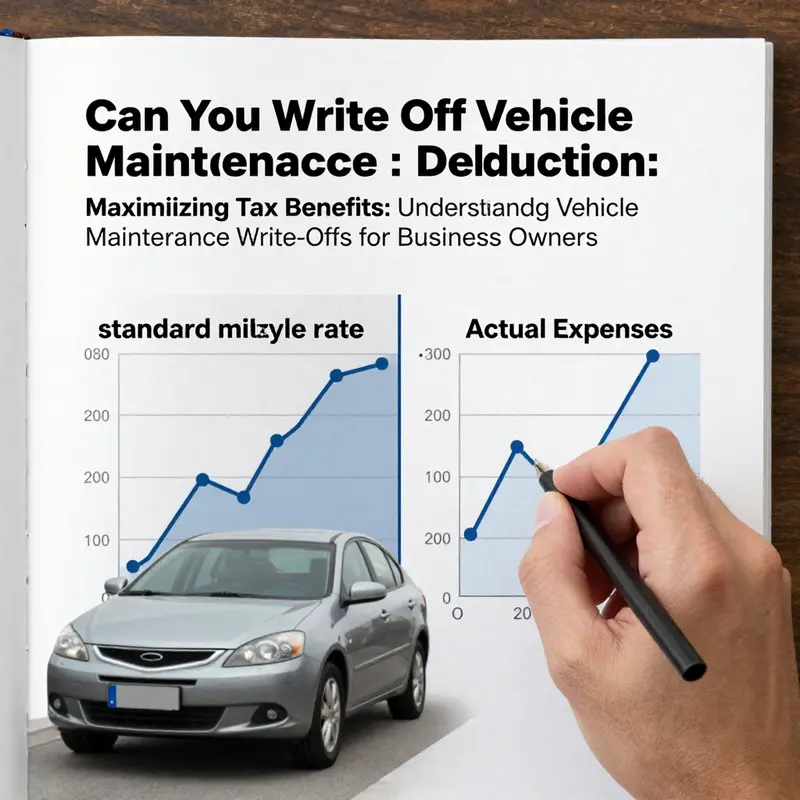
When people ask whether they can write off vehicle maintenance, they often mean whether maintenance costs can reduce taxable income rather than whether a car can be written off as a total loss. In practical terms, the question centers on business use. If you employ a vehicle for work—whether you are self-employed, run a small business, or regularly drive for work-related tasks—many of those maintenance expenses can be deductible. The key is to connect the costs to business use and to keep careful records. This chapter weaves together the core ideas you’ll need: the two main deduction methods, the kinds of maintenance that qualify, and how to determine the portion you can legitimately write off. It also clarifies how personal use changes what you may claim and why professional guidance matters when you’re navigating the rules of your jurisdiction.
Two paths frame the deduction conversation. First is the Standard Mileage Rate, a simple method that bundles maintenance, fuel, depreciation, insurance, and other costs into a per-mile deduction. Second is the Actual Expense Method, which requires you to tally and allocate every operating cost, including maintenance, and then apply the business-use percentage to those costs. The choice between these paths can change not only how much you deduct but which records you must retain, so understanding each approach helps you decide what works best for your situation.
Under the Standard Mileage Rate, you deduct a fixed amount for each mile you drive for business. As of 2026, the rate stands at $0.67 per mile. This rate is issued annually by the tax authority and is designed to cover the array of vehicle-related expenses—a broad umbrella that includes fuel, maintenance, repairs, depreciation, insurance, and registration. The appeal is straightforward: you don’t track every receipt and invoice for maintenance. You simply log your business miles and multiply by the per-mile rate. If you prefer a hassle-free approach and your business miles aren’t exceptionally high, this can be the most efficient path. It’s particularly attractive to those who value predictability and simplicity.
The other route, the Actual Expense Method, is more granular and potentially more generous depending on your circumstances. With this method, you track the actual costs of operating the vehicle for business use. You then calculate the percentage of total miles that were for business purposes and apply that percentage to the total costs. Eligible costs include maintenance and repairs—oil changes, tire replacements and rotations, brake work, battery replacement, fluid flushes, and routine servicing. It also encompasses non-maintenance costs such as fuel, insurance, registration, depreciation, parking, and tolls. If the vehicle incurs substantial maintenance or if you drive a lot for business, the actual expense route can yield a larger deduction. But it demands meticulous record-keeping: receipts, invoices, date-stamped maintenance, and a precise log of business versus personal mileage.
A practical illustration helps crystallize the choice. Suppose a vehicle has 12,000 total miles in a year, with 8,000 miles specifically for business. If you opt for the Standard Mileage Rate, your deduction is 8,000 miles times $0.67, which equals $5,360. If you choose the Actual Expense Method, you would add up all operating costs—say maintenance costs total $3,000, fuel costs $4,000, insurance $1,200, depreciation $5,000, registration $150, and parking $600, for a grand total of $14,950. The business-use portion would be 8,000/12,000, or 66.7%. You would deduct 66.7% of $14,950, roughly $9,967. The math can tilt in favor of one method or the other, which is why many taxpayers run the numbers under both approaches in their tax planning to determine which yields the larger deduction.
When talking about maintenance itself, the list of deductible items typically includes routine services and repairs that keep the vehicle in safe, operable condition. Oil changes, tire replacements and rotations, brake repairs, battery replacements, flushing fluids such as coolant or transmission fluid, and general servicing all count. Car washes and detailing can be deductible when they are clearly related to the vehicle’s business appearance or professionalism, such as for client-facing visits. These are not receipts you can cobble together for personal trips, of course; the deduction hinges on the business-use fraction.
The business-use fraction is a central concept in the Actual Expense Method. If your vehicle is used 70% of the time for business, you can deduct 70% of the total operating costs, including maintenance. That proportion, however, must be grounded in solid mileage records. A meticulous log of dates, destinations, trip purposes, and miles driven is essential. The more precise your mileage tracking, the more defensible your deduction will be if questioned by tax authorities. In practice, many small-business owners find it worthwhile to maintain both a paper log and a digital record, ensuring your business purpose is explicit and contemporaneous rather than reconstructed at year-end.
Another layer of complexity arises when you consider depreciation. Under the Actual Expense Method, you may also depreciate the vehicle itself according to business use. Depreciation represents the gradual loss of value as the vehicle ages, and the deduction aligns with the portion of use for business purposes. For those who own or finance their vehicle, depreciation can be a substantial element of the overall deduction, especially for higher-value vehicles used heavily for business activities. The interaction between depreciation and other costs requires careful calculation, particularly if you switch between methods in successive years or if your business use fluctuates.
Alongside the mechanics of the two methods, the guidance stresses the importance of documentation. No matter which path you choose, you must keep records that clearly demonstrate business use. This includes a log of miles, travel purpose, destinations, and dates, as well as itemized receipts for maintenance and other costs. In some cases, the tax authority may require you to separate out personal miles from business miles, and to allocate each expense accordingly. Even if you do not think you will need every receipt someday, the rule of thumb is to keep thorough records for the maximum allowable deduction and to defend your numbers if ever audited.
A common question concerns what counts as regular maintenance versus upgrades or improvements. Maintenance keeps the vehicle in good operating condition and preserves its expected lifespan. Upgrades or improvements—things that add value or extend the vehicle’s life in a meaningful way—may be treated differently for depreciation and deduction purposes. The line between these categories can be nuanced, and the safest approach is to track each cost and consult authoritative guidance or a tax professional. In practice, most routine maintenance costs fall squarely into the deductible maintenance category under both the Standard Mileage Rate and the Actual Expense Method, provided they relate to business use.
Two reflexive cautions accompany any discussion of deductions. First, personal use of the vehicle cannot be counted toward your business deduction. If your driving is split roughly 50/50 between business and personal tasks, you must apply only the business portion of your costs. The second caution is that tax rules adapt over time and differ across jurisdictions. What applies in one country or tax year may shift in the next. For this reason, many taxpayers benefit from consulting a qualified accountant or tax professional who understands the specifics of your situation and keeps you aligned with current rules.
To anchor this discussion in resources, a concise overview of what counts as vehicle maintenance can be found in dedicated guidance that clarifies terminology and scope. For a quick reference, you can explore a resource that defines vehicle maintenance and its role in business deductions. This link can help you confirm which expenses you should classify as maintenance versus other categories: What is vehicle maintenance?. This short read acts as a practical primer that complements the more detailed rules discussed here, and it can help you prepare the records you’ll need should you decide to apply either deduction method.
The choice between Standard Mileage and Actual Expenses should be revisited periodically. If your business use or driving patterns shift, it can alter which method yields the larger deduction. Some individuals start with the simpler mileage rate and later switch to the actual expenses as their costs grow or as vehicle depreciation becomes more pronounced. In practice, re-evaluating at least once a year before filing a return ensures you’re optimizing the deduction based on current mileage and costs. As you prepare, remember that the ultimate aim is to align your records with the business activity they reflect, maintaining clarity between personal and business travel while ensuring compliance with applicable tax guidelines.
In closing, yes, you can write off vehicle maintenance costs as a business expense if the vehicle is used for business purposes and you keep accurate records. The two main methods—Standard Mileage Rate and the Actual Expense Method—offer different pathways to a deductible amount. The Standard Mileage Rate provides simplicity and a bundled approach to maintenance costs, while the Actual Expense Method offers a tailored deduction that reflects your exact spending and your precise share of business use. Your decision should reflect both your record-keeping preferences and the financial reality of your vehicle expenses. For official guidance and the most up-to-date rates, refer to the tax authority’s published standards. External resources, such as the standard mileage rate document, provide a definitive reference point for the current year’s rate and rules: https://www.irs.gov/pub/irs-utl/standardmileagerate_2026.pdf
Final thoughts
In conclusion, understanding how to effectively write off vehicle maintenance costs can lead to substantial financial benefits for business owners. By ensuring your vehicle is used primarily for business, maintaining accurate records, and knowing which expenses are deductible, you can significantly enhance your tax deductions. Always consider consulting with a tax professional to optimize your deductions and ensure compliance with regulations. Leveraging these write-offs not only aids your tax strategy but also allows you to focus on driving your business forward.