
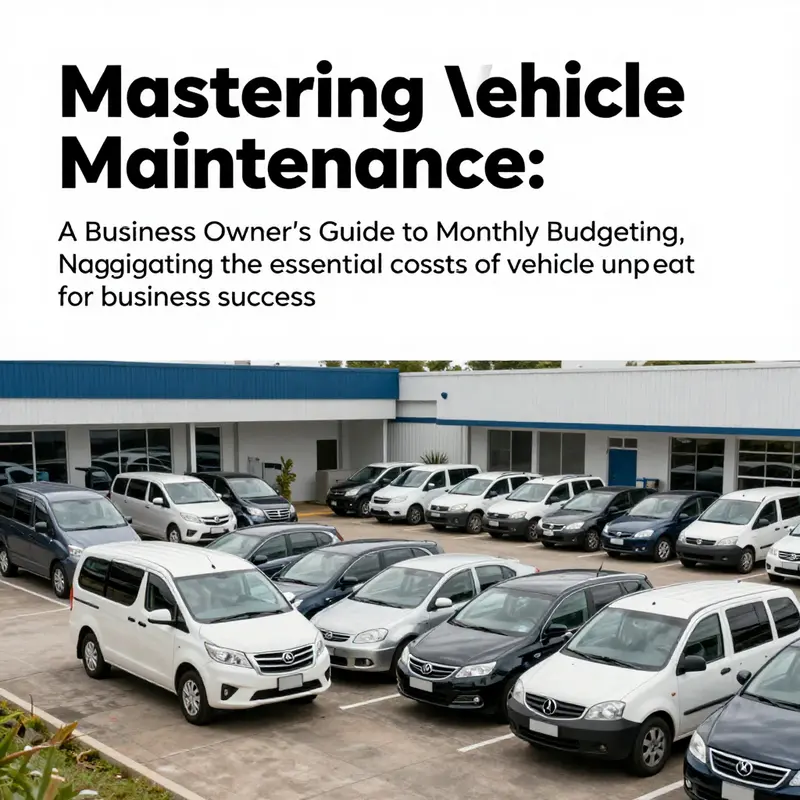
For business owners, understanding vehicle maintenance budgeting is vital for operational efficiency and cost control. Without a structured monthly plan, unforeseen expenses can derail financial projections and impact overall profitability. This comprehensive guide will delve into the key facets of vehicle maintenance budgeting – from fuel costs to insurance and routine maintenance – allowing you to strategically allocate your financial resources. Each chapter will provide insights into the various components of vehicle upkeep, ensuring you can make informed decisions critical for your business’s success.
The Realistic Monthly Roadmap for Vehicle Maintenance: How Much Should You Budget?
The monthly cost of keeping a vehicle in reliable, safe condition is rarely a single fixed number. It shifts with the car’s age, how hard you drive it, the climate you live in, and even where you park it at night. Yet there is value in framing a practical, monthly maintenance target that you can adjust as your circumstances change. Rather than chasing an abstract annual total or chasing the myth of a perfect zero-fault scenario, think in terms of steady, predictable allocations that cover routine care, surprise repairs, and the everyday wear that accumulates as the miles pile up. When you approach maintenance budgeting as a dynamic, ongoing habit rather than an annual bill to be endured, you gain clarity on your choices and your savings strategy. The numbers may comfort you or compel you to recalibrate, but they are a starting point for a financially sound approach that supports your driving needs and your broader financial goals.
Across a broad cross-section of typical drivers, the best starting point sits in the range of roughly one hundred to three hundred dollars per month for maintenance and related costs. For many, a target of about one hundred fifty to two hundred fifty dollars per month balances routine services, the occasional repair, and the costs that many drivers prefer to treat as savings rather than as a constant drain on the monthly budget. Those numbers are not universal absolutes. If your car is older, has higher mileage, or you live in a climate that taxes tires, brakes, and cooling systems more aggressively, you will likely see costs creeping toward the upper end of the range or beyond. If your vehicle is younger, well-maintained, and used mostly for short commutes in a temperate area with low parking and toll costs, you may comfortably spend closer to the lower end. The math of budgeting, in other words, is less about a single figure and more about creating a cushion that reflects your vehicle’s realities and your financial comfort zone.
To understand what makes up that cushion, it helps to break down monthly costs into the core components that most influence your day-to-day expenses. Fuel, as the largest variable expense, usually dominates the monthly picture. Even with good fuel economy, high mileage can push the monthly fuel bill into the higher end of the spectrum. Insurance, a fixed cost that behaves like a semi-regular bill, also weighs in strongly on your monthly budget. It can vary dramatically by location, driving history, and coverage level, and while it’s sometimes paid annually or semi-annually, you must translate it into a monthly expectation to keep your budget accurate. Regular maintenance and repairs form the heart of the ongoing care your car requires. This category spans routine tasks that keep systems healthy—the oil and filter changes, fluid replacements, and filter checks—as well as the more expensive items that tend to come up as a car ages or accrues miles. Then there is parking and toll expense, a factor that often surprises new budget planners. City dwellers or frequent travelers can easily find themselves paying more for parking in congested areas and for tolls on busy routes. Finally, most financial advisors and trusted car owners will tell you to set aside a safety buffer for the unexpected: a sudden hose failure, an unforeseen brake issue, or a small electrical fault that crops up without warning. An emergency fund in the range of fifty to a hundred dollars per month can be a wise hedge against small but disruptive repairs that would otherwise derail a carefully planned budget.
Consider a practical application of these categories in a typical month. If you drive a mid-aged sedan in a suburban setting and you put about 1,000 to 1,200 kilometers on it each month, your fuel bill might land around one hundred to three hundred dollars, depending on your car’s efficiency and your fuel price. Insurance would contribute a fixed slice—think roughly one hundred to two hundred dollars monthly, though the exact amount varies by where you live and your coverage. Routine maintenance and small repairs, including oil changes, filter replacements, and a check on fluids, would likely fall around fifty to one hundred fifty dollars. Parking and tolls could range from fifty to two hundred dollars if you commute to downtown work several times a week or travel through high-fee zones. Add an emergency fund of fifty to one hundred dollars, and you have a monthly budget that sits near the lower to middle part of the commonly recommended range. This framework is deliberately elastic. It invites you to monitor actual expenses over a few months and then adjust the allocations up or down depending on what the real world hands you. The aim is not to lock you into a rigid figure but to give you a dependable baseline from which to plan.
A point that often causes confusion is the idea that maintenance must cost a fixed, high monthly amount. The notion that you need a hundred or a thousand dollars every month can distort expectations. Real-world costs are influenced by how you drive, how you service your car, and how well you shop for service and parts. For instance, a low-mileage, reliable car in a city with modest parking costs and a long interval between tire replacements may require far less monthly cash than a newer, high-mileage vehicle in a major city where insurance costs are higher and parking is expensive. In fact, when you crunch the numbers for a modest, well-cared-for vehicle in the right circumstances, your monthly maintenance budget might be closer to the lower end of the range, or even dip below it for several months in a row if you avoid major tire or brake replacement campaigns because you’ve kept up with preventative maintenance. Conversely, if you drive more than two thousand kilometers a month, or you live in a place with extreme weather that accelerates wear on brakes, tires, and cooling systems, you can easily reach and surpass the upper limits of the typical monthly band.
For people who lead a van life or live in a converted vehicle, the calculus shifts again. Living with a vehicle as your primary residence introduces a different kind of financial equation. The lack of rent is a compelling saving, but the flip side is that every mile you drive is a wear-and-tear event that adds to maintenance costs. Recent analyses, including those that compare total housing costs with vehicle costs in a van life setup, show that maintenance and related vehicle costs must be built into the budget as a steady line item. In practice, many van dweller budgets recommend budgeting at least two hundred to three hundred dollars monthly for maintenance and related costs, even when housing costs are minimized. This approach acknowledges that fuel, insurance, and upkeep do not disappear when rent does; they simply move in as ongoing expenses that must be planned for to avoid debt or cutbacks in safety-related services. The numbers aren’t a promote-or-perish mandate; rather, they reflect the reality that in a vehicle-as-home setup, reliability and readiness become critical, and the cushion remains essential to prevent small issues from spiraling into costly repairs.
The practical question, then, is how to plan with discipline while remaining flexible. The most straightforward tactic is meticulous expense tracking. For three to six months, jot down every car-related expense—from the oil change you scheduled six months ahead to the parking fee you paid on a rainy Tuesday. The goal is a transparent baseline. Once you know your actual monthly average, you can tailor the budget to reflect your real usage rather than your intentions. A dedicated savings account for car maintenance can turn a volatile cost into a predictable expense. You set aside a fixed amount each month—say one hundred fifty dollars—and let that money accumulate for the inevitable repairs. When a service is due, you draw from that fund instead of tapping into your everyday budget, preserving your financial stability and reducing anxiety every time your dash lights up with a maintenance reminder.
Another element is choosing cost-effective care without compromising safety. The drive toward affordability does not require low-quality work. In fact, reputable independent shops or well-regarded chain centers often provide substantial savings on routine items like oil changes and brake work compared with dealership pricing. The core idea is to align quality with value: you want skilled technicians, transparent quotes, and clear expectations about what is included in the service. Building a relationship with a trusted shop can yield better pricing over time and fewer surprise costs when a repair is needed. The same logic applies to parts: discussing options with your mechanic about conventional versus synthetic oil, or about tire choices with a focus on durability and longevity, can have meaningful financial returns in the long run. Understanding that some repairs are inevitable while others can be anticipated through better maintenance helps you distinguish between truly necessary expenses and discretionary upgrades that can be postponed without compromising safety.
The discipline of maintenance budgeting also intersects with driving habits. Gentle acceleration, steady speeds, and smooth braking reduce wear on brakes, tires, and the engine, extending the life of critical components and lowering the frequency of costly replacements. It is not simply a matter of fuel efficiency; the habit changes ripple through the entire upkeep cycle. Small changes—anticipating traffic, coasting into stoplights when safe, and maintaining proper tire inflation—can translate into meaningful cost savings over time. When you couple prudent driving with a steady savings routine for maintenance, you build resilience into your financial plan. There is a practical magic in treating maintenance as a monthly investment in safety, reliability, and peak performance rather than a reactive expense that appears only when something breaks.
In this context, it helps to acknowledge the value of information and a habit of review. Insurance quotes, for instance, deserve annual scrutiny. Shoppers who compare quotes can often discover substantial savings by adjusting coverage levels, increasing deductibles, or taking advantage of discounts for safe driving or multi-vehicle households. A small rebalancing once a year can free up funds that you can reallocate toward maintenance or toward a larger emergency fund. With these adjustments, you transform a yearly negotiation into a recurring benefit that supports ongoing reliability. The broader takeaway is that maintenance budgeting is both a financial discipline and a practical logistics problem: you need predictable cash flow, a plan for the unpredictable, and a method to keep your vehicle performing at its best without derailing other financial goals.
For readers who are exploring the link between maintenance and overall operating costs, there is real value in examining how routine care affects fuel economy and, by extension, monthly fuel spend. Regular oil changes, clean air and fuel filters, and timely tire maintenance help your engine run efficiently, reduce friction losses, and keep your tires at optimal pressure. These effects ripple through your monthly budget by lowering the amount you spend on fuel and by reducing the risk of high-cost repairs that could require emergency funding. The relationship between maintenance and gas expenses is a practical reminder that a sensible maintenance schedule has benefits beyond extending the life of your car. If you want to dive deeper into that specific angle, you can explore a detailed discussion on how maintenance practices translate into better fuel economy and lower gas costs here: How vehicle maintenance saves on gas expenses.
In summary, the path to a practical monthly maintenance budget starts with a clear picture of your car’s realities and your life context. Use a baseline in the range of roughly $100 to $300 per month as a starting point, but tailor that figure to reflect age, mileage, and climate. Build a dedicated savings habit so that the budget remains stable even when unexpected repairs arise. Partner with trustworthy service providers who offer transparent pricing, and cultivate driving habits that minimize wear. And remember, for those living a van life or a similar setup, it is prudent to plan for higher ongoing maintenance-related costs, recognizing that the absence of rent does not shield you from upkeep. By aligning expectations with the specifics of your situation, you create a resilient financial plan that keeps your wheels turning with confidence and clarity, rather than anxiety and guesswork. For the broader reader, these principles can translate into a sustainable, balanced approach to maintenance that respects both your car and your budget, freeing you from the cycle of debt or last-minute scrambles when a reminder light glows on the dash.
External perspective can also help ground your planning. A recent van life costs analysis shows that while eliminating rent can reduce one major expense, maintenance and other vehicle-related costs still demand careful budgeting to prevent offsets to savings. This broader context underscores the practical takeaway: a steady, disciplined monthly maintenance budget remains essential, regardless of housing arrangements or commuting patterns. To explore a broader financial picture that includes van life considerations, see this external resource: Van Life Costs Breakdown: Is Living in a Vehicle Actually Cheaper Than Renting?.
Balancing the Pump and the Portfolio: A Holistic Monthly Budget for Vehicle Maintenance
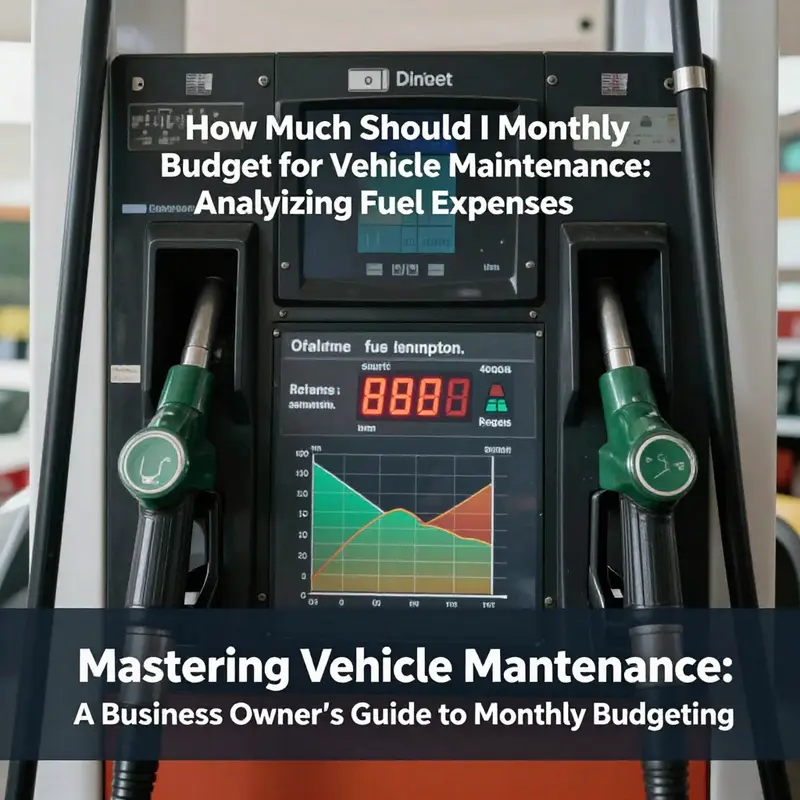
When you sit down to map a monthly budget for vehicle maintenance, the instinct is often to focus on the obvious line items: fuel, insurance, oil changes, tires, and a cushion for emergencies. The more complete approach, however, treats fuel not as a single expense but as an integral thread that runs through every other cost. Fuel use, after all, is the largest recurring outlay for most drivers and it directly interacts with how you maintain your car, how often you drive, and where you drive. If you want a sustainable, practical monthly plan, you need a holistic view that connects your daily driving choices with the broader costs of upkeep. That perspective isn’t about pinning a fixed number to every month; it’s about building a budget that flexes with miles, weather, and wear while still protecting you from surprise bills.
Start with the fuel piece, because it often occupies the largest share of the budget. If you drive a typical mid-aged car and cover about a thousand miles a month, your fuel cost hinges on your vehicle’s fuel economy and the current price of fuel. A straightforward example helps: a car that averages 25 miles per gallon and travels 1,000 miles in one month will use roughly 40 gallons. At $3.50 per gallon, that comes to about $140 for fuel in that month. If your vehicle is more or less efficient, or if you drive more or less, the number shifts in a similar pattern. If you live in a region with cheaper gas or you drive a fuel-sipper, that line may be nearer the lower end; if you own a performance car with higher fuel consumption or you log longer commutes, it climbs. The critical point is to anchor your monthly budget around this fuel reality, because it often dictates the level of funds you’ll have for maintenance thereafter.
Beyond fuel, the other core cost categories form a natural second layer of the budget: insurance, routine maintenance and repairs, and parking or tolls. Insurance remains a significant fixed obligation for most households, typically materializing as a monthly cost even if premiums are paid annually or biannually. The actual monthly amount can swing widely—driven by location, driving history, coverage levels, and the type of vehicle you own—so your monthly plan should include a reasonable cushion to accommodate those fluctuations. Regular maintenance and repairs constitute the heart of upkeep. Oil changes, tire rotations, air and cabin filters, coolant checks, and other routine checks create a steady cadence of small expenses that add up over time. While the per-visit cost of an oil change might seem modest, the frequency matters. An oil change every 5,000 to 10,000 kilometers translates into multiple services per year, each with its own price tag. Tires are a larger, longer-horizon cost; brakes likewise, with replacement intervals that vary by driving style and conditions. The important point for budgeting is not to treat these as once-a-year surprises but to spread expectations across the months. A practical range for regular maintenance and repairs is roughly fifty to one hundred fifty dollars per month, recognizing that older cars or high-mileage fleets usually require more frequent care.
Parking and tolls, though sometimes overlooked, can rival fuel in its monthly impact, especially for urban drivers. In dense city centers, parking fees accumulate quickly, and highway tolls can be a predictable line item if you commute across bridges or tolled expressways. A reasonable month-to-month estimate for parking and tolls is in the fifty to two hundred dollars band, depending on your city, your typical routes, and whether you regularly circle downtowns for work or leisure. When you add up fuel, insurance, routine maintenance, and parking, the base picture begins to look much more substantial than a simple per-month sticker price. And then there is the emergency cushion—a buffer you allocate to handle the unexpected, from a blown hose to an unplanned brake job. A practical range for this safety net is fifty to a hundred dollars per month. Think of it as insurance for your budget against the unpredictable, which, in car ownership, tends to show up at the least convenient moments.
A common misconception worth addressing is the notion that you must shell out a thousand dollars every month just to “maintain” a vehicle. In reality, for most drivers, a total realistic monthly budget sits in the range of a hundred fifty to three hundred dollars. If you drive very little, own an older, highly reliable car, and operate in a region with low parking costs and mild weather, you may even fall below that lower bound without sacrificing safety or reliability. Conversely, higher-mileage driving, a newer car with strong insurance premiums, or living in a city with expensive parking can push the monthly total higher. The key is not chasing a fixed number but cultivating a budget that adapts as your car ages, as miles accumulate, and as weather or road conditions change.
To bring this idea into concrete planning, many drivers find it useful to compare their expenses against three practical scenarios. In a low-mileage, urban context, fuel is still a dominant line item, but maintenance remains predictable, and the cushion for emergencies can cover minor, unexpected repairs without breaking the monthly plan. In a moderate to high-mileage context, fuel costs grow, and maintenance can become more frequent as components wear differently. A newer car with higher insurance costs may require a slightly higher insurance and maintenance allowance, but it can be offset by better reliability and fewer major repairs in the short term. The universal truth is that fuel costs anchor the budget, but every add-on—be it enhanced maintenance or parking—has a multiplying effect on the monthly total. You should expect to recalibrate your plan at least yearly, and ideally whenever your driving patterns or fuel prices shift significantly.
What does a balanced, sustainable budget look like in numbers? A realistic target for most drivers sits around one hundred fifty to two hundred fifty dollars per month for ongoing maintenance and repairs, with fuel typically occupying the next sizeable share. Insurance, parking, and tolls then fill the remainder in a way that reflects your local costs and personal driving habits. If your monthly fuel cost climbs toward the upper end of the spectrum due to long commutes or a less efficient car, you can still keep a robust maintenance fund by trimming discretionary costs elsewhere or by shopping for savings in nonessential areas of the budget. The important discipline is to treat maintenance funding as a regular, automated transfer into a designated savings account, not as a surplus that can be diverted when life gets busy. By consistently carving out a fixed portion each month—say, a modest, dedicated maintenance fund—you create a financial buffer that reduces stress when repairs turn up.
For many readers, the practical route to achieving this discipline starts with a simple audit of current spending. Track every car-related expense for three to six months, logging fuel, insurance, oil changes, tires, brakes, filters, parking, and tolls. A spreadsheet or a straightforward budgeting app works well for this. The aim is not to punish yourself for past choices but to reveal patterns: do you drive more on weekends, are you paying premium insurance, do you frequent garage visits beyond routine maintenance? From there you can estimate a sustainable monthly target that aligns with your actual driving and local costs rather than a generic rule of thumb.
In addition to tracking, a few strategic moves can help you keep the monthly plan intact without sacrificing reliability. First, create a dedicated car maintenance savings account and automate a fixed monthly contribution—just as you would automatically move money into savings for a vacation or an emergency fund. Second, seek cost-effective repair options for routine work. Independent shops often offer substantial savings on oil changes and brake work, while still delivering quality service. Third, adopt driving habits that reduce wear and tear: smooth acceleration and braking, steady speeds, timely tire rotations, and regular checks of critical fluids. These habits can extend the life of brakes, tires, and the engine, lowering the likelihood of expensive repairs and supporting a more predictable maintenance budget over time. Fourth, review your insurance annually. Shopping around for quotes can save hundreds per year, and a modest improvement in premium can free up funds for maintenance without changing your coverage quality.
If you want a foundational guide to the topic that underpins this budget approach, consider exploring resources that explain what maintenance truly encompasses. For a concise overview, you can read about what is vehicle maintenance, which elaborates on routine care and the ways it translates into costs over the life of a vehicle. This groundwork helps you translate a conceptual maintenance strategy into a practical monthly plan that works in your specific context.
Ultimately, the goal is a sustainable monthly plan that captures fuel costs as a principal driver while weaving in insurance, routine maintenance, and parking as essential, manageable components. It’s not a fixed cage but a flexible framework that acknowledges the realities of weather, miles, and wear. When you treat maintenance as a regular financial habit rather than an occasional repair budget, you reduce the chance of an unmet need becoming a financial crisis. You also create a path toward better long-term ownership costs, which matters whether you’re planning to keep your vehicle for several years or are weighing future replacement.
External guidance supports this approach by offering practical formulas and benchmarks rooted in data. For those seeking a robust method to calculate maintenance budgets with updated benchmarks, a leading consumer-oriented guide from 2025 provides clear steps to estimate monthly costs and to distinguish between routine upkeep and unexpected repairs. This external resource complements the narrative above by offering a structured way to translate driving patterns into a sensible monthly budget.
For readers who want to drill down into linked topics without losing the thread of this chapter, a concise reference point is available at what is vehicle maintenance. Reading about the broader scope of maintenance can reinforce how everyday choices—like where you fill up, how aggressively you accelerate, and when you schedule service—shape your monthly numbers. Integrating these insights into your personal plan makes budgeting more than a number; it becomes a responsible, proactive habit that keeps your car reliable without compromising financial health.
In sum, fuel expenses form a predictable, significant portion of the monthly equation, but they do not stand alone. A well-crafted maintenance budget accounts for the long-term realities of tires, brakes, fluids, and scheduled care; it buffers against the occasional emergency; and it adapts to the inevitable changes in miles, road conditions, and insurance costs. By anchoring your plan in actual driving patterns, automating savings, and using cost-effective service options, you set yourself up for steady, manageable costs rather than abrupt, disruptive spikes. The result is a sensible, sustainable monthly budget that respects the value of your vehicle and your financial priorities, without pretending that every month will be the same.
Internal link: what is vehicle maintenance
External resource for deeper budgeting methodology: https://www.consumerreports.org/cars/car-maintenance-budget/
Balancing the Ledger: The Insurance Factor in Your Monthly Vehicle Maintenance Budget
When you map out a monthly budget for your vehicle, the line items you expect often feel straightforward: fuel, routine service, perhaps a tire rotation here and there, and a small cushion for emergencies. But a clearer, more accurate picture emerges when you weave insurance into the same fabric as maintenance. Insurance is not just a separate expense that arrives as a fixed monthly premium; it actively shapes how much you can comfortably allocate for maintenance over the long run. By viewing insurance and maintenance as companions rather than competitors for your dollars, you gain a truer sense of what a sustainable monthly budget looks like for a typical driver.
To ground the discussion, consider the common ranges most households encounter. The broader maintenance budget can range from about 100 to 300+ per month, depending on factors like age and condition of the car, how much you drive, and where you park. In practical terms, many drivers find a feasible target sits in the 150 to 250 per month window when maintenance, insurance, and modest parking or toll costs are all rolled into the calculation. Yet this is a moving target, not a fixed rule, because fuel and insurance costs can tilt the balance in one direction or another before you even touch the repair bill. In particular, insurance is a major fixed cost that often sits alongside or even above routine maintenance in a month-by-month budget.
When we break down the components that feed into maintenance expenses, several realities surface. Routine maintenance—oil changes, filter replacements, brake inspections, and tire rotations—generally accounts for a smaller monthly slice, roughly 50 to 150 per month if you average out the timing of service across the year. The caveat here is the timing and frequency of work. Oil changes cost roughly 70 to 150 depending on the vehicle and service interval, while brake pads and tires loom as longer-term investments that are not evenly distributed month to month. Tires, for instance, are a major expense spread across many years, so the annualized impact can be modest in a single month yet substantial when a set wears out. The routine checks—filters, coolant, belts, and fluids—add another modest layer, typically 50 to 100 per month when averaged across the year.
Insurance, by contrast, sits as a more stubborn line item. In many cases, the monthly insurance bill lands somewhere in the 100 to 200 per month range, though this is highly contingent on where you live, your driving history, the coverage level you choose, and the vehicle type. It is common for premiums to outpace maintenance costs, especially for certain profiles—high-risk drivers, new drivers, or owners of newer or more expensive vehicles often see higher monthly premiums. Because insurance is calculated from risk factors that can shift with time (a safer driving record, a move to a lower-crime area, or a different coverage package), it deserves a regular, proactive check alongside maintenance budgeting.
When you combine these strands, a realistic monthly target for total vehicle-related expenses generally lands in a spectrum of 180 to 325 for many households. That total reflects maintenance and insurance working together, acknowledging that other recurring costs—such as parking and tolls—can push the total higher, while favorable insurance quotes or careful maintenance scheduling can pull it lower. This framing helps prevent the common trap of thinking maintenance is a standalone burden that can be trimmed in isolation. If your parking in a dense city costs more, or if your commute pushes your annual mileage up, you will see the total drift toward the upper end of that range. If, instead, you park on a quiet street and drive modestly, you may find yourself closer to the lower boundary.
A practical way to use these ranges is to create a dual-tracker budget. Start with a baseline for routine maintenance—say, the mid-point of the maintenance band, around 100 to 125 per month for ordinary service and small repairs. Then add insurance as a discrete line item, using the actual premium you pay or a reasonable estimate based on your current policy. The sum becomes your core monthly maintenance budget. From there, you factor in variable costs: parking, tolls, and occasional larger repairs. If you adopt this holistic approach, you can see where your money goes each month and identify opportunities to optimize without reducing essential protection for your vehicle.
A useful discipline is to treat maintenance as a fund you contribute to regularly, not as an unpredictable bill that appears when you least expect it. Opening a dedicated savings account or a separate envelope in your budget helps keep those funds available for maintenance needs without siphoning from everyday expenses. A steady, predictable contribution—perhaps 150 per month into a car-maintenance reserve—reduces the stress of repair costs and smooths out the timing of larger expenditures, like replacing brakes or tires. This aligns with the intent of proactive maintenance: catching wear before it becomes a costly failure and preserving safety, fuel efficiency, and resale value.
To tailor the plan to your situation, consider the factors that influence both maintenance and insurance. Vehicle age matters; older cars typically require more frequent maintenance but may incur lower insurance premiums unless they lack modern safety features. Driving behavior matters as well. Smooth acceleration, gentle braking, and regular checks help extend the life of brakes, tires, and engine components, reducing the long-term maintenance bill. Location matters: urban drivers often face higher parking costs and more frequent minor repairs triggered by stop-and-go traffic, while rural drivers may see fewer parking fines and lower toll exposure but potentially higher tire wear depending on road conditions.
A precise, data-driven approach helps you avoid surprises. Track your car-related expenses for three to six months. Log every oil change, every tire rotation, every brake job, and every incidental repair. Do the same for insurance—note premium payments, any discounts you qualify for, and any changes in policy terms. This practice yields a clearer picture of your true monthly average, which helps you calibrate your budget more accurately than relying on broad ranges alone. If you want to dive deeper into what constitutes vehicle maintenance and how it fits into overall budgeting, you can explore the concept of vehicle maintenance in more depth through this resource: what is vehicle maintenance.
Another key lever is shopping for insurance with the same seriousness you apply to routine maintenance. Insurance quotes can vary widely by insurer, and discounts abound if you bundle policies, maintain a clean driving record, install certain safety devices, or choose a higher deductible. The aim isn’t to skimp on coverage but to balance premium costs with meaningful protection. Annual or biannual reviews of your coverage can yield meaningful savings, and the impact of even modest reductions in premiums over time compounds across months and years. Keeping your coverage aligned with your actual risk exposure—the miles you drive, the region you operate in, and your vehicle’s safety features—helps ensure your monthly budget remains realistic rather than aspirational.
Consider the broader context of emergency readiness. An explicit, dedicated emergency fund for vehicle issues remains one of the most prudent moves you can make. The occasional unexpected repair—perhaps a cooling system issue, a failing hose, or a sudden alternator problem—can disrupt even the best-planned budgets. Allocating a small cushion, such as 50 to 100 per month as a general buffer, gives you a safety net that prevents a single breakdown from cascading into debt or into a scramble for financing. This approach reinforces financial resilience and gives you more control over your driving life, rather than letting unplanned costs steer your spending.
In weighing the overall message, the takeaways are straightforward. First, insurance should be considered in the same budgeting conversation as maintenance. The total monthly vehicle-related expenses you should anticipate typically sit in the 180 to 325 band for many households, though individual circumstances can push this higher or lower. Second, routine maintenance costs, while important, usually comprise a smaller, steadier share of the budget, with oil changes, filters, and routine checks forming the foundation and larger expenses distributed over time. Third, a disciplined approach—tracking expenses, creating a dedicated savings flow, shopping for insurance, and practicing economical driving—transforms maintenance from reactive pain to a predictable, manageable part of car ownership. Finally, the most successful budgets recognize that maintenance and insurance are not adversaries but allies in preserving safety, reliability, and value over the life of the vehicle. Embracing that view makes it easier to stay out of distressful repair cycles and to keep your car on the road longer, with greater confidence in your financial plan.
For readers seeking a concise, reader-friendly primer on the nature of maintenance and its financial implications, the linked resource provides a broader safety and cost context that complements the budgeting focus of this chapter: what is vehicle maintenance. This article helps ground your understanding of why certain maintenance tasks matter as part of the overall cost of ownership, reinforcing the idea that proactive upkeep acts as a shield against larger, unexpected expenses over time.
The overarching takeaway remains stable and practical: your monthly maintenance budget is not a fixed, standalone figure. It is a dynamic blend of routine care, the cost of insurance, and the realities of how you drive, where you park, and what the vehicle costs to insure. By adopting a holistic view—tracking real expenses, building a dedicated savings buffer, and regularly shopping for insurance—you equip yourself to meet the true costs of vehicle ownership without sacrificing safety or peace of mind. This approach not only clarifies the numbers but also clarifies the choices that keep you moving with confidence.
External resource: https://www.nsc.org/road-safety/safety-resources/types-of-accidents/vehicle-maintenance
Budgeting Car Care: A Practical, Realistic Monthly Plan for Maintenance and Repairs
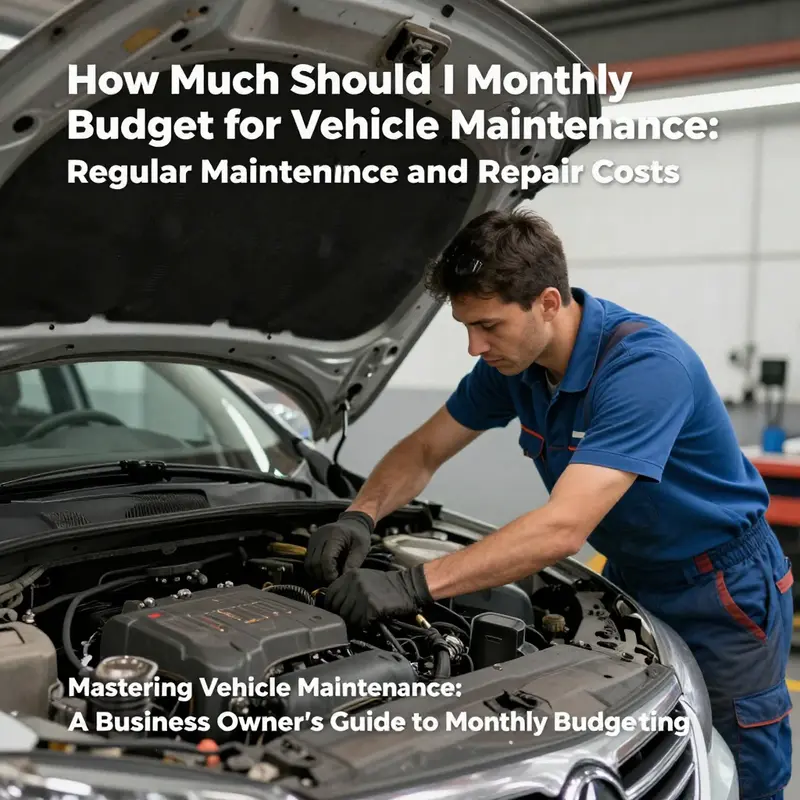
Setting a monthly maintenance budget for your vehicle is less about penny-pinching and more about stabilizing a predictable expense that supports reliability, safety, and long-term value. The latest data and practical experience converge on a simple truth: most drivers will find a realistic target between about $100 and $300 per month, with a comfortable center of gravity around $150 to $250 for a typical mid-aged car used mainly for commuting. This range covers routine maintenance, unexpected repairs, and the often overlooked costs that quietly accumulate, such as parking and insurance fees that reappear in monthly budgets even though they are paid less frequently in reality. The broader point is not to chase a single number but to establish a steady rhythm of saving, spending, and reassessing that aligns with how you drive, where you live, and what you drive. For those who want a concise reference on what maintenance actually entails, see What is Vehicle Maintenance, which helps anchor the discussion in a shared definition before diving into the numbers that affect your wallet every month. What might feel like a vague obligation—keeping a car in good shape—turns into a practical plan when you translate it into recurring, predictable deposits and measured spending. The monthly maintenance budget begins with the simple recognition that fuel and insurance are essential, but maintenance is the part you can influence most directly through habits, shopping, and timing. Fuel costs, while often the largest monthly outlay, sit alongside maintenance because they reflect how you drive and how efficiently your car uses fuel. A typical 1,000-kilometer month in a city with moderate fuel prices, paired with a car that averages around 8 liters per 100 kilometers, can place fuel around the mid-hundreds, depending on price fluctuations. If fuel costs sit in the $100 to $300 range across a month, that does not diminish the maintenance budget; rather, it highlights how you allocate the total vehicle expense to keep the car running smoothly while still meeting other financial goals. Insurance, another fixed monthly obligation, usually lands in the $100 to $200 band for many drivers. It’s often paid annually or semi-annually, but the monthly budgeting approach should reflect the effect of premiums on your cash flow and savings capacity. The core maintenance and repairs line—think oil changes, filters, brake wear, and tire maintenance—typically runs about $50 to $150 per month for most drivers. This is the part you can influence most directly by choosing the right maintenance cadence and a dependable shop rather than chasing the lowest price alone. Oil changes fall into a range of roughly $70 to $150, depending on the vehicle and service interval, usually every 5,000 to 10,000 kilometers. Tires, a major but less frequent expense, are spread over years rather than months, but a prudent budget should acknowledge that a set might be needed every 50,000 to 80,000 kilometers. Brake pads, a cost that many drivers notice with a bang when a warning light or a squeal appears, can be between $200 and $500 per axle, and their replacement cadence ranges from 30,000 to 70,000 kilometers. Routine checks for filters, coolant, and fluids typically sit in the $50 to $100 range each period. The least glamorous line item—parking and tolls—also deserves a home in the monthly budget, often $50 to $200 depending on how much time you spend in city centers, whether you park in garages with daily rates, and how often you encounter toll roads during your commutes or weekend trips. Then there is the emergency fund—a buffer you should treat as a core part of the budget rather than an afterthought. Allocating $50 to $100 per month as a reserve helps you cover unexpected repairs or parts failures that can arise when you least expect them, like a blown hose on a cold morning or a sudden brake wear issue. The math behind these numbers can feel abstract until you translate it into your own car’s age, mileage, and usage. Data from the AAA Vehicle Maintenance Cost Report, one of the most trusted sources for annual maintenance patterns, suggests that the typical car owner spends about $1,200 per year on maintenance and repairs, which averages to roughly $100 per month. This aligns with the lower end of the common maintenance band for well-kept vehicles and underscores that the real opportunity lies in intentional budgeting, not chasing extreme cases. Vehicle age and mileage are decisive, though. An older car with higher mileage tends to require more frequent and sometimes costlier repairs, lifting monthly maintenance needs toward the upper end of the spectrum, sometimes beyond $150 per month, especially if wear becomes progressive or if components near the end of their service life. Conversely, newer vehicles or those with lower mileage often stay within the $100 to $150 monthly range, with occasional peaks when services like timing belts or major system checks are due, but those peaks are comparatively rare in the early years. The make and model also matter. Luxury or high-performance vehicles typically incur higher service costs due to specialized parts, more complex labor, and the need for OEM-level parts, while mainstream models tend to be less expensive to repair and maintain. Driving conditions, climate, and terrain also leave their imprint: stop-and-go urban driving accelerates brake wear and fluid degradation, while extreme temperatures can affect coolant systems, battery health, and tire pressures. In places with harsh winters or dusty environments, maintenance tasks can become more frequent or more urgent, nudging the monthly budget higher to accommodate the added wear. Warranty status offers another meaningful variable. Under warranty, many out-of-pocket expenses are reduced, though this advantage is time-limited and varies by coverage and the terms of the warranty. Once a warranty lapses, owners typically face the full repair bill, which makes proactive budgeting even more important in the years immediately following warranty expiration. The practical upshot is that you should treat maintenance budgeting as a dynamic process rather than a fixed line on a calendar. Start with a baseline of around $150 to $250 per month for a typical mid-aged car used for daily commuting, adjust for miles driven, local parking costs, and the vehicle’s particular maintenance profile, and then review annually or after a major repair event. If you see your expenditures consistently tight at the upper limits, consider the behavioral and shop-related levers you can pull to bring costs down: schedule oil changes at appropriate intervals rather than rushing them into a closer-than-recommended window, compare quotes from independent shops against dealerships, and choose reputable local shops that offer transparent pricing and reputable parts. The idea of a dedicated maintenance fund is a useful mental model: treat this money as a separate savings target that shields your main budget from repair volatility and preserves your financial plan for more important goals. You can set aside a fixed amount each month—whether it’s $150 or $100—into a car-maintenance savings account, and then use that fund to cover the routine services and the surprises. This approach reduces the temptation to dip into discretionary spending when a big repair bill lands or when a premium part is required after a wear-out event. Driving smarter can also yield meaningful savings over time. Smooth acceleration, minimal rapid braking, and maintaining steady speeds reduce wear on brakes, tires, and engine components, thereby lowering the pace at which maintenance costs climb. A well-chosen driving style is not just about fuel efficiency; it’s about preserving your car’s health. Finally, keep an eye on the broader financial picture. Review your auto insurance options annually, as premiums can shift with your driving history, location, and bundled policies or discounts. A simple comparison every year can trim hundreds of dollars from your annual cost, which, when distributed across the months, can free up more money for maintenance or for a larger emergency cushion. In summary, a realistic and sustainable monthly budget for vehicle maintenance typically sits in the $150 to $300 range for most people, with the lower end appropriate for well-maintained, lower-mileage vehicles and the upper end sensible for higher-mileage or more expensive cars. The rule of thumb—treat maintenance as a dedicated, automatic expense, not an afterthought—helps you prevent small issues from becoming large bills. The maintenance fund concept keeps your finances steady even when the unexpected occurs, and taking the time to track expenses, compare service options, and adjust for changing circumstances will pay dividends in reliability and peace of mind. For the most current, region-specific guidance and cost benchmarks, you can consult the AAA Vehicle Maintenance Cost Report.
Balancing the Drive: A Practical, Data-Driven Monthly Budget for Vehicle Maintenance
Budgeting for vehicle maintenance should be driven by data, not guesswork. It starts with understanding how you use your car and the realities of aging hardware. A solid plan treats upkeep as a regular, accountable expense rather than a yearly shock.
A realistic monthly range for maintenance is often between 100 and 300 dollars, with many drivers finding a sweet spot around 150 to 250. This band accommodates routine services like oil changes, tire rotations, brake inspections, and fluid checks, while leaving room for occasional repairs. The exact number should reflect your car’s age, mileage, climate, parking situation, and driving patterns. The goal is a fixed monthly amount you can commit to, month after month.
Break the budget into four core components plus a small contingency. The four are: fuel (which, while not maintenance, affects overall cash flow), insurance, core maintenance and repairs, and parking or tolls. Fuel is highly variable but often dominates the month, while insurance is a fixed cost you should translate into a smooth monthly expense. Core maintenance includes oil changes every 5,000 to 10,000 km (roughly 70 to 150 dollars per service), tire costs amortized over their lifespan, brake pad replacements (roughly 200 to 500 dollars per axle), and routine checks (filters, coolant, fluids) averaging 50 to 100 dollars per month when spread over the year. Parking and tolls depend on location and commute, and should be tracked separately to avoid distorting the maintenance plan.
Finally, build a small emergency buffer. A monthly contribution of 50 to 100 dollars can cover unexpected repairs without derailing the budget. If you drive an older car or accumulate high mileage, you may wish to reserve more.
The key is to start with real data. Track every car expense for three to six months, then set a dedicated savings account for maintenance and contribute a fixed amount each month, for example 150 dollars. Regularly compare shop costs; a good local shop can save a meaningful amount on oil changes and brake work, improving the value of your budget.
Adjust the plan as your life changes: a new route to work, relocation, or higher mileage month should be reflected in the numbers. The point is not to chase a perfect universal number but to calibrate the budget to your actual driving and the car you own.
In summary, a practical monthly maintenance budget is data driven, adaptable, and anchored by a regular savings habit. Start with a realistic baseline, track your costs, and refine the target amount over time. The record of your expenses will guide you toward a predictable, manageable plan that keeps the car reliable without compromising other financial goals.
Final thoughts
In the realm of running a successful business, managing vehicle maintenance expenses is crucial. Adopting a careful approach to budgeting not only aids in tracking costs but also helps in anticipating future expenses. By understanding the various components—from fuel and insurance to regular maintenance—you can ensure that your vehicle-related expenses do not exceed your financial capacity. An informed budgeting strategy will empower you to maintain the reliability and efficiency of your business’s vehicles, ultimately contributing to its sustained success.