
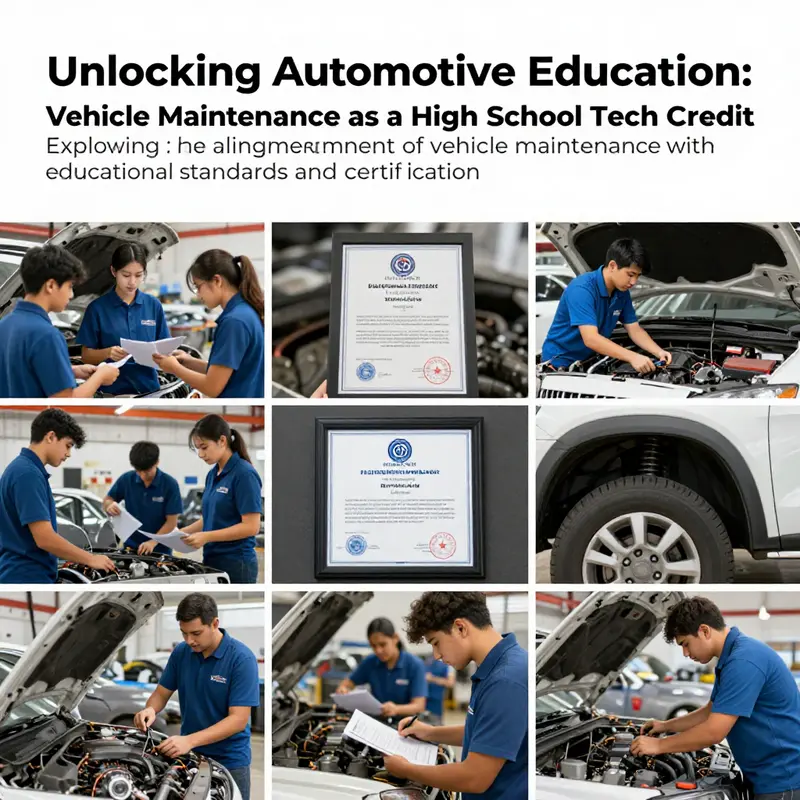
As the landscape of education continues to evolve, the intersection of vehicle maintenance and high school technology credits emerges as a significant topic for business owners. Understanding whether vehicle maintenance can count toward a high school tech credit not only highlights opportunities for educational collaboration but also serves as a gateway to enriching the skillsets of future workforce participants. This exploration will guide business owners through the curriculum requirements, industry certifications, and comparisons to other career and technical education (CTE) programs, solidifying the role of automotive education in preparing young individuals for meaningful careers in a dynamic industry.
From Gears to Graduation: Aligning Vehicle Maintenance with a High School Tech Credit
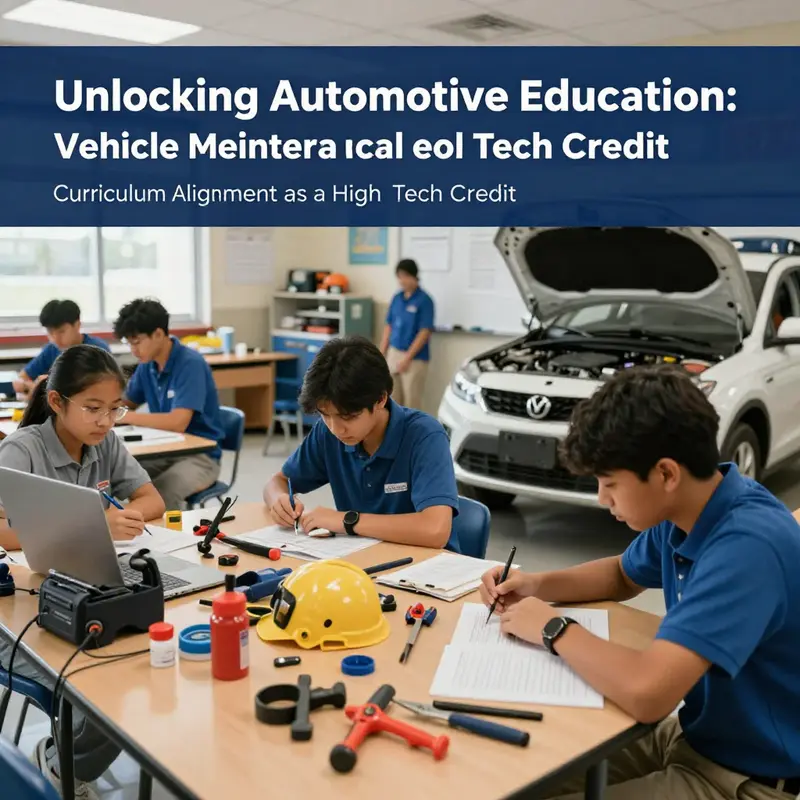
Vehicle maintenance often serves as a practical, real-world entry point for high school students pursuing a technology or applied-science credit. When the curriculum is designed to mirror industry practice—diagnostics, data interpretation, and systematic troubleshooting—the act of maintaining vehicles becomes more than routine shop work; it becomes a credible pathway toward a credential that signals readiness for college or meaningful entry into the workforce.
In practice, aligning maintenance activities with a tech credit begins with a clear map of competencies. Students should demonstrate proficiency in core areas such as engine and electrical systems, diagnostics using scan tools, reading live data from ECUs, and applying safety and quality-control standards. A strong program links hands-on tasks to measurable outcomes, ensuring that each maintenance activity—oil changes, brake inspections, or diagnostics of a fault code—contributes to an evidence-based portfolio that teachers and administrators can assess. When curricula connect classroom concepts with the tools and workflows used in modern shops, students experience a meaningful transfer of learning.
Equipping the classroom with industry-grade tools, diagnostic interfaces, and up-to-date simulation resources is essential. With electronics and computer-control modules playing a central role in today’s vehicles, instructors need access to equipment that lets students practice real-world workflows: connecting a scan tool to an ECU, interpreting live sensor data, and correlating observed symptoms with possible root causes. The curriculum should emphasize a diagnostic mindset—formulating hypotheses, collecting data from multiple sources, and verifying conclusions through testing. This approach helps students convert theoretical knowledge from textbooks into practical reasoning they can apply under time constraints and safety requirements in a shop setting.
Beyond the technical skills, a successful tech-credit vehicle-maintenance program considers equity and accessibility. Programs should offer multiple entry points, accommodate diverse backgrounds, and provide supports such as tutoring, staged skill-building, and flexible pathways to certification. When students see a clear route from shop tasks to formal recognition, motivation and engagement tend to rise. Partnerships with local employers and training facilities can provide authentic contexts, current equipment, and opportunities for industry-recognized credentials that augment the school’s credit offer. These connections help ensure that the credential has recognizable value to colleges and employers alike.
Of course, there are practical challenges to address. Budget constraints, the need for ongoing professional development for instructors, and the requirement to maintain and calibrate advanced gear all demand thoughtful management. Schools must plan for cost, time, and staffing to sustain a high-quality program. However, well-structured investment in equipment, facilities, and teacher preparation yields dividends in student outcomes: higher engagement, stronger diagnostic reasoning, and a demonstrated readiness to pursue postsecondary pathways or entry-level careers in the tech sector.
In the end, vehicle maintenance as a tech credit is about more than counting hours spent in the shop. It is about documenting evidence of competence, aligning instruction with industry expectations, and building a bridge from curiosity to capability. When designed with coherence and supported by community partnerships, such a program can create graduates who understand how modern vehicle systems work, how to apply data-driven problem-solving, and how to communicate their reasoning clearly to peers and supervisors alike.
Driving Toward Credit: Vehicle Maintenance as a Pathway to High School Tech Certification and Skills Mastery
Driving Toward Credit: Vehicle Maintenance as a Pathway to High School Tech Certification and Skills Mastery
When students ask whether the things they do in a shop class or automotive club can count toward a high school tech credit, the answer hinges on structure, standards, and the way a program is embedded in the school’s graduation framework. Vehicle maintenance, once seen as a practical hobby, has moved squarely into the realm of formal education through career and technical education (CTE) pathways. These pathways are designed not merely to teach how a car works but to cultivate a disciplined approach to problem solving, safety, and professional conduct that schools recognize as technology literacy in action. The transition from a hobbyist’s curiosity to a documented tech credit rests on one core idea: learning in a structured, standards-aligned program that blends hands-on practice with theoretical grounding and ends with verifiable outcomes, such as industry-ready skills or recognized certifications. In many districts, that blend is what makes vehicle maintenance a legitimate technology credit rather than a series of independent, uncredited labs.
Central to the conversation is the notion of a pathway. Modern high schools increasingly organize their automotive offerings as part of a formal CTE program that aligns with state standards and often intersects with college or workforce-ready benchmarks. In this model, students do not simply tinker; they follow a curriculum map that outlines engine systems, brake function, drivetrain basics, electrical circuits, and computerized diagnostics, all within a framework that emphasizes safety, quality control, and ethical workmanship. The lab space becomes a classroom of real-world application, where the mechanics of a wheel and tire change become an entry point to larger themes like systems thinking, process improvement, and adherence to industry-style procedures. The objective is not only to understand what a car needs to run but to internalize a method for evaluating problems, proposing action, and documenting work in a way that matches what employers and postsecondary programs expect. This is how a practical skill becomes an accredited credit—through a credible educational architecture that validates the learning outcomes in the same way mathematics or chemistry are validated in other pathways.
The depth of such a program matters as much as its breadth. A typical automotive maintenance course that counts toward a tech credit covers a spectrum of topics that mirror real shop practice. Students learn about engine subsystems, from intake to exhaust, along with the careful inspection and maintenance of fluids, filters, and lubricants. They study brakes, including inspection procedures and when replacement is warranted, and they gain exposure to steering and suspension components, including the diagnostics needed when a vehicle pulls to one side or vibrates at speed. Electrical systems receive systematic attention, from wiring diagrams to battery testing and alternator function, each piece reinforcing the broader principle that modern vehicles are intricate networks rather than simple mechanical devices. Tire maintenance becomes more than a tire rotation; it evolves into understanding alignment, tread wear patterns, and the preventative routines that protect both safety and fuel efficiency. Throughout, students practice diagnostic techniques using appropriate tools, learning how to interpret data, form hypotheses, and verify results through careful testing. The cadence of such coursework—hands-on labs punctuated by brief, guided assessments—helps students see how theory translates into tangible outcomes, such as a repaired brake squeal or a diagnostic report that pinpoints an electrical fault within an integrated system.
A core question remains: how does this translate into a high school tech credit? In districts offering properly authorized programs, the course is positioned within the graduation requirements as a technology or applied science credit. The distinction matters because it signals to students and families that the work is valued on the transcript with comparable weight to other tech-focused coursework. The accreditation process ensures that the program meets state educational standards and that the outcomes align with what colleges and employers expect. When a course is approved, students gain not only practical know-how but also a formal record that can be referenced in college applications, scholarship materials, and resumes. The credentialing aspect becomes especially meaningful when the program provides dual enrollment options that allow college credit to be earned concurrently. Dual enrollment can be especially attractive, creating a smooth pathway from high school to community college or technical programs. It also helps students see how skill development translates into educational progress, reinforcing the sense that their work in the shop is not merely extracurricular but central to their academic trajectory. The process often involves outlining a student’s learning plan, specifying competencies the student will master, and documenting outcomes with a record of performance or a portfolio of completed projects. In many cases, a robust program will include a capstone project that requires students to demonstrate comprehensive understanding—diagnosing a fault, designing a repair plan, and executing it with attention to safety, cost considerations, and quality control. When such a capstone is completed successfully, its documentation becomes part of the student’s tech credential.
The question of verification is essential. Students and families should consult the school counselor or the course catalog to confirm whether a particular vehicle maintenance program qualifies for a tech credit. Accreditation details matter: a program that has earned district approval and state acknowledgment can clearly contribute to graduation requirements, while others may offer dual enrollment options that allow college credit to be earned concurrently. Dual enrollment can be especially attractive, creating a smooth pathway from high school to community college or technical programs. It also helps students see how skill development translates into educational progress, reinforcing the sense that their work in the shop is not merely extracurricular but central to their academic trajectory. The process often involves outlining a student’s learning plan, specifying competencies the student will master, and documenting outcomes with a record of performance or a portfolio of completed projects. In many cases, a robust program will include a capstone project that requires students to demonstrate comprehensive understanding—diagnosing a fault, designing a repair plan, and executing it with attention to safety, cost considerations, and quality control. When such a capstone is completed successfully, its documentation becomes part of the student’s tech credential.
The role of industry standards in these discussions cannot be overstated. Programs that emphasize industry-standard practices provide a reliable signal to students about the transferability of what they learn. Rather than offering ad hoc experiments, they deliver a coherent sequence of skills that map onto what technicians do in real shops. In practice, that means students work with diagnostic tools, learn to read service manuals with the same rigor a technician would employ, and internalize a structured approach to diagnosing and repairing. They also learn the soft skills that matter in any technical job: documenting work clearly, communicating findings to teammates or customers, and maintaining meticulous records that track the history and rationale behind each action. The aim is not only to fix the car in front of them but to cultivate a professional posture—responsibility, reliability, and attention to detail—that will serve them in any technical field they choose to pursue later on.
For students who are curious about the theoretical underpinnings of what they do in the shop, the everyday activities in these courses offer a concrete entry point into broader questions about technology and society. Vehicle maintenance is a gateway into systems thinking, an understanding that everything in a complex product—such as a modern automobile—relies on interconnected subsystems that must be understood in concert. The same mindset that guides a technician to trace a voltage drop in a circuit informs scientists and engineers who design more efficient, safer machines. In this sense, the shop becomes a living laboratory where the abstract ideas of physics, fluid dynamics, and material science are translated into real outcomes—outcomes that matter in the world beyond a classroom. The students’ progress then takes on new meaning when they reflect on how the skills they are practicing could support a future in design, manufacturing, or energy systems. The link between maintenance skills and broader technical literacy begins to resemble a ladder: each rung a concrete capability, each rung connected to the next, culminating in a well-rounded technician who can diagnose, communicate, and adapt.
A practical consideration for families and students is the question of how certifications fit into this equation. Programs that offer certifications provide a tangible acknowledgment of a student’s attainment. The value of such credentials lies not just in the immediate sense of achievement but in the signals they send to future movers—college admissions offices, training programs, and potential employers. When a student completes a focused sequence of lab-based tasks and demonstrates mastery through assessments aligned with industry expectations, the resulting certification becomes a portable asset. It demonstrates readiness for more advanced study or for entry-level work, which can influence decisions about college majors, apprenticeships, and even early job opportunities in a student’s preferred field. Schools often facilitate this by partnering with local colleges or vocational schools to ensure that the coursework meets both academic standards and industry benchmarks. The result is a program that honors the students’ interests while also delivering verifiable, transferable outcomes that others can recognize.
For students seeking guidance, a good starting point is to examine the core questions they would want to answer if they were planning their high school years around a tech pathway. What do I want to learn, and how will that knowledge translate into a credential my future self can use? Which units in the course map correspond to the skills I will need in college or in a trade? How will I document my work so that a teacher or a prospective program can clearly understand what I did and how well I did it? These questions are not abstract; they are the practical scaffolding that supports a successful journey from high school shop bench to a college classroom or a maintenance bay. In this context, the embedded link to foundational knowledge can be helpful: What is Vehicle Maintenance. This resource offers a grounded explanation of maintenance’s scope and aims, helping students and parents align expectations with the actual curriculum they experience in the classroom.
The broader educational ecosystem also matters. Schools that frame vehicle maintenance within a larger CTE ecosystem often provide exposure to a network of opportunities, including internships, mentorships, and visits from industry professionals who bring real-world perspectives into the classroom. These experiences help demystify what technicians do and illuminate potential career paths that extend beyond the high school years. A school that emphasizes such connections demonstrates to students that their work is not confined to the four walls of a lab but participates in a living industry ecosystem. This ecosystem, in turn, reinforces the legitimacy of tech credits earned through automotive maintenance and makes them part of a coherent story about a student’s readiness for college and career.
As this chapter examines how vehicle maintenance can count toward a high school tech credit, it is important to acknowledge the role of credible resources that support CTE pathways. National and regional organizations provide frameworks, guidance, and validation for school programs that aim to produce graduates who leave with both confidence and competence. These organizations emphasize that authentic learning experiences—where students diagnose, repair, and document outcomes—are essential to building the kinds of technical fluency that modern workplaces demand. They also stress that such experiences should be designed with clear alignment to standards and outcomes, ensuring that credits earned in the shop translate into meaningful academic recognition. For families and educators alike, the practical takeaway is straightforward: seek out programs that articulate clear competencies, provide opportunities for industry-aligned certification, and offer pathways to further education and employment. When these elements come together, vehicle maintenance ceases to be a discrete, after-school activity and becomes a deliberate, recognized route to a high school tech credential and beyond.
In closing this exploration of how vehicle maintenance can count toward a high school tech credit, the message is that credibility and coherence are essential. A successful program is not merely about teaching students to change oil or rotate tires; it is about embedding those activities in a rigorous, standards-driven curriculum that demonstrates a student’s mastery over a set of outcomes that are valued by colleges and employers. Students who engage deeply in such programs leave with a portfolio of work, a potential certification, and a record of achievement that opens doors to continued study and the trades. The integration of shop-based learning with academic credit reinforces a broader commitment to helping students see themselves as capable, adaptable, and prepared for a rapidly changing technological landscape. As districts and schools continue to refine their CTE offerings, vehicle maintenance stands as a compelling exemplar of how hands-on technical education can translate into formal recognition, preparing students not only to fix cars but to navigate the complex systems that define modern life. For those who want to explore the larger framework of CTE pathways and credit recognition, view NASSP resources on CTE pathways and credit recognition, which offer guidance that complements the local, school-based decisions that determine how a student’s interest in maintenance becomes a credible tech credential.
Driving Credits: How Vehicle Maintenance Counts Toward a High School Tech Credit—and Why It Matters
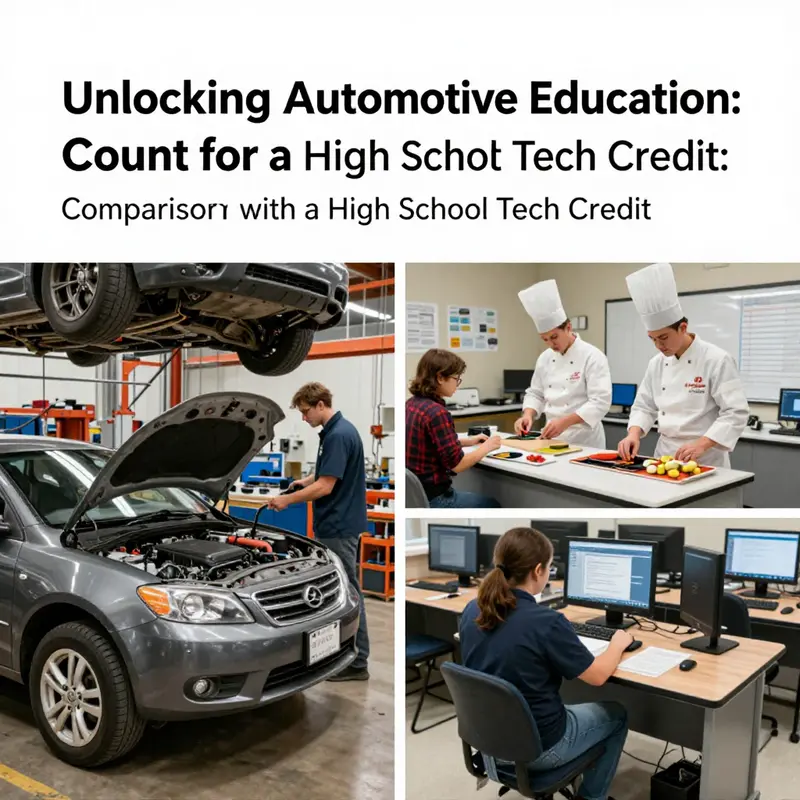
The question of whether vehicle maintenance can count toward a high school technology credit sits at the intersection of practical skill, academic standards, and the evolving needs of today’s learners. On the surface, it seems straightforward: students learn to service engines, change oil, inspect brakes, test electrical systems, and diagnose faults. But behind that surface lies a more nuanced truth. When a district designs a Career and Technical Education (CTE) pathway in automotive technology that aligns with state standards and industry expectations, hands-on vehicle maintenance becomes not merely a hobby or a vocational track, but a legitimate route to a technology credit that can count toward graduation requirements. This is not about a single skill tucked away in a shop class; it is about grounding a student’s tech literacy in a real-world, transferable set of competencies that connect classroom theory with shop-floor problem solving, safety protocols, and systematic thinking. In districts where such programs are thoughtfully integrated, the act of maintaining a vehicle—whether a family sedan or a school-provided project car—illustrates core technological literacy: diagnosing systems, interpreting data from tools, applying safety rules, and documenting processes in a way that mirrors professional practice.
To understand how that translates into credit, it helps to recognize the broader framework in which high schools treat technology and applied science. CTE pathways, especially in automotive technology, are designed to mirror industry workflows. An introductory course might cover engine basics, the intricacies of braking systems, electrical circuits, and the role of modern computer control modules. As students progress, labs shift from routine maintenance tasks to diagnostic challenges that require a reasoned, evidence-based approach. They learn to interpret error codes, use scan tools, and connect observed symptoms to root causes. Across this spectrum, the objective remains consistent: develop practical, applicable knowledge while cultivating the habits of mind that employers in the auto service sector expect. The very act of turning a wrench becomes a vehicle for developing critical thinking, attention to precision, and professional communication—foundational elements of any technology credit.
In many schools, the structure of automotive courses is explicitly mapped to state CTE standards. A typical program, often labeled Automotive Technology or Introduction to Automotive Systems, is designed to satisfy technology or applied science credits through a blend of theoretical instruction and hands-on practice. The curriculum may be aligned with industry certifications such as ASE, which, while not universally required, can add credibility for students planning college entry or a skilled trade pathway. When a course is approved by the school district or state education board, its learning objectives, assessment methods, and lab activities are recognized in the same way as more traditional tech courses. For students, that can mean not only earning a credit but also walking away with documentation that supports college or apprenticeship applications. The practical implications of this alignment are tangible: a student who completes a structured automotive tech course may fulfill a designated technology credit while simultaneously building a portfolio of diagnostics reports, service logs, and safety-compliant procedures that future programs can review.
The question of legitimacy, then, often hinges on local policies and accreditation. Vehicle maintenance programs are not universally accepted as tech credits in every district, and the specifics can vary from state to state, district to district. Some districts emphasize formal accreditation, while others rely on partnerships with vocational colleges or industry groups to validate the transferability of the learning. In places where accreditation is strong, the pathway is clearer: credit is awarded for demonstrated mastery of standards that mirror the practice of automotive technicians, and students can document both the skill set and the process by which they arrived at a diagnosis or solution. In other areas, students may be required to complete additional assessments, capstone projects, or portfolio reviews to prove that the hands-on work meets the expected academic rigors. The determining factor is a coherent narrative that links classroom content to documented performance, with clear rubrics that translate shop floor activity into measurable learning outcomes.
One helpful way to frame vehicle maintenance within a tech credit is to view it as a living lab for technology literacy. The core questions that drive each lab session—What is happening? Why is it happening? How can we verify the diagnosis? What is the safe and effective solution?—mirror the inquiry process that underpins many tech disciplines. Students learn to articulate hypotheses about why a system fails, gather data from tools and measurements, and test a sequence of corrective actions before recording the final result. In practice, a lab might begin with a routine maintenance task—replacing a worn filter, inspecting and topping off fluids, or checking tire tread. From there, a student might progress to a diagnostic scenario that requires correlating symptoms with a fault code, interpreting oscilloscopic waveforms or electrical resistance readings, and proposing a repair plan that balances cost, safety, and reliability. Such experiences cultivate not only technical competence but also professional habits: meticulous record-keeping, transparent communication with teammates or customers, and a disciplined approach to safety and risk management.
A central feature of these programs is their potential to link directly with industry standards and certifications. The presence of a recognized credential, such as an ASE student certification, can elevate a student’s readiness for postsecondary pathways, whether that means college-based automotive programs, apprenticeship programs, or entry into a local repair shop with a tangible portfolio of demonstrated competencies. Even where certifications are not bundled into the credit, the practice of pursuing them often reinforces the learning objectives of the course: precise measurement, compliance with safety protocols, and an understanding of how electronic control systems regulate mechanical function. The result is a dual payoff. Students earn a tech credit that counts toward graduation, and they accumulate evidence of professional-quality work that can be shown to colleges, employers, or internship programs. The credit becomes not a mere checkbox on a transcript, but a marker of credibility in a field that prizes hands-on expertise and the ability to translate concepts into reliable maintenance practice.
In comparing vehicle maintenance to other CTE programs, the unique value proposition becomes clearer. Computer science, digital media, and health sciences each cultivate critical thinking and problem-solving, but automotive technology grounds those skills in physical systems and tangible outcomes. The interplay of mechanical systems, electrical networks, and real-world safety considerations offers a different texture of learning. Students must integrate diverse knowledge areas—thermodynamics, fluid dynamics, electronics, materials science, and even ergonomics and human factors—to craft a solution that is not only correct but safe and repeatable. This integrated approach can be especially appealing to students who learn best through concrete, observable tasks rather than purely abstract problem solving. The practical payoff is immediate: a well-executed diagnostic or service task reduces risk, extends vehicle life, and builds confidence in applying scientific reasoning to everyday technology. While other tracks chart their own valuable courses, automotive maintenance gives learners direct experience with the mechanics of modern vehicles, including evolving technologies such as electric drivetrains and computerized control modules that increasingly shape every repair decision.
The policy landscape surrounding these programs matters just as much as the lab work. Local districts set the tempo, sometimes collaborating with vocational schools or community colleges to provide articulation agreements that allow credits to transfer or stack toward a broader tech credential. State standards play a crucial role in shaping what constitutes an acceptable technology credit. In districts that adopt frameworks aligned with the National Career Clusters Framework or with recognized vocational associations, automotive technology courses stand a stronger chance of being credited as technology or applied science credits. When such alignment exists, students can plan their high school schedules with greater predictability, knowing that the effort spent on a maintenance project may count toward their graduation requirements rather than merely serving as an elective. This clarity is essential for equity, because it helps ensure that students from different schools and backgrounds can access meaningful, career-relevant learning without encountering opaque credit policies that discourage participation in hands-on, industry-relevant tracks.
For families and students exploring this path, several practical steps help translate interest into an approved credit. Start with a conversation with the school counselor to map out the course catalog and identify which automotive courses are officially credited as technology or applied science. Review the course standards and assessment rubrics to understand how mastery is demonstrated—through labs, written tests, practical demonstrations, or a portfolio submission. If the district pursues external accreditation or industry alignment, ask about certifications that may accompany the course, such as ASE-related credentials, and how those certifications might influence credit recognition or postsecondary options. It is also wise to inquire about opportunities for dual enrollment or articulation agreements with local technical schools. Such pathways can provide a seamless transition from high school credit toward college-level credits and/or career training, reinforcing the practical value of the course as a stepping stone rather than a standalone experience.
From a student’s perspective, the appeal of counting vehicle maintenance toward a tech credit lies in the convergence of relevance and rigor. The content is inherently engaging because it looks and feels like real work. The problems are concrete, the tools are familiar to any student who has spent time under the hood, and the outcomes—safer vehicles, better performance, more efficient maintenance—are visible in everyday life. Yet the pathway to credit is not automatic; it requires deliberate design, clear standards, and ongoing assessment that honors both learning and coding of practice. The best programs are transparent about expectations and ensure that every lab session has a documented objective, a reproducible procedure, and a means of confirming that the student has achieved mastery. When a student can point to a specific diagnostic method, a precise repair process, and a completed service log that aligns with the course rubric, the credit feels earned, not earned only in a symbolic sense. The chapter of the student’s transcript that records this work becomes a narrative of skill, judgment, and responsibility—the core of what we mean by technology literacy in a modern educational context.
In practice, these courses can also broaden the appeal of tech pathways to students who might not have previously considered automotive work as a legitimate technology track. The field has evolved; modern automotive work is as much about data, software, and networked systems as it is about torque and wrenches. Students who engage with sensors, data acquisition, and diagnostic interfaces gain exposure to the same analytical mindset required in other tech domains: formulate a hypothesis, collect evidence, validate with repeatable tests, and communicate results with clarity and precision. The ability to connect physical maintenance tasks with digital diagnostics mirrors the cross-disciplinary collaboration that many tech employers value. It also opens doors to a spectrum of postsecondary options, from advanced manufacturing and collision repair to automotive software development and hybrid or electric vehicle systems. While not every student will pursue a career as a technician, the problem-solving discipline and the technical literacy gained through these courses are transferable to any field that values systematic thinking and hands-on competence.
To close the loop between classroom practice and academic credit, we can return to a simple but important reminder: curiosity, recorded evidence, and structured reflection are the pillars that underwrite the credit decision. Students should be encouraged to maintain a maintenance log, document the steps they took, note the tools used, and reflect on what worked and what did not. This habit of meticulous documentation does not merely satisfy a rubric; it cultivates a professional discipline that serves learners well beyond the high school walls. The log becomes a story students tell about how they learned to think through problems, manage risk, and apply empirical reasoning to a dynamic, real-world system. When combined with the theoretical knowledge students gain in lectures and reading assignments, maintenance activity becomes a coherent, credible demonstration of technology competency that districts can recognize as a legitimate tech credit.
For educators and program designers, the challenge lies in balancing the hands-on appeal of maintenance work with the rigor required for academic credit. The best programs weave safety, ethics, and standards into every activity, ensuring that students appreciate not only how to fix a problem but why a particular approach is preferred in terms of reliability, cost, and long-term vehicle health. They also recognize the value of cross-curricular connections. A well-designed automotive technology course can integrate elements of mathematics (through data interpretation and measurement accuracy), science (through dynamics and energy transfer), and even digital literacy (through the use of diagnostic software and vehicle communication protocols). In this sense, counting vehicle maintenance toward a tech credit is not a narrowing of a student’s educational experience but an authentic expansion of it, aligning practical mechanics with broader technological fluency that educators strive to cultivate across disciplines.
If a reader is curious about the broader policy landscape or wants a quick primer on how the field is framed in national contexts, a helpful starting point is to explore introductory materials that describe the scope and purpose of vehicle maintenance within technology education. For a quick primer, consider reading What is vehicle maintenance?. This resource helps situate the practice in a broader educational context, clarifying how routine service tasks translate into a structured learning agenda and how such work can be validated for credit through district standards and professional norms. It is not a substitute for local guidance, but it provides a useful frame for students and parents as they navigate the credit landscape within their own schools.
As we connect these threads, it becomes clear that the question is less about whether maintenance belongs in a tech credit and more about how a school designs and documents a program that treats maintenance as a technology-based practice. When districts invest in comprehensive curricula, robust assessment rubrics, and meaningful pathways to further training, vehicle maintenance can function as a powerful catalyst for student engagement and readiness. It transforms a practical, hands-on skill into a credentialed, transferable form of knowledge that students can carry forward into college, apprenticeships, or the workforce. The chapter of each student’s educational story thus becomes a narrative of applying scientific reasoning to tangible systems, of translating theory into practice, and of building a foundation for lifelong learning in technology-rich environments. In that sense, the credit is not merely awarded; it is earned through disciplined inquiry, careful measurement, and responsible stewardship of technology that affects everyday life.
External resources and policy guidance provide a broader lens for districts seeking clarity about credit recognition. For districts and states aiming to align automotive technology with recognized standards, the U.S. Department of Education’s Office of Career, Technical, and Adult Education offers resources on CTE frameworks and credit equivalency that help codify how hands-on programs map onto graduation requirements and postsecondary readiness. See https://www2.ed.gov/about/offices/list/ovae/cte/index.html for further context on CTE frameworks and guidance.
External resource: https://www2.ed.gov/about/offices/list/ovae/cte/index.html
Final thoughts
In conclusion, incorporating vehicle maintenance into high school technology credits presents a robust avenue for enhancing student education and preparing them for future careers. Understanding the curriculum alignment, potential certifications, and its position among other career and technical education programs is vital for business owners who are invested in shaping the workforce. By advocating for such programs, you not only enhance educational ties but also support the growth of a skilled labor force that can confidently step into the automotive industry.