
Understanding vehicle maintenance requirements is crucial for business owners managing fleets of various types. Adhering to maintenance regulations not only ensures the safety and reliability of vehicles but also helps businesses avoid legal pitfalls. This guide will explore essential sources such as the Road Transport Vehicle Technical Management Regulations and Public Transport Vehicle Maintenance Regulations, alongside practical log management tips and maintenance specifications. Each chapter aims to equip you with the knowledge to navigate these regulations effectively for your business’s operational success.
Tracing the Maintenance Mandates: Locating Vehicle Care Rules in the Road Transport Vehicle Technical Management Regulations
When a fleet manager or a regulatory compliance officer asks where vehicle maintenance requirements truly reside, the answer points to a framework embedded in the nation’s regulatory texts rather than a standalone checklist. The Road Transport Vehicle Technical Management Regulations stand as the foundational document that defines not only what makes a vehicle roadworthy but also who is responsible for maintaining it, how such maintenance should be organized, and what records must be kept to demonstrate ongoing compliance. These regulations are not merely bureaucratic; they are the technical and safety backbone of road transport. Updated and effective since 2023, they reflect a shift toward a more structured, data driven approach to maintenance that combines driver involvement with professional servicing. The layers of guidance within these regulations are designed to be navigated by operators, drivers, and maintenance professionals alike, yet they remain legally binding for all road transport operators in the country. For anyone responsible for keeping fleets compliant, the first move is to meet the regulations where they live: in the text of the rules themselves, supplemented by the implementing rules and practical guidance documents that translate those rules into day to day practice. The core question—where can you find the maintenance requirements—thus has a concrete answer in three connected streams: the primary technical management regulation, secondary maintenance and inspection regulations tailored to specific vehicle types, and practical daily maintenance guidance that helps operators translate mandates into action on the ground.
The primary document, the Road Transport Vehicle Technical Management Regulations, articulates a tiered maintenance system that ensures vehicles stay within defined technical boundaries. The most visible element is the three level maintenance construct. Daily maintenance is framed as the driver’s duty, a belt of checks and small, routine tasks that run before and after each trip. These tasks include practical items such as fluid levels, visible leaks, tire condition and pressure indicators, and the basic functionality of safety systems like lighting. The goal is to catch simple anomalies early, reduce the risk of on road failures, and support safe operation on every route. Beyond the daily check, Level One maintenance, or first level maintenance, is organized and implemented by the road transport operator. It expands the scope to include lubrication, filtering, and checks of more dynamic systems such as suspension and braking, with a focus on consistent serviceability rather than reactive repair. Level Two maintenance pushes further toward a comprehensive service that may require disassembly, inspection, and adjustment of major components. Each level has defined intervals and criteria, but the regulations also empower operators to tailor cycles to their own fleet realities, as long as the decisions are grounded in engineering judgment and supported by reference standards.
A fundamental principle in these provisions is the operator’s accountability for technical management. Operators are charged with establishing a formal vehicle maintenance system, ensuring that Level One and Level Two activities are carried out by qualified personnel or accredited repair providers, and maintaining meticulous records. The aim is not merely to perform work, but to prove, through documentation, that the vehicle’s technical condition has been monitored and preserved over time. In practice, this means every maintenance event—its date, the type of maintenance performed, and the parts replaced—must be recorded and traceable. The emphasis on records dovetails with the broader trend in road transport toward data transparency and accountability. In this sense, the regulation moves maintenance from a purely tacit, experience based enterprise into a documented, auditable process compatible with modern fleet management.
A notable and practical shift introduced with the 2023 revisions is that the operator bears the authority—and the responsibility—to determine the specific maintenance cycle for each fleet. This is not a free for all; it rests on a principle of informed engineering judgment. Operators must consult national standards and the vehicle manufacturer’s repair manuals and user guides as references. The cycle design must reflect a constellation of vehicle characteristics and operating conditions: the type of service, typical routes, terrain, road conditions, total mileage, and the vehicle’s age. This encourages a move away from rigid, calendar based schedules toward a condition aware, risk based approach that aligns maintenance intensity with actual wear and performance risk. Yet even as the operator gains flexibility, the rulebook anchors decisions in established benchmarks and manufacturer guidance, ensuring that cycles remain within a framework that preserves safety margins and reliability.
A corollary to this cycle philosophy is the repair principle at the heart of the regulations: maintenance should be performed based on condition, not just because a timetable says so. This condition based approach—often summarized as viewing and repairing when required—acknowledges that modern vehicles exhibit complex wear patterns and that not every component benefits from a fixed interval. Prompt repairs when issues arise are promoted to prevent safety or performance degradation from escalating. This does not eliminate scheduled checkups; rather, it harmonizes them with real time observations and vehicle data. The result is a maintenance system that can adapt to varied operating environments while maintaining consistent safety standards across a fleet.
The regulations also address the special case of hazardous goods vehicles. When a vehicle transports highly toxic chemicals or explosives, the repair work must be entrusted to specialized repair companies with the appropriate qualifications and capabilities. This precaution recognizes the heightened risk profile and ensures that repairs are conducted by personnel with the right expertise and facilities to handle such cargo safely. The emphasis on specialized maintenance for hazardous goods underlines the seriousness with which the regulatory framework treats certain capacities and risk classes, and it reinforces the broader theme that maintenance is a layered discipline governed by risk, safety, and technical competence.
The regulatory structure thus presents maintenance as a three tiered ecosystem anchored by operator responsibility, with the driver playing a central daily role and with a clear expectation that the operator’s maintenance cycles are scientifically grounded and auditable. The operator’s obligation to maintain formal systems extends beyond the maintenance itself to how information flows within the organization. A complete and well maintained set of technical records, often described as the “one vehicle one file” concept, is a cornerstone. Each vehicle file aggregates the vehicle’s technical data, maintenance history, repair records, inspection results, and conformity to standards. This becomes the single source of truth for that vehicle whenever regulators, insurers, or fleet managers review safety and compliance status. The file system is not mere archiving; it supports traceability, enables trend analysis to anticipate failures, and provides a robust mechanism for demonstrating compliance during inspections.
How these formal requirements translate into day to day practice depends partly on the broader ecosystem in which the fleet operates. A key resource that complements the Road Transport Vehicle Technical Management Regulations is the Regulations for Road Transport Vehicle Maintenance and Inspection Management. This document provides more granular operational guidelines for specific vehicle categories, notably public transportation. It introduces detailed maintenance schedules and levels—often extending to Level I, II, III, and IV maintenance—and specifies inspection items for critical systems such as brakes, steering, tires, and electrical components. It also prescribes procedures for repair work, quality control, and vehicle acceptance after maintenance. For fleet managers, this means there is a practical, stage by stage playbook that complements the higher level framework established by the primary regulations. The presence of multiple layers of guidance reflects the complexity of road transport and acknowledges that different vehicle types and service profiles warrant tailored operational care.
In addition to the regulatory text, there exists practical guidance that speaks directly to the day to day experiences of drivers and fleet managers. The Vehicle Maintenance Specifications and Daily Log Management Analysis focuses on the operational routines that underwrite the theoretical maintenance framework. It outlines specific tasks for daily maintenance checks—oil and coolant levels, brake fluid, tire pressure, lights, windshield wipers, and the integrity of fluid leaks—along with the requirement that these checks be recorded in a driver’s logbook. It also emphasizes the importance of adhering to a Driver Daily Maintenance Operation Project Table, a matrix that translates guidelines into actionable daily tasks. While the table itself serves as a bridge between regulation and practice, the overarching message is consistent: daily vigilance is the first line of defense against failures and safety incidents, and that vigilance must be documented for accountability and continuous improvement.
Taken together, these sources form a comprehensive map of where maintenance requirements live and how they are implemented. The primary regulation sets the structural framework—the three maintenance levels, the division of responsibilities, the principle of condition based repairs, and the emphasis on meticulous records. The secondary regulations for specific vehicle types add practical detail about maintenance cycles and inspection checklists tailored to the operating context of different fleets, especially public transport. The practical daily guidance anchors this framework in everyday work with concrete tasks, record keeping, and emphasis on driver involvement. For those charged with compliance, it means starting with the official text, but not stopping there. It means translating that text into a living system that can be audited, monitored, and improved over time, with clear ownership, defined processes, and robust data collection.
If you are seeking the official text to confirm the exact wordings and to ensure alignment with the latest amendments, the primary source remains the Road Transport Vehicle Technical Management Regulations. It is the foundational policy document that all subsidiary guidance builds upon. A direct pathway to the central policy is available through the Chinese government portal, which hosts the policy document and updates as they are issued. While operators may work with interpreted summaries and practical checklists, the authority for compliance rests with the text itself and the official notices that accompany it. For anyone responsible for compliance in practice, this means a disciplined approach: read the core regulation, study the related maintenance and inspection regulations for the relevant vehicle category, and adopt the daily guidance for practical execution. The end goal is a fleet that not only meets the letter of the law but embodies a proactive, condition aware maintenance culture.
To deepen the understanding of what constitutes vehicle maintenance and how it fits into the regulatory framework, you can explore a concise overview that distills the concept into practical terms. See What is vehicle maintenance for a baseline reference that complements the detailed regulatory material. [](
https://vehicletricks.com/blog/what-is-vehicle-maintenance/)
In practical terms, the route from regulation to road readiness begins with governance. Operators must establish a formal maintenance system that clearly assigns responsibility to qualified personnel or authorized repair entities. They must design and implement Level One and Level Two maintenance programs that are aligned with national standards, vehicle manufacturer manuals, and empirical data about operating conditions. They must maintain the comprehensive vehicle files that document every maintenance action, every inspection, and every decision related to repair timing. And they must ensure daily maintenance tasks remain the driver’s responsibility, performed consistently, and recorded in the driver’s logbook. The goal is straightforward: a vehicle entering service with a documented, verifiable maintenance history that demonstrates its safety and reliability, and a maintenance program that can adapt to changing operating conditions without compromising safety margins.
From the perspective of a road transport operator, this framework is not a leash but a capability. It provides the structural clarity necessary to manage maintenance across a diverse fleet while preserving safety as the top priority. It also offers a path to continuous improvement. The operator can analyze maintenance data, compare cycles against outcomes, and adjust the maintenance schedule based on observed wear patterns, incident rates, and evolving standards. In this way, maintenance becomes a strategic function that supports on road performance, reduces downtime, and enhances overall fleet resilience. The alignment between regulation, practice, and data-driven adaptation is what makes the maintenance program sustainable and enforceable across different operating environments.
Finally, the legal and practical guidance converges on a simple, enduring truth: the maintenance requirements are not a single paragraph in a handbook but a living system. It is a system built from text, supplemented by guidance that translates the text into procedures, and reinforced by daily discipline and meticulous documentation. The road to compliance starts with reading the core regulation, continues with applying its principles through Level One and Level Two maintenance, and culminates in the daily rhythm of checks, logs, and timely repairs that keep vehicles safe, reliable, and within the bounds of the law. For those who want to see the regulatory map at a glance, the official policy document remains the definitive source, a reference that ensures every fleet can meet national standards while adapting to the realities of operation on the road. The journey from disclosure to compliance is not a distant itinerary; it is a continuous process that unfolds with every mile driven, every inspection completed, and every entry recorded in the vehicle file.
External resource: Official policy document: https://www.gov.cn/zhengce/zhengceku/2023-06/15/content_5768948.htm
Navigating Public Transport Vehicle Maintenance Regulations: Where to Find the Rules Shaping Safer, More Reliable Fleets
Maintaining a public transit fleet is less about intuition and more about codified expectation. The road to reliable service is paved with written requirements that specify how vehicles must perform, how often they must be checked, and how records should be kept. For operators, managers, and even curious readers, the essential maintenance rules are found not in a single handbook but across a suite of official regulations and technical standards. They are designed to harmonize safety, reliability, and efficiency, ensuring that buses, trams, and other mass transit assets meet a consistent baseline no matter where they operate. Reading these rules in sequence, and understanding how they connect to everyday practice, reveals a coherent system: the regulations set the targets, the procedures describe how to reach them, and the records prove that the targets were met. In this sense, the chapter of maintenance requirements is not a loose collection of tips but a structured, enforceable framework that governs every ride from the depot to the rolling horizon of the city streets.
In the most detailed national contexts, maintenance requirements for public transport vehicles are anchored in formal laws and administrative regulations issued by Ministries of Transport or their equivalents. The overarching idea is simple: vehicles must remain in a condition that guarantees safe operation, predictable performance, and manageable environmental impact. The implementation, however, is layered. A typical public transport regulatory landscape includes a foundational set of technical conditions, a maintenance system with clearly defined levels and intervals, and a robust regime for recording and auditing maintenance work. The combination of these elements creates a lifecycle of compliance that supports safe service delivery, helps prevent breakdowns, and extends vehicle life. To appreciate how this works in practice, it helps to look at representative examples and the logic that underpins them.
One of the most explicit illustrations of this structure comes from a country’s road transport vehicle technical framework. In that framework, the maintenance system is foregrounded in a dedicated chapter that describes maintenance levels and the frequency with which inspections should occur. The document specifies how maintenance is categorized—often in escalating levels or tiers—so operators can plan service windows, allocate skilled technicians, and coordinate with workshop resources. It also requires a formal record-keeping scheme, sometimes termed a “one vehicle one file” system, in which each vehicle has a complete, auditable technical file that travels with it through its service life. This combination of technical performance standards, scheduled maintenance, and meticulous documentation creates a defensible baseline for safety and reliability. It also provides a structured path for fleet operators to demonstrate compliance during inspections and audits.
Beyond the foundational regulation, there is typically a second, more operational layer aimed specifically at the day-to-day realities of public transport. Public transit maintenance regulations often articulate explicit schedules and levels for different vehicle types and service conditions. For example, they may define Level I or Level II maintenance in general terms, but also tailor those levels to the vehicle category, the age or mileage of the fleet, and the criticality of various subsystems. Brake systems, steering, tires, electrical networks, and safety equipment commonly appear as prioritized areas for inspection. The regulations describe not only what must be checked but how to verify it—containing or cross-referencing checklists, inspection criteria, and acceptance tests. They also lay out procedures for repairs, quality control mechanisms to ensure the work is performed to standard, and acceptance criteria so a vehicle can rejoin service only after meeting defined thresholds. The practical effect is to create a predictable maintenance cadence that aligns with service demand, peak periods, and the realities of urban operation.
A third element reinforces the system: the management of technical records. The maintenance framework is tied to a formal record-keeping obligation that captures what was inspected, what was found, what repairs were performed, and what tests were conducted to confirm the vehicle’s readiness. The record-keeping component serves multiple purposes. It supports regulatory compliance by providing verifiable evidence of ongoing maintenance, it enables fleet managers to track maintenance histories and anticipate replacement needs, and it furnishes a transparent data trail for safety investigations or fault analyses if an incident occurs. In the best practice narratives, this record-keeping is standardized across the fleet to facilitate quick audits and consistent reporting. The discipline of maintaining complete, accessible files for every vehicle is a small but powerful enabler of accountability and continuous improvement.
To access the detailed vehicle maintenance requirements, transit operators and regulators must consult the official texts produced by the competent authorities. In many jurisdictions, the primary documents are published by the national or regional ministries responsible for transport, sometimes with supporting regulations from agencies that supervise road transport, vehicle inspections, and public transit operations. These authoritative sources are the definitive reference for what must be done, when it must be done, and in what form the proof must be kept. For readers and practitioners, the starting point is to locate the official publication that corresponds to their jurisdiction, then to navigate the document’s chapters and appendices to understand the exact requirements applicable to their fleet. These sources are legally binding for operators, and they are continually updated to reflect new technologies, evolving safety standards, and shifts in enforcement priorities. When in doubt, the official text remains the most reliable guide for interpreting how maintenance requirements translate into daily practice.
A close examination of the maintenance landscape in public transportation reveals how different regulatory traditions organize the same core idea. In some places, the public transport sector is written into a broader motor-vehicle maintenance regime, with explicit provisions for bus fleets, trolleybuses, and rail-based services that share the same safety philosophy but have distinct inspection items and performance criteria. In other jurisdictions, the public transport maintenance regime is a stand-alone set of rules tailored to the peculiarities of urban transit, including the scheduling of overnight checks, the management of spare parts inventories, and the integration of safety-critical systems such as door control and signaling interfaces with ongoing preventive maintenance programs. In all cases, the aim is consistency: to ensure that whether a vehicle is performing a simple urban loop or a high-demand peak-hour route, it remains a safe, reliable, and efficient asset. The regulatory logic is pragmatic as well as aspirational: it acknowledges the realities of constrained workshop capacity, varying technical competencies, and the need for timely interventions when performance gaps are detected.
For readers seeking a practical, comparative sense of how maintenance requirements travel across borders, it helps to view public transport guidelines through a global lens. In the United States, for example, the Federal Transit Administration provides guidance and technical assistance that supports transit agencies in maintaining safe and reliable fleets. These guidelines cover broad maintenance principles, qualifying inspections, and the management of maintenance records, while also offering concrete references to best practices in vehicle upkeep. In the European Union, directives harmonize many aspects of vehicle maintenance across member states, addressing areas such as brake performance, tire integrity, lighting, emissions controls, and onboard safety equipment. While the specifics differ by jurisdiction, the underlying emphasis is universal: maintenance must be planned, executed by qualified personnel, and documented with auditable proof. This international perspective helps reveal the shared purpose of local rules and underscores the value of standardization and knowledge exchange across borders.
Accessing the rules—whether in China, the United States, the European Union, or another regulatory environment—requires a structured approach. Start by identifying the authoritative source: the national or regional regulation that governs public transport in the relevant area. Then locate the chapters or sections that address maintenance planning, inspection intervals, and the maintenance levels that apply to your fleet. Pay close attention to any cross-references to national standards, such as specific technical performance benchmarks or dimension and weight requirements, which can affect inspection criteria and repair thresholds. The prescription for when maintenance is due—whether tied to mileage, calendar time, or a combination of both—often appears in a dedicated maintenance schedule within the regulation’s maintenance section. Finally, examine the sections that cover record management, noting the level of detail required for each vehicle file and the format in which inspections and repairs must be recorded. Some jurisdictions require electronic records with standardized fields, while others accept paper logs that must be archived for a defined period. Whatever the format, the objective remains the same: a reliable, traceable account of maintenance activity that endures beyond a single service event.
The practical implications of these regulatory structures extend into every facet of transit operations. For fleet managers, the regulations translate into a planning regime that aligns maintenance tasks with service schedules, ensuring that critical components are inspected before they pose a risk on the road. For workshop personnel, the rules provide clear criteria for what constitutes acceptable repair work and what constitutes a failed inspection, reducing ambiguity during the maintenance process. For drivers, the regulations reinforce the importance of daily checks and timely reporting, transforming routine observations into actionable data that can trigger a Level I or Level II maintenance cycle as needed. And for city officials and regulators, the comprehensive documentation of maintenance activities offers a transparent mechanism to monitor, audit, and continuously improve the safety and reliability of public transport services.
Among the practical touchpoints that connect regulation to daily operation is the emphasis on daily maintenance checks documented in driver logs. Public transport regulations often require drivers to perform a standardized set of tasks each day—inspecting fluids, tire pressures, lights, and windshield wipers, among others—and to record the results. This routine serves as the first line of defense against minor issues that, if left unaddressed, could escalate into service disruptions or safety incidents. The daily check is not a superfluous ritual but a purposeful, proactive step that keeps the fleet in a state of readiness. It also creates a feedback loop that informs the maintenance system; repeated observations of a particular fault in daily checks can prompt more extensive Level I or Level II inspections, ensuring that issues are addressed before they escalate.
To provide readers with a compact sense of how these regulatory ideas translate into accessible, user-friendly guidance, consider the notion of a practical primer that describes “what maintenance is” in plain terms. A reader may begin with a broad definition and then drill down into how the rules shape real-world practice. The essential concept, as reflected in the maintenance law and its interpretation, is straightforward: maintenance is a planned, repeatable process aimed at preserving vehicle safety, reliability, and efficiency. It is not a one-off repair; it is a disciplined program that integrates technical standards, inspection schedules, and rigorous record-keeping. For a quick primer that aligns with this understanding, see What is vehicle maintenance. This reference provides a readable entry point into the broader regulatory conversation and helps contextualize the detailed rules discussed above.
As readers move from theory to practice, the picture that emerges is one of a layered, interconnected regulatory architecture. The foundational technical conditions lay out the minimum capabilities a vehicle must possess. The maintenance system translates those conditions into tangible actions—how often to check what, and what to do when something fails. The record management requirement ensures that every action is documented, creating a verifiable trail that can be reviewed during inspections or investigations. Together, these layers form a cohesive program that not only prescribes what must be done but also delineates how to prove that it has been done. In this way, maintenance requirements become operationally meaningful: they guide fleet planning, inform workshop workflows, and empower drivers to participate meaningfully in the safety-and-reliability equation.
For practitioners who want to explore beyond their home system, it is valuable to consult the international reference points that illustrate how other jurisdictions frame the same core concerns. The Federal Transit Administration’s vehicle maintenance guidelines, for instance, provide a comprehensive, accessible resource that complements national regulations by offering practical guidance, best practices, and regulatory references for maintaining public transportation vehicles across buses, light rail, and related assets. These guidelines reflect the shared aims of public transport maintenance standards: safety, reliability, and efficiency achieved through careful planning, disciplined execution, and transparent documentation. The URL below takes readers to the U.S. federal resource and provides a concrete example of how a well-structured maintenance regime can be described, implemented, and audited in a real-world setting. It is not a substitute for local regulations, but it serves as a useful companion for understanding the broader context and the kinds of practices that regulatory frameworks are designed to encourage.
External resource (for reference): https://www.transit.dot.gov/vehicle-maintenance
In sum, the journey to finding and applying public transport vehicle maintenance requirements is less about chasing isolated rules and more about following a deliberate trail through official texts, schedules, and recording standards. The most reliable path starts with the foundational technical management regulations that govern vehicle performance, moves through the maintenance and inspection management provisions that specify schedules and inspection items, and then anchors itself in daily operational practices such as driver checks and the driver daily maintenance operation project table. This chain of requirements is designed to ensure that the vehicles performing millions of passenger miles every day do so with predictable safety margins, consistent reliability, and a transparent, auditable record of every preventive step taken. For readers seeking a concise, accessible entry point into the concept of maintenance, the linked article on vehicle maintenance provides a helpful definition and orientation, while the external federal guidelines illustrate how a mature maintenance framework can be articulated in a way that supports good practice across diverse transit environments.
Daily Logs as a Compass: Navigating Vehicle Maintenance Requirements for a Safe, Compliant Fleet
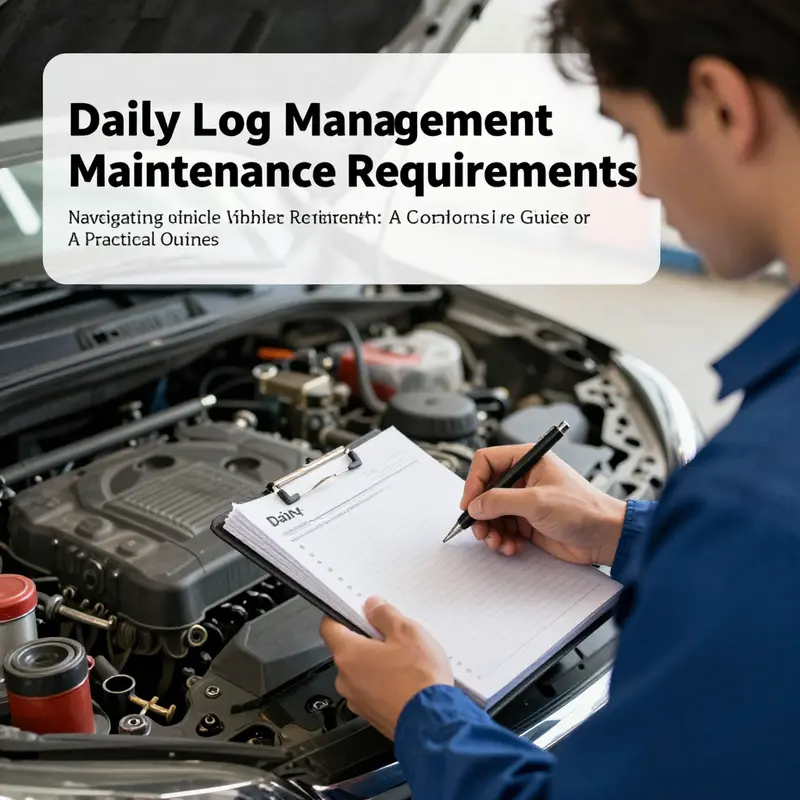
Daily logs act as the operational nerve center for vehicle maintenance. This chapter outlines how to translate regulatory requirements into practical daily practices, document consistently, and connect log data to a proactive maintenance calendar. It covers core log categories—inspections, maintenance tasks, fuel use, mileage, driver hours, and incidents—emphasizing timeliness, clarity, and standardized templates. It explains how logs feed maintenance scheduling, how to audit data quality, and how to implement a cohesive one vehicle one file system that travels with the vehicle. The overall aim is safety, reliability, and regulatory compliance achieved through disciplined recording and data-driven planning.
Vehicle Maintenance Regulation Landscape in China
This chapter explains where maintenance requirements live in China: national laws, regional regulations, and practical guidance. The national framework includes the Road Transport Vehicle Technical Management Regulations and the Regulations for Road Transport Vehicle Maintenance and Inspection Management. These texts establish maintenance levels, inspection items, and documentation requirements. They are complemented by the GB/T 30967-2014 standard, which defines inspection, diagnosis, and maintenance procedures. Practical guidance covers daily driver checks, maintenance logs, and the seven-step maintenance workflow: Cleaning, Inspection, Replenishment, Lubrication, Tightening, Adjustment, Replacement. The content emphasizes that maintenance rules are enforced through formal regulations and auditable records, and that operational practices translate legal requirements into day-to-day tasks. For full detail, consult the official sources mentioned.
Final thoughts
Staying informed about vehicle maintenance requirements is essential for business owners in the road transport sector. By understanding and utilizing the Road Transport Vehicle Technical Management Regulations and other important documents, you can ensure your fleet operates efficiently and complies with legal standards. Daily log management and maintenance specifications not only enhance vehicle safety but also improve operational accountability. Equip yourself with this knowledge to maintain the reliability and efficiency of your fleet, ultimately contributing to the success of your business.