
Efficiently managing vehicle maintenance is crucial for any business that relies on a fleet. A well-structured vehicle maintenance database not only helps in tracking service history and costs but also ensures compliance with safety standards. As business owners consider the implications of maintenance management, this article outlines the essential steps in creating a robust vehicle maintenance database. From defining the requirements and scope, to designing the database structure, choosing the right management system, implementing your database, and ensuring its ongoing effectiveness, each chapter offers critical insights to facilitate seamless vehicle upkeep while enhancing operational efficiency.
From Ground Rules to Ground Truth: Defining Requirements and Scope for a Vehicle Maintenance Database

Defining requirements and scope is the quiet engine that powers a reliable vehicle maintenance database. It begins with a clear map of the fleet, the regulatory environment, and the workflows that managers and technicians navigate every day. Rather than a laundry list of fields, this stage translates real world needs into a focused data contract. The scope should cover every vehicle in the organization’s fleet, including registration details, maintenance history, service intervals, and supporting documentation. When you sit with stakeholders to sketch this scope, you are not merely noting what to store; you are aligning data capture with how decisions are made, how audits unfold, and how compliance is demonstrated across time. In practice, a well-scoped project creates a durable backbone for the database that subsequent design choices can reliably rest upon.
A central element of scope is regulatory clarity, which in many regions translates into specific obligations about traceability and data integrity. For example, in EU contexts, vehicles registered in the National Vehicle Register often implicate an Electronic Control Module in governance terms. The ECM bears overarching responsibility for maintaining the vehicle maintenance system, and that reality implies that the database must support an auditable chain of maintenance events, with immutable logs, tamper-evident records, and clear associations to each vehicle’s identity. This regulatory frame is not an abstract concern; it shapes how you structure fields, enforce constraints, and design reporting that can withstand an external review. It also informs your policy on data retention, access controls, and the lifecycle of maintenance data from first service through every subsequent repair.
Beyond compliance, requirement management offers a practical mechanism to prevent gaps in scheduling and to guard against unexpected failures. A formalized maintenance program, sometimes referred to as a Fleet Maintenance Program in practice, lets a team define interval and threshold values for a range of tasks. Oil changes, brake inspections, tire rotations, battery checks, and fluid replacements can be programmed to trigger alerts when mileage or time thresholds are reached. The beauty of embedding these parameters in the requirements phase is that your database becomes a proactive partner rather than a reactive ledger. When a vehicle crosses a mileage milestone or a time boundary, the system can surface reminders, assign work orders, or update dashboard metrics for fleet managers. In this sense, the requirements specify not only what data to collect but how data should behave when it is collected. The database thus becomes a living instrument of maintenance discipline rather than a static archive.
Sustainability considerations increasingly color maintenance programs, and they deserve a seat at the requirements table from the outset. International guidance like ISO 23434-1:2021, which addresses sustainability vocabulary for industrial trucks, invites organizations to quantify and optimize energy use, emissions, and repair material flows. When sustainability is treated as a requirement, the database documents not only service events but also the environmental footprint of maintenance activities. Tracks of energy consumption during operations, repair material usage, and even disposal practices can be associated with each service record. This approach enables organizations to report on progress toward green objectives, reveal opportunities for waste reduction, and demonstrate responsible resource stewardship to customers, regulators, and internal leadership. The scope should therefore include fields or linked records that capture such sustainability attributes without complicating the core maintenance history, ensuring a clean separation of concerns while preserving a holistic picture of vehicle health and environmental impact.
To anchor design decisions, the project can adopt reputable guidance that brings together best practices and practical templates. Authorities such as the U S Department of Energy’s Alternative Fuels Data Center offer authoritative resources on effective maintenance databases. These inputs help translate the goals of regulatory compliance and sustainability into concrete data structures, workflows, and integration points. A thoughtful interpretation of these resources within the scope of your organization will yield a database that not only records what happened but also accelerates audits, improves uptime, and aligns with strategic sustainability reporting. As you review the materials and align them with business processes, you will see how the scope becomes a living blueprint that guides schema design, validation rules, and automation rules without locking you into a rigid, unchangeable model.
A practical starting point for teams is to clarify what counts as maintenance, because the definition influences data collection, reporting, and decision making. In many fleets, maintenance is broader than scheduled service; it includes corrective repairs, diagnostic assessments, and system health checks that prevent unexpected breakdowns. A concise, organization-wide definition helps avoid ambiguity and ensures that each maintenance event is consistently classified. For additional context, see What is vehicle maintenance, which outlines the breadth of activities that typically fall under this umbrella. This clarity informs how you design the Maintenance Records, Service Types, and related tables so that every event is accurately categorized and traceable across the vehicle’s life cycle. What is vehicle maintenance
With scope and definitions in place, it becomes easier to articulate the data relationships that will make the database robust and scalable. The Vehicles element remains the anchor, carrying identifiers such as VIN, license plate, and department ownership, while Maintenance Records attach to Vehicles to present a complete service history. Service Types act as a reference layer that standardizes terminology for maintenance tasks, enabling consistent reporting and analytics. When requirements address integration needs, you begin to specify which external systems must exchange data and which data translation occurs at boundaries. This kind of forward planning matters because it reduces later rework and makes the project resilient to future changes in fleet size, service providers, or regulatory regimes. The scope thus serves as a boundary and a guide, ensuring that every subsequent design decision remains aligned with user needs and compliance demands.
Finally, the chapter-length considerations around governance and continuity should be reflected in the requirements themselves. Governance encompasses access controls, change management, data quality checks, and versioning strategies that protect the integrity of the fleet data as the system evolves. Continuity planning addresses backups, disaster recovery, and business continuity scenarios so that a maintenance database remains available and trustworthy even under duress. When a team documents these governance and continuity requirements alongside regulatory and sustainability aims, the resulting database design gains a level of discipline that translates into measurable improvements in uptime, safety, and reporting quality. In short, a well-scoped requirements phase does not delay delivery; it clarifies purpose, reduces risk, and accelerates the path from concept to a practical, reliable maintenance database.
For teams starting out, the process of defining requirements and scope can be iterative and collaborative. Stakeholders from maintenance, operations, safety, compliance, and IT should contribute to a living document that evolves with the fleet and with regulatory expectations. The objective is simple: translate complex real-world needs into a data model and a set of rules that can be implemented, tested, and trusted. When this alignment is achieved, the rest of the chapter on database structure, data integrity, and automation can unfold with confidence, because the foundation reflects not just what is technically possible but what the organization must do to keep vehicles safe, compliant, and efficient over their lifetimes. The resulting database is then ready to support robust scheduling, transparent reporting, and responsible stewardship of resources, all while remaining adaptable as the fleet and its regulatory landscape grow.
As a practical next step, teams can translate these insights into a concise requirements document that lists core entities, essential attributes, and critical rules. Such a document does not replace the need for technical design; it informs schemas, constraints, and relationships. It also provides a communicable reference point for audits and stakeholder reviews. The ultimate aim is a data contract that aligns with the fleet’s realities and with the organization’s long-term goals for safety, efficiency, and sustainability. By treating requirements and scope as strategic design input, organizations lay a solid foundation for a vehicle maintenance database that delivers reliable service history, predictable maintenance scheduling, and auditable compliance from day one. External guidance and industry best practices can be revisited as the project matures, but the core of success remains a shared understanding of what needs to be tracked and why.
For authoritative guidance on best practices in maintenance data management, consider consulting the DOE resource on vehicle maintenance databases for practical, field-tested recommendations and templates.
Architecting a Resilient Vehicle Maintenance Database: From Entities to Efficient, Scalable Relationships
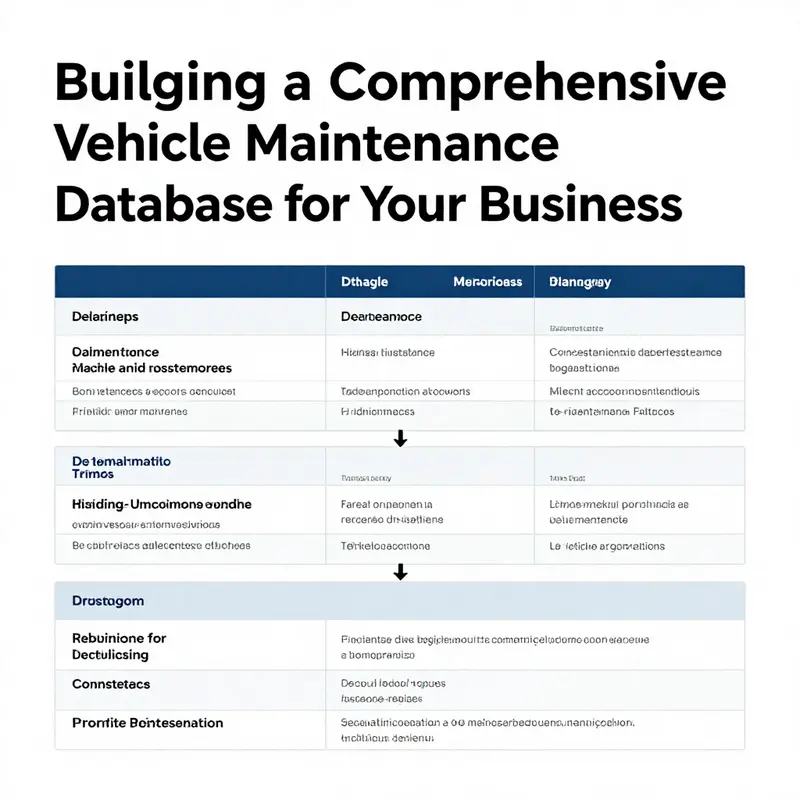
Designing a vehicle maintenance database begins long before tables are drawn or queries tested. It starts with a clear sense of purpose: what questions the system must answer, what operations it must support, and how the data will flow across people, processes, and devices. The guiding idea is that structure enables insight. A well-structured database doesn’t just record what happened; it makes it possible to track patterns, forecast needs, and streamline day‑to‑day work. With this aim in mind, the design focuses on defining the core entities, their relationships, and the rules that keep information accurate, secure, and efficient as the fleet grows.
At the heart of the design are the essential entities that capture every facet of vehicle upkeep. The primary object is the vehicle itself, identified robustly by a Vehicle Identification Number and a license plate, while other attributes such as make, model, color, purchase date, and the owning department or custodian help distinguish mileage and usage contexts. Linked to each vehicle is a customer or fleet owner, whose contact details are stored separately to avoid redundancy and to support communications and service history requests without leaking sensitive information into unrelated records. The repair orders form the bridge between the vehicle and the people who service it. Each repair order ties a vehicle to an employee and records the maintenance tasks performed, the parts used, the labor hours or costs, and the order’s status. Maintenance records stand as the historical backbone, cataloging every service and repair as a discrete entry that can be queried by date, mileage, service type, or technician. The parts table, kept in tandem with a maintenance record, tracks inventory levels, part numbers, descriptions, unit costs, and usage history so that stock levels can be managed and reorder thresholds triggered automatically. Finally, employees or technicians are represented as a distinct entity, capturing identifiers, roles, and contact information to support assignment, accountability, and performance analytics.
This catalog of entities—Vehicles, Customers, Repair Orders, Parts, Employees, and Maintenance Records—frames the database’s core schema. Each entity is defined with a primary key that uniquely identifies a row and, where appropriate, with additional attributes that describe its context and history. A VehicleID becomes the canonical reference for all records associated with a given vehicle, while a CustomerID anchors ownership or tenancy relationships. In the same vein, a RepairOrderID links a specific vehicle to a particular technician, then aggregates the surrounding data that makes up a servicing event: the date, the odometer reading at service, the list of maintenance tasks performed, the parts consumed, and the financials tied to labor and parts. The Parts table is not merely a catalog of components; it also records inventory quantities and procurement details so that the system can flag shortages before they interrupt service schedules. The MaintenanceRecords table stores the historical log of each service, including service type, any descriptions or notes, and the measurable outcomes, such as improved performance or extended intervals until the next required action.
To express how these pieces relate, the design relies on well-defined associations and keys. A Vehicle belongs to a Customer, typically a one-to-many relationship from the customer to vehicles under their care. A Repair Order is tightly coupled to a single Vehicle and to an Employee who performed or supervised the work, forming a many-to-one link from orders to vehicles and from orders to employees. Each Repair Order may reference multiple Maintenance Tasks and Parts; modeling this correctly often involves junction tables that connect orders to tasks and to parts with quantities. This approach keeps data normalized: information about a maintenance task or a part exists in its own realm and is referenced whenever it is used in an order, eliminating duplication and ensuring updates propagate cleanly. The result is an ER-like structure where referential integrity is protected by foreign keys that enforce valid links—for example, a RepairOrder must always reference a real Vehicle, and a Part usage line must reference a Part that exists in the inventory.
Normalization plays a central role in maintaining data accuracy and consistency. By organizing data into multiple related tables and eliminating repeating groups, the design minimizes anomalies when records are inserted, updated, or deleted. The goal is a system where a single change—say, updating a part’s price or correcting a VIN—must be made in one place, without needing to harmonize scattered copies of the same information. This discipline also simplifies data governance. When sensitive customer contact details are involved, the schema supports access controls that restrict who can view or modify personally identifiable information, while operational data like service dates or vehicle mileage can be exposed to broader groups for maintenance planning and reporting.
Performance considerations naturally accompany this structure. Strategic indexing targets fields that drivers of the system will query most often: VIN and LicensePlate in the Vehicles table, ServiceDate and Mileage in the MaintenanceRecords, OrderDate and Status in RepairOrders, and perhaps PartNumber in the Parts catalog. Thoughtful indexes reduce the cost of common tasks such as locating a vehicle’s full service history, identifying overdue maintenance, or reconciling a repair order with the exact parts used. But indexing is a balance: too many indexes slow insert and update operations, so the design emphasizes indexes on frequently queried columns and on foreign keys that join tables, ensuring navigations across relationships remain efficient as data volumes rise.
Security and data integrity are not afterthoughts; they are design criteria baked into the schema. Role-based access control should restrict who can see or modify different data domains—owners and fleet managers may require broader visibility into service histories, while technicians may only need to view and update repair orders assigned to them. Encryption should protect sensitive customer information and financial records, both in transit and at rest. The design also incorporates audit trails and transaction controls so that every change is recorded and recoverable, preserving a trustworthy history of maintenance decisions and inventory movements. Regular backups, tested disaster recovery procedures, and a plan for data retention and deletion help ensure compliance with regulatory requirements and internal policies.
From a scalability perspective, the database must accommodate growth in fleet size, service complexity, and data streams. A well-structured relational core supports rich, transactional queries and robust reporting while remaining approachable for developers and maintenance staff. As needs evolve, teams may introduce additional data streams, such as telemetry from connected vehicles or IoT devices, to enhance predictive maintenance capabilities. Rather than forcing all data into a single model, the perspective is to keep the core structured data in a reliable relational layer while allowing specialized stores to handle high-volume, time-stamped telemetry or unstructured diagnostics when those needs arise. This hybrid mindset preserves data integrity in the core while enabling advanced analytics without compromising transactional reliability.
Implementation proceeds by translating the conceptual model into a practical schema, setting up the primary keys, foreign keys, and constraints that guard referential integrity. The process includes creating the Vehicles table with VehicleID as a surrogate key, and columns for VIN, LicensePlate, Make, Model, Color, PurchaseDate, and DepartmentID. The Customers table stores CustomerID, Name, and contact details; the RepairOrders table houses OrderID, VehicleID, EmployeeID, OrderDate, Status, and TotalCost; the MaintenanceRecords table captures ServiceDate, Mileage, ServiceType, Description, Cost, and Technician; the Parts table records PartID, PartNumber, Description, UnitCost, and InventoryQty; and the junction structures link orders to parts and to maintenance tasks. While drafting, the team also considers natural keys for readability and surrogate keys for stable referential ties, ensuring that every relationship can be navigated efficiently by queries and reports. Documentation accompanies the schema, including data dictionaries for each table, definitions of maintenance types, and standardized codes for service statuses. The result is a durable blueprint that serves as the foundation for reliable data capture, fast retrieval, and secure, auditable operation.
As the design matures, it remains a living blueprint rather than a one-off deliverable. The architecture must be adaptable to evolving business rules, regulatory changes, and new maintenance practices. The model invites extensions such as service level agreements, warranty considerations, and vendor management, all of which can be integrated through carefully planned foreign keys and well-scoped lookup tables. At the same time, the core denial of redundancy and the commitment to data integrity endure, ensuring that information remains coherent no matter how the fleet or the maintenance program grows.
For readers seeking a practical touchstone beyond the theory, a concise overview of maintenance concepts can help ground design decisions. See What is vehicle maintenance for a quick refresher on the activities and data points that commonly populate maintenance records. This reference helps ensure that the model aligns with real-world workflows and expectations, preserving usability as the database scales. What is vehicle maintenance
The chapter closes with a reminder that the database’s value compounds when the design is treated as an evolving asset. A thoughtful structure enables clear reporting, efficient scheduling, and disciplined data governance, which in turn unlocks real-world outcomes—from lower downtime to more accurate budgeting and safer, better-maintained fleets. The next steps build on this foundation by detailing how to populate the model, validate data quality, and begin integrating with scheduling and expense-tracking workflows, all while preserving the integrity and performance that the structure guarantees. External exploration of the broader design principles and their applications in vehicle maintenance systems can be found in scholarly work that examines entity-relationship modeling, normalization, and real-time data integration. External resource: IEEE Xplore – Database Design for Vehicle Maintenance Management Systems
Choosing the Right Database Management System for Vehicle Maintenance: Building a Reliable Foundation for Fleet Data

Selecting a database management system (DBMS) for a vehicle maintenance application is not a decision to take lightly. It sets the foundation for accurate records, reliable reporting, and scalable growth. The wrong choice can force workarounds, degrade data quality, and hinder the fleet’s ability to optimize maintenance schedules. The path to a robust solution begins with a clear mapping of requirements: what data must be captured, how it will be used, who will access it, and what scale is anticipated. In practice, most teams start by prioritizing a structured data model that supports the core entities—the vehicle, its service history, and the components that keep it on the road. From that base, you can extend to inventory, parts costs, and technician assignments without disrupting the integrity of the maintenance history. While the literature offers a range of configurations, the central question remains: should you pursue a relational, schema-bound core that guarantees consistency and precise querying, or lean toward a flexible, schema-free approach that can grow with unstructured data? The answer often lies in the balance between data discipline and adaptability, with relational models providing a reliable backbone for the essential fleet data while acknowledging scenarios where a flexible store can absorb specialized data streams.
Relational databases offer a proven track record for structured domains like vehicle maintenance. They store data in well-defined tables with explicit relationships and enforceable constraints. The core advantage is data integrity. A vehicle’s identity is a single row in a Vehicles table, and every service entry references that row via a foreign key. This structure makes it straightforward to answer questions that drive maintenance decisions: what is the service history for a vehicle’s record? what was the total maintenance spend for the last quarter? which vehicles are approaching their next scheduled service based on mileage and time thresholds? Because the schema enforces consistency, these answers come with confidence even as the volume of data grows. At the same time, relational systems support sophisticated analytics and reporting. They excel at joins, aggregations, and parameterized queries that fleet managers rely on to monitor compliance, optimize budgets, and forecast future needs. They also come with mature operational tooling for backup, security, and auditing, which matters when you must demonstrate regulatory compliance or internal governance.
Non-relational stores bring flexibility for data that does not fit neatly into tables. If your maintenance program begins to ingest sensor data from telematics devices, video metadata, or other streaming information, a schema-less approach can smooth ingestion and indexing. Yet most vehicle maintenance use cases stay anchored in structured data: vehicles, service events, parts, and costs. In practice, many teams employ a hybrid approach: keep the transactional, auditable core in a relational store while offloading large, unstructured data to a separate system with clear interfaces to the primary database. The benefit is clear: you preserve the reliability and query power of the core, while providing scalable storage for supplementary data that informs maintenance decisions, such as real-time fuel usage patterns or environmental conditions around service events. The challenge is in defining clean boundaries and robust data contracts so that the parts of the system remain interoperable rather than disparate silos.
Whichever path you choose, a thoughtful evaluation framework helps avoid missteps. Key criteria include data volume and concurrency, the complexity of your queries, integration needs with scheduling or accounting tools, security posture, and the total cost of ownership. For a fleet manager, the ability to generate accurate service histories, cost breakdowns, and compliance reports is non-negotiable. In addition, plan for future growth: will you merge multiple fleets, add new service categories, or expand to inventory management and driver records? The DBMS should support such evolution without forcing a costly redesign. Cloud versus on-premises considerations matter too. Cloud-based deployments can reduce hardware overhead and deliver elastic storage, but they introduce data governance and latency considerations. On-premises systems might offer tighter security controls and deeper integration with existing enterprise ecosystems. Regardless of deployment mode, ensure robust backup strategies, tested disaster recovery, and clear access controls that distinguish roles such as technicians, supervisors, and finance staff. The objective is a reliable, scalable foundation that remains comprehensible to your team, avoiding over-engineering while resisting premature optimization.
From a design standpoint, begin with a compact yet scalable schema. The Vehicles table should anchor the dataset with a unique VehicleID and key identifiers like VIN and license plate, plus basic attributes. The MaintenanceRecords table then references Vehicles via VehicleID and stores ServiceDate, Mileage, ServiceType, Description, Cost, and Technician. A ServiceTypes table serves as a central catalog to keep service categorization consistent, while a Parts table can capture component details, unit costs, and supplier information. Tight foreign-key relationships—Vehicles to MaintenanceRecords, and MaintenanceRecords to ServiceTypes and Parts—ensure referential integrity and enable efficient joins for reporting. Build in indexing on the fields most frequently used in queries, such as VehicleID, ServiceDate, and Mileage, to accelerate lookups as data grows. It is equally important to plan for data quality: enforce required fields, standardize date formats, and implement validation rules that guard against incomplete entries. As the database evolves, remain mindful of the balance between normalization and practical performance; a few well-chosen denormalized views or materialized aggregates can improve report speed without compromising data integrity. Finally, address lifecycle concerns—how you will migrate data from legacy systems, how you will manage schema changes, and how you will archive older records in a way that keeps the core history intact for audits and analysis.
Putting the selection into practice is as important as the theory. Start with a targeted pilot that mirrors common maintenance scenarios and use cases. Track the responsiveness of typical queries, test the reliability of data ingestion from maintenance workflows, and validate backup and restore procedures. Collect feedback from users across maintenance, procurement, and management to ensure the system supports real work processes rather than abstract requirements. If your team lacks deep database expertise, seek solutions with intuitive tooling for data entry, scheduling, and reporting, and rely on careful documentation to guide governance. Design decisions should align with your organization’s broader IT strategy: will you shift toward cloud-based services, consolidate fleets, or extend functionality to expense tracking or driver management? A pragmatic, staged approach reduces rework and positions the database to support proactive maintenance decisions—alerts for upcoming service, insights into cost drivers, and reliable records for audits when needed. For a grounded view of the domain, see What is vehicle maintenance. If you want a broader perspective on DBMS evaluation, see TechTarget’s guide: Choosing the right database for your business.
null
null
From Prototype to Fleet Backbone: Testing, Integrating, and Maintaining Your Vehicle Maintenance Database
A vehicle maintenance database is more than a repository for records; it is a living system that supports decisions, operations, and compliance across a fleet, a family of vehicles, or even disparate equipment like lawn mowers. The chapter that follows treats testing, integration, and maintenance not as isolated tasks but as a continuous lifecycle that strengthens data integrity, streamlines workflows, and preserves value over time. When you approach the database this way, you create a foundation that reliably tracks services, mileages, trips, events, and costs for a range of assets—from cars and motorcycles to equipment with different usage patterns. The result is a system that not only stores information but also informs scheduling, budgeting, and risk management with confidence.
Testing, in particular, should be seen as an ongoing commitment to quality that extends beyond the moment you deploy a schema or import a dataset. At its core, testing ensures data accuracy. Validation rules must guard against common entry errors, such as inconsistent date formats, invalid VINs, or missing mileage at service. The database should reject anomalous values or, at minimum, flag them for review. This requires thoughtfully designed constraints and checks that are not merely decorative but functional gatekeepers. For example, a maintenance record should reference a valid vehicle, and the service date should never precede the purchase date of that vehicle. Validation does not end with the initial population. It must accommodate real-world scenarios: late entries, retroactive adjustments, or repairs logged after a service window. When validation is robust, users experience fewer surprises during reporting and fewer reconciliation headaches during audits.
Beyond data correctness, the user interface (UI) must be responsive and intuitive. A well-behaved UI translates complex maintenance histories into readable, actionable information. It should allow a mechanic or fleet administrator to locate a vehicle quickly, scan its service history, and identify trends. Usability testing should measure how efficiently a user can perform a typical sequence of actions: add a service, view the latest maintenance note, export a report, and trigger a reminder. The aim is not to build a glossy dashboard but to create an interface that minimizes clicks, reduces cognitive load, and supports accurate data capture. Accessibility considerations—clear labeling, keyboard navigability, and readable typography—ensure that the database serves all users, including those who rely on assistive technologies.
Testing also encompasses the system’s ability to interoperate with external tools. In practice, a maintenance database should exchange information with GPS tracking, calendar applications, and budgeting or accounting processes. This is where integration testing takes center stage. You must verify that data flows correctly between systems, that fields map consistently, and that updates propagate without duplication or loss. For instance, a service completed in the field should reflect in both the vehicle’s maintenance log and its next-scheduled-service reminder, with mileage synchronization across records. When such integrations fail, the cost is not only potential data corruption but also missed maintenance windows or tangled workflows. A disciplined approach to testing ensures that integrations are reliable across network conditions, user roles, and data formats.
The second pillar, integration, is about making the database a capable hub rather than a stand-alone silo. A key design principle is supporting standardized data formats for import and export. CSV and JSON are typically the most practical choices because they balance human readability with machine parsability. Establish a clear data dictionary and consistent field types so that external systems—the GPS platform, the calendar app, or an expense tracker—can map their data to your schema with minimal friction. This standardization reduces the risk of misalignment between systems and makes onboarding new data sources smoother. In addition to data formats, your database should expose APIs that enable controlled synchronization with other software. Well-documented APIs empower internal developers and trusted partners to build complementary tools, such as mobile apps for maintenance reminders or fleet dashboards for managers. These APIs should include authentication, granular permissions, and clear error handling so integrations behave predictably even when external systems encounter downtime or latency issues.
During integration, it is essential to consider data lineage and traceability. When a maintenance event is added, the system should record who entered it, when, and from which source. If a service is imported from an external system, there should be an auditable trail showing the mapping between external fields and the internal schema. This traceability supports accountability, troubleshooting, and regulatory compliance, especially in environments with strict vehicle maintenance records requirements. Equally crucial is a thoughtful approach to error handling. Instead of allowing a failed import to halt a workflow, the system should gracefully flag problematic records, present clear remediation steps, and offer a retry mechanism once issues are resolved. In practice, robust error handling saves time and preserves the integrity of the broader data ecosystem.
Security and access control must run parallel to testing and integration. A database that stores service histories, costs, and potentially sensitive information about ownership or department affiliation requires careful treatment of who can view, modify, or export data. Role-based access ensures that technicians can log services while supervisors can approve and adjust schedules. Logging every access and change creates a transparent environment where accountability is evident during reviews. This is particularly important when the system interconnects with personnel records or financial data. Securing data in transit and at rest, implementing encryption where appropriate, and applying regular security assessments are preventive measures that protect both the organization and its fleet.
Maintenance, the third pillar, is the discipline that keeps the database useful over time. It begins with regular software updates to incorporate new features, bug fixes, and security improvements. While the exact timing depends on your environment, a predictable update cadence helps users plan and avoids the disruption that comes with ad hoc changes. In parallel, establish routine data backups with tested recovery procedures. A solid backup strategy defines objectives like recovery point and recovery time, ensuring you can restore critical maintenance history after a hardware failure, corruption, or accidental deletion. Regular backups also enable data archival policies, such as long-term retention of service records for compliance or analytics.
Performance monitoring is another essential maintenance activity. Tracking query response times, index usage, and storage growth reveals bottlenecks before they impact daily operations. Proactive maintenance may include optimizing indexes, archiving stale records, or re-architecting parts of the schema to support evolving reporting needs. As a fleet grows or as maintenance practices become more sophisticated, the database should scale gracefully. That scalability might involve partitioning large tables by vehicle or year, or it could mean adopting a more distributed storage approach that preserves fast access for common queries while accommodating peak loads.
Security vigilance is not a one-off task but an ongoing practice. Periodic vulnerability assessments, patch management, and access audits reduce the chance of breaches or data leakage. A clear policy for incident response, including notification and remediation steps, minimizes the impact of any security event. Documentation supports continuity, especially when new team members join or when stakeholders review the system’s health. A well-documented maintenance plan includes guidelines for data governance, change control, and user training so reforms do not create confusion or data inconsistencies.
To translate these principles into a practical mindset, imagine a typical maintenance cycle. You begin with a validated data model and a clean import of existing records. You verify that all fields validate and that the UI presents intuitive controls for entering new services. You test how the system communicates with a calendar to trigger reminders when a vehicle nears its service threshold and how the data updates in the fleet dashboard that a supervisor uses to allocate resources. You implement a scheduled backup, set a monitoring alert for slow queries, and conduct a quarterly security review. Through this cycle, the database becomes a reliable backbone—not a project artifact but a perpetual operational asset.
As you pursue ongoing improvement, keep a single, guiding question in mind: does the database reduce friction and improve decisions around maintenance? If the answer is yes, your testing, integration, and maintenance practices are aligned with real-world value. The measures—data accuracy, smooth interoperation with other tools, timely backups, and resilient performance—translate into fewer late repairs, better budgeting, and safer vehicles across the fleet. For a practical perspective on how good maintenance translates to fuel efficiency and cost savings, explore this example: How Vehicle Maintenance Saves on Gas Expenses.
For further guidance and in-depth frameworks on designing robust vehicle maintenance databases, consult external resources such as the Microsoft Learn Vehicle Maintenance Database Guide. It offers structured approaches to data modeling, governance, and scalable architectures that complement the hands-on practices described here: https://learn.microsoft.com/en-us/azure/architecture/data-guide/database-design/vehicle-maintenance-database. These references provide a broader context for thinking about reliability, security, and long-term viability as you evolve your database from a prototype into a fleet backbone.
Final thoughts
Creating a vehicle maintenance database is a strategic move that optimizes operations and costs. By following the outlined steps—defining your requirements, designing an organized structure, selecting an appropriate management system, and ensuring thorough implementation—you position your business for effective fleet management. Ongoing maintenance of the database will support long-term efficiency and aid in meeting compliance standards, fostering an environment of proactive vehicle care. With the right tools and processes in place, your organization can ensure that all vehicles are maintained in peak condition, ultimately contributing to enhanced productivity and safety.